The Star That Spins Like a Blender
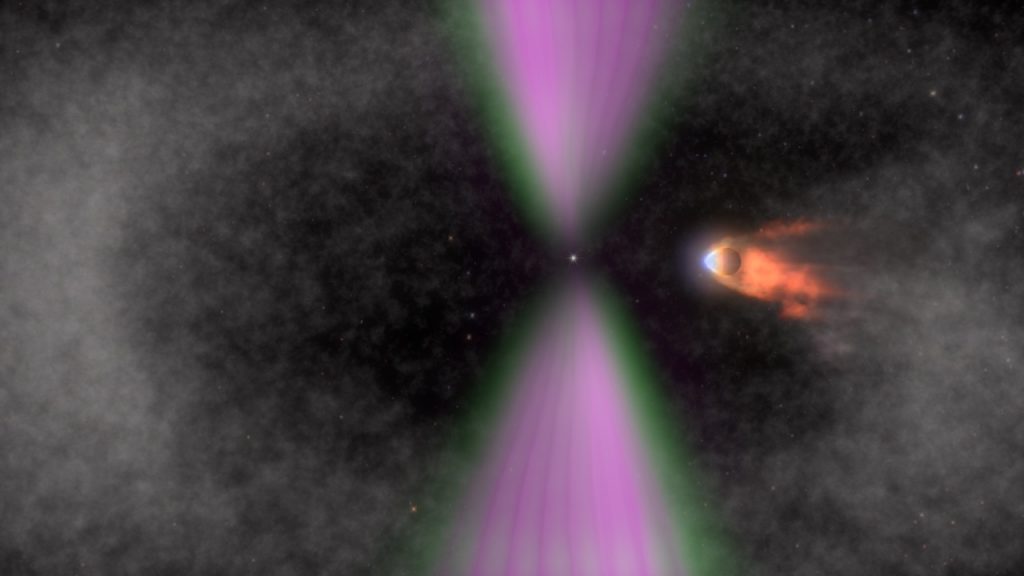
Picture a stellar remnant the size of Manhattan whipping around 700 times a second—faster than your kitchen blender on puree. That’s PSR J1748–2446ad, a pulsar that’s the universe’s extreme spin master. Born from a supernova’s fury, it’s a neutron star: ultra-dense, ultra-fast, and a physics lab in the sky.
The Mechanics: From Collapse to Cosmic Whirlwind
Massive stars don’t fade quietly. When fuel runs dry, gravity wins, slamming the core into a sphere just 20 km across. Enter conservation of angular momentum, the same principle that amps up an ice skater’s twirl when she tucks her arms.
• Pre-collapse: A bloated star, leisurely rotating once a day.
• Post-collapse: Shrunk by a factor of millions, it revs to blender speeds—up to 716 Hz for this beast.
• Density hack: One teaspoon? ~1 billion tons. That’s materials science on steroids—electrons crushed into protons, forming neutrons packed tighter than an atomic nucleus.
Trade-off: Magnetic fields weaken over eons, but this one’s still cranking. Forward view: If we crack neutron star guts, it could inspire ultra-compact energy storage or quantum materials back home.
Beyond the Spectacle: Pulsars as Galactic Tools
These aren’t just fireworks; they’re precision instruments. Pulsars sweep radio beams like lighthouse beacons, pulsing with clockwork reliability.
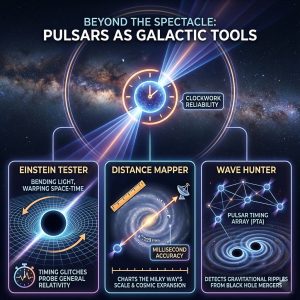
• Einstein tester: Timing glitches probe general relativity—bending light, warping space-time.
• Distance mapper: Millisecond accuracy charts the Milky Way’s scale, pinning cosmic expansion.
• Wave hunter: Arrays of pulsars detect gravitational ripples from black hole mergers, via pulsar timing arrays (PTAs).
Implications? Spotting alien signals or navigating deep space. It challenges our hubris: We’re not the center; we’re just borrowing these labs.
Out there, PSR J1748–2446ad keeps blending the void. Won’t quit for billions of years. What’s your take—cosmic curiosity or blueprint for tomorrow’s tech? Drop a comment.
Share this content: