
_(cropped).jpg)
You don't need a telescope. You don't need an app. You just need to know when to look up.
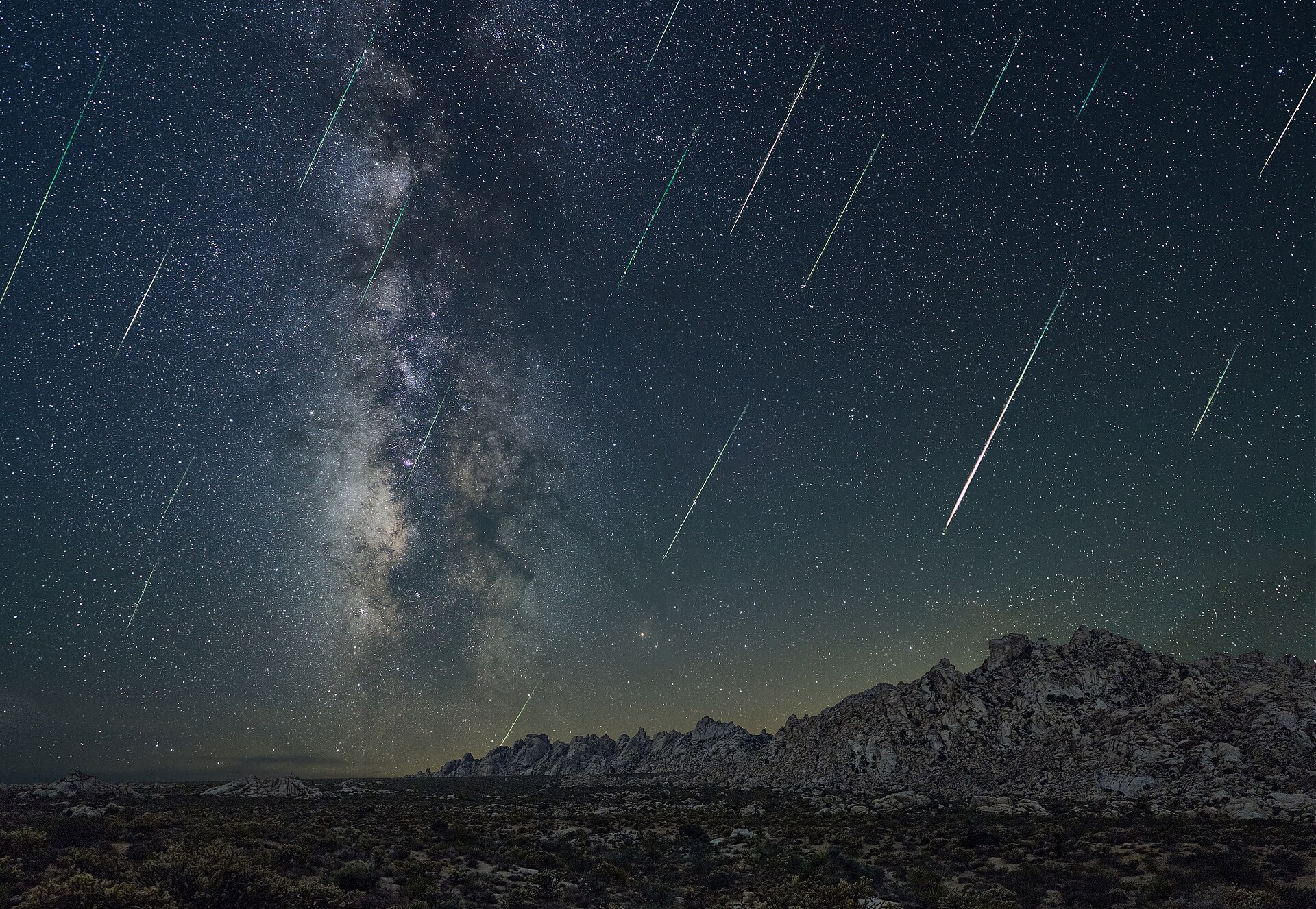
Every year, Earth passes through streams of debris left behind by comets and asteroids. When those tiny particles — most no larger than a grain of sand — hit our atmosphere at tens of thousands of miles per hour, they burn up in a streak of light. A meteor. When Earth passes through a particularly dense debris trail, we get a meteor shower: dozens or even hundreds of meteors per hour, all appearing to radiate from the same point in the sky.
Meteor showers are predictable. They happen on roughly the same dates every year, because Earth crosses the same orbital paths at the same point in its journey around the Sun. The only variables are the Moon (bright moonlight washes out faint meteors) and weather.
Here's every major meteor shower in 2026 — when to watch, what to expect, and how to see the most.
How to Watch
Before the calendar, a few universal tips that apply to every shower:
- No equipment needed. Meteors are best seen with the naked eye. Telescopes and binoculars narrow your field of view.
- Find dark sky. Get away from city lights. Even 20–30 minutes of driving makes a difference.
- Give your eyes 20 minutes. It takes that long for your pupils to fully adapt to darkness. Don't look at your phone.
- Face away from the Moon. If the Moon is up, put it behind you or behind a tree.
- Best hours: midnight to predawn. After midnight, your location on Earth faces into the direction of orbital motion, sweeping up more debris.
- Recline. A lawn chair or blanket on the ground lets you watch a wide swath of sky without neck strain.
- Dress warmer than you think. You're not moving. You'll get cold.
The 2026 Meteor Shower Calendar
Quadrantids — January 3–4
- ZHR:~120 (one of the year's strongest)
- Parent body: Asteroid 2003 EH1 (possibly an extinct comet)
- Peak window: Very narrow — only about 6 hours of strong activity
- Moon: Waxing gibbous (~85% illuminated) — significant interference. Best viewing after moonset in predawn hours.
- Notes: The Quadrantids can rival the Geminids and Perseids in raw numbers, but the narrow peak and frequent cloud cover in January make them unreliable for casual observers. If you catch the peak window in dark sky, they're spectacular.
Lyrids — April 22–23
- ZHR:~18
- Parent body: Comet C/1861 G1 (Thatcher)
- Peak window: Broad — several hours of activity
- Moon: New moon (~2% illuminated) — excellent conditions. Dark skies all night.
- Notes: A modest shower, but the 2026 Lyrids benefit from near-perfect Moon conditions. Worth watching if you have clear skies. Occasional bright fireballs.
Eta Aquariids — May 5–6
- ZHR:~50
- Parent body: Comet 1P/Halley (Halley's Comet)
- Peak window: Broad — best in predawn hours
- Moon: Waxing gibbous (~75%) — moderate interference.
- Notes: Debris from Halley's Comet. Best viewed from the Southern Hemisphere, where the radiant rises higher. From northern latitudes, the radiant barely clears the horizon before dawn, limiting visible rates to 10–20/hour. Fast meteors (66 km/s) with persistent trains.
Southern Delta Aquariids — July 30–31
- ZHR:~25
- Parent body: Comet 96P/Machholz (likely)
- Peak window: Broad
- Moon: Waxing crescent (~35%) — sets early, leaving dark skies after midnight.
- Notes: A warm-weather shower that serves as a preview of the Perseids. Moderate rates, but pleasant viewing conditions in midsummer. Best from southern latitudes.
Perseids — August 12–13
- ZHR:~100
- Parent body: Comet 109P/Swift-Tuttle
- Peak window: Broad — several days of elevated activity, with the sharpest peak on the night of August 12–13
- Moon: Waning crescent (~15%) — rises late, excellent conditions for most of the night.
- Notes: The most popular meteor shower of the year, and for good reason. Reliable rates, warm August nights, and a broad peak that forgives imprecise timing. The 2026 Perseids have nearly ideal Moon conditions. This is the shower to prioritize if you only watch one.
Orionids — October 21–22
- ZHR:~20
- Parent body: Comet 1P/Halley (Halley's Comet)
- Peak window: Broad
- Moon: New moon (~1%) — excellent conditions.
- Notes: The second annual shower from Halley's Comet debris. Fast meteors (67 km/s), often with persistent trains. Best after midnight when the radiant rises. Dark skies in 2026 make this a good year for the Orionids.
Leonids — November 17–18
- ZHR:~15 (variable — historically capable of storms)
- Parent body: Comet 55P/Tempel-Tuttle
- Peak window: Narrow
- Moon: New moon (~3%) — excellent conditions.
- Notes: The Leonids produced legendary meteor storms in 1833 and 1966 (thousands per hour). Modern rates are modest, but the shower remains unpredictable. 2026 offers dark skies. Worth a look, especially if you're already watching for Geminids.
Geminids — December 12–15
- ZHR:~150 (the strongest meteor shower of the year)
- Parent body: Asteroid 3200 Phaethon
- Peak window: Broad — strong activity for 24+ hours around peak
- Moon: Waning crescent (~20%) — rises late, minimal interference.
- Notes: The Geminids are the best meteor shower of the year, period. Highest ZHR, multi-colored meteors, and activity that starts as early as 9–10 PM (most showers don't peak until after midnight). The source is an asteroid, not a comet — making the Geminids scientifically unusual. The 2026 Geminids have excellent Moon conditions. Don't miss this one.
Ursids — December 22–23
- ZHR:~10
- Parent body: Comet 8P/Tuttle
- Peak window: Narrow
- Moon: Waxing crescent (~5%) — excellent conditions.
- Notes: A quiet shower to close the year. Low rates, but dark skies and solstice timing make it a peaceful way to end the meteor season.
The Science Behind Meteor Showers
Meteor showers happen because comets (and some asteroids) shed material as they orbit the Sun. When a comet approaches the inner solar system, solar heating vaporizes ices on its surface, releasing dust and rock particles. Those particles spread along the comet's orbital path, forming a debris stream.
Earth's orbit intersects these streams at the same points every year. When we pass through, the particles enter our atmosphere at high speed and burn up — producing the streaks of light we call meteors.
Theradiantis the point in the sky where the meteors appear to originate. It's a perspective effect — like snowflakes appearing to radiate from a point ahead of you while driving. Showers are named after the constellation that contains their radiant (Perseids from Perseus, Geminids from Gemini, etc.).
ZHR(Zenithal Hourly Rate) is the theoretical maximum number of meteors per hour under ideal conditions: dark sky, radiant directly overhead, limiting magnitude of 6.5. In practice, you'll see fewer — but ZHR is useful for comparing showers.
The Geminids are unusual because their parent body, 3200 Phaethon, is classified as an asteroid, not a comet. How an asteroid produces a debris stream dense enough for the strongest annual meteor shower remains an active area of research. JAXA's DESTINY+ mission, planned for the late 2020s, will fly past Phaethon to investigate.
Best Showers for Beginners
If you're new to meteor watching, start with these two:
- Perseids (August 12–13)— Warm weather, reliable rates, broad peak. Forgiving for beginners.
- Geminids (December 14–15)— Highest rates, starts early evening. Bundle up.
Both have excellent Moon conditions in 2026. Pick one, find a dark spot, give your eyes 20 minutes, and look up.
Sources
- American Meteor Society —2026 Meteor Shower Calendar
- International Meteor Organization —IMO Working List
- NASA Solar System Exploration —Meteors & Meteorites
- NASA/JPL —3200 Phaethon
- U.S. Naval Observatory —Moon Phase Data
Further reading and primary sources
As an Amazon Associate I earn from qualifying purchases. If you buy through an active affiliate link, StarPixels may earn a commission at no additional cost to you.