
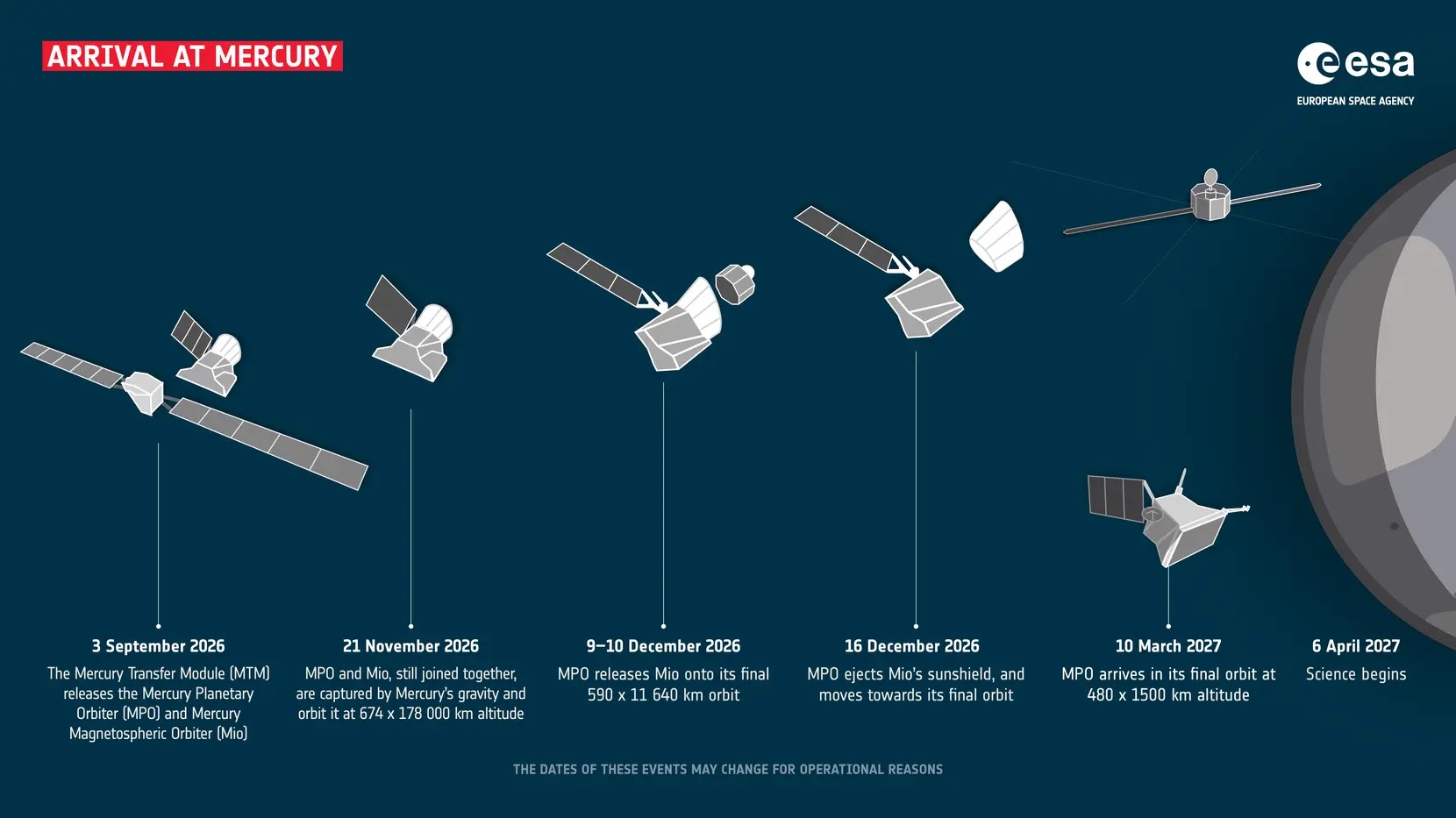
After eight years in space, BepiColombo is about to stop falling toward the Sun and start circling Mercury instead. The joint ESA and JAXA mission is scheduled to be captured into orbit around the smallest planet on Saturday, November 21, 2026. It will be only the second mission ever to orbit Mercury. NASA's MESSENGER circled the planet from 2011 to 2015. BepiColombo is the first to put two orbiters there at the same time.
The spacecraft left Earth on October 20, 2018, on an Ariane 5 rocket. Getting to Mercury took the long way around. The mission flew past Earth once, Venus twice, and Mercury six times, using each planet's gravity to slow down and bend its path toward the Sun. Nine flybys in all, over eight years and billions of kilometres.
It was supposed to arrive a year earlier. In 2024, engineers found unexpected electric currents between the spacecraft's solar array and its power unit, cutting the thrust available from its solar-electric propulsion system. The arrival slipped from December 2025 to November 2026 while the team redesigned the trajectory.
The cruise engines are already finished. The last electric-propulsion thrust arc ended on June 15, 2026, and the Mercury Transfer Module that carried those engines separated from the spacecraft stack on September 3, more than 200 million kilometres from Earth. From there, ESA's Mercury Planetary Orbiter, the MPO, took charge of the final approach, carrying JAXA's Mio orbiter still attached to it.
On September 24, the MPO tested its axial thrusters for the first time in this new configuration. They fired for 8 minutes and 42 seconds, a push of 11.4 metres per second, and the spacecraft stayed on course. A series of small corrections like that one lined up the approach for the capture.
Capture itself uses a technique ESA calls weak stability boundary capture, with the MPO's chemical thrusters handling the approach corrections and the orbit insertion. Saturday is the first step, not the finish. After capture comes a sequence of orbit adjustments stretching into next year. The two orbiters separate on December 9 and 10, when Mio settles into its own elliptical polar orbit. The sunshield that protects Mio is released on December 16. The MPO then descends toward its own science orbit, 480 by 1,500 kilometres above the surface, circling Mercury about every 2.3 hours. Science operations are set to begin in April 2027.
The teams have rehearsed all of it. On October 29, the mission control team completed its final simulation, focused on the sunshield separation, closing out a campaign that began in June and worked through every major step of the arrival sequence, including deliberate faults thrown in to test the teams' responses.
The hardware looks ready. On September 15, all 15 instruments on the MPO were switched on together for the first time since the transfer module separated, and the first checks showed them in good health. The laser altimeter BELA fired its laser for the first time, sending more than 700,000 pulses into open space over 21.5 hours. The MERTIS spectrometer observed deep space through both of its viewing ports, returning around a gigabit of data. The SIMBIO-SYS science camera took its first image in space.
Two orbiters matter because Mercury is a puzzle that one viewpoint cannot solve. The MPO will map the surface and probe the planet's interior from a low orbit, while Mio watches the magnetic field and the magnetosphere from farther out. Together they will study how a planet so small keeps a magnetic field at all, what its huge iron core is doing, and how the solar wind strips material from a world with almost no atmosphere.
Mercury itself is putting on a show this weekend. The planet reached its greatest western elongation on November 20, 2026, about 19.6 degrees from the Sun, and it stays near its best through the weekend of November 21-22, 2026. Look east before dawn and you can see the same little world BepiColombo is about to join.
All of Saturday's dates are plans, and ESA notes they can still shift for operational reasons. Confirmation will come from ESA's arrival updates page. If capture goes as planned, the eight-year trip ends with a spacecraft that spent most of its life falling toward the Sun finally settling into orbit around the planet it came to study.
Source: ESA, "Latest updates: BepiColombo's arrival at Mercury," October 29, 2026; ESA, "End of the blue glow: BepiColombo turns off solar electric propulsion for Mercury arrival," June 24, 2026.
Image credit: ESA
As an Amazon Associate I earn from qualifying purchases. If you buy through an active affiliate link, StarPixels may earn a commission at no additional cost to you.