
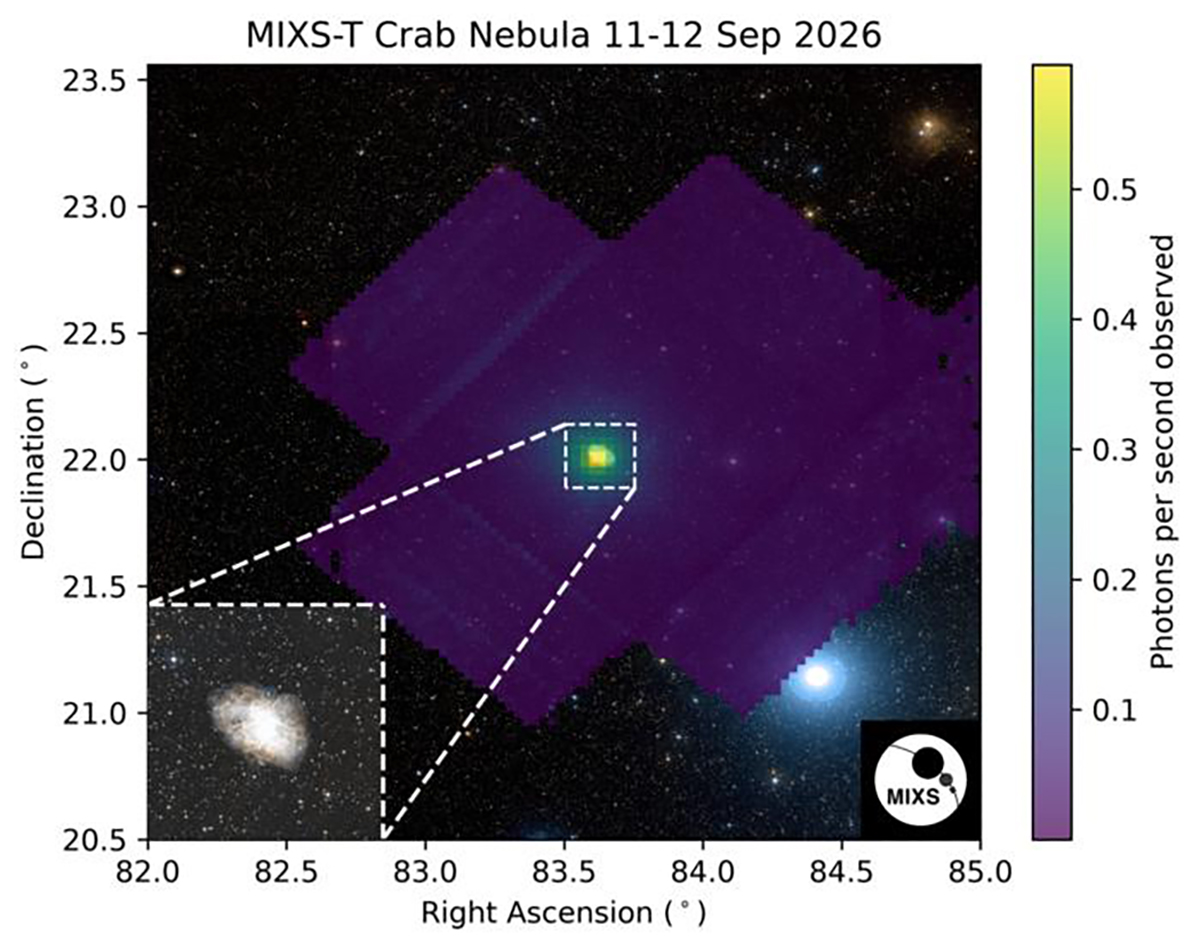
Eight years after launch, an X-ray camera flying to Mercury has taken its first look at the sky. The Mercury Imaging X-ray Spectrometer, known as MIXS, spent September 11 and 12 pointed at the Crab Nebula, and the picture it sent back shows the instrument is in good shape for the work ahead.
MIXS rides on BepiColombo, the European and Japanese mission that entered orbit around Mercury on November 21, 2026. It is the first imaging X-ray telescope ever flown on a planetary science mission. Its job at Mercury will be to read the planet's surface by the X-rays it gives off. When high-energy X-rays from the Sun strike Mercury's rocks, the rocks fluoresce, giving off X-rays of their own at energies that reveal which elements are present. MIXS will use that glow, together with measurements from the Solar Intensity X-ray and particle Spectrometer, to build a global map of Mercury's surface composition. It will also watch the planet's nightside, where particles trapped in Mercury's magnetic field can set off X-rays of a different kind.
None of that could be tested until September. For the whole cruise to Mercury, the Mercury Transfer Module sat in front of MIXS and blocked its view of space. The transfer module separated from the two science orbiters on September 3, 2026, and for the first time the instrument could look outward. The team pointed it at the Crab Nebula, the remains of a star that exploded almost a thousand years ago, about 6,500 light-years away. The Crab is one of the brightest and best-studied X-ray sources in the sky, which makes it the standard target for checking an X-ray instrument: point at something whose X-ray output is already known, and see whether the instrument reports it correctly.
The calibration run took 39 hours across September 11 and 12, with the spacecraft turning to 55 different pointings. The picture that came out is a data figure rather than a photograph: a coloured patch showing the Crab's X-ray glow, measured in photons per second, laid over a visible-light star field, with a small inset showing the nebula as a telescope sees it. Measuring how widely the Crab's image spreads across the detector tells the team how sharply MIXS can pick out features on Mercury's surface. That sharpness came out slightly better than it was when the instrument was last measured in the laboratory in 2015.
The health check came back clean in the ways that matter. There is no stray light leaking into the images, the detector has suffered no radiation damage after eight years in space, and the cosmic-ray effects the team sees are ones they understand and can filter out. There is a small amount of self-fluorescence when sunlight falls on the optics, but it will not affect observations of Mercury's dayside. A few smaller effects are still being studied, and the team plans fine-tuning during the commissioning phase before science begins.
For the people who built it, the result lands personally. Professor Emma Bunce of the University of Leicester, the instrument's principal investigator, said the team had waited a long time to make measurements with MIXS and called it fantastic to see it operating brilliantly in space. She noted that 80 percent of the technology on MIXS is new. Dr Adrian Martindale, the instrument scientist, has been involved with the mission since 2003, when he was an undergraduate student, and has worked on almost every part of the instrument. He said the last time anyone could see through the telescope it was in a basement under the School of Physics and Astronomy in Leicester, and after a rocket launch, eight years in space and 10 billion kilometres travelled, it looks just the same.
The instrument also carries a legacy. Professor George Fraser, the original principal investigator, designed the novel optic at the heart of MIXS and died in March 2014, years before launch. Bunce said the team was thinking of him as they operated MIXS fully in space for the first time.
MIXS was developed by a consortium of institutes and companies across Europe, led by the University of Leicester, and it is the only UK-led science instrument on BepiColombo. The mission launched on October 20, 2018, on an Ariane 5 rocket. With orbit insertion on November 21, the two science orbiters will separate on December 9 and 10, and the science phase is set to begin in April 2027. The Crab Nebula picture is a calibration image, not a science result, but it answers the question the team needed answered before the real work starts: after eight years and 10 billion kilometres, the camera still sees clearly.
Source: University of Leicester, "First X-ray imaging instrument at another planet releases first picture since launch," November 19, 2026.
Image credit: University of Leicester
As an Amazon Associate I earn from qualifying purchases. If you buy through an active affiliate link, StarPixels may earn a commission at no additional cost to you.