
For about 15 years, a giant star 30 million light-years away has flared up like a supernova, faded back down, and then done it again. The star is AT 2016blu, sitting in the spiral galaxy NGC 4559, and astronomers have now found what is driving the show. A hidden companion, either a stellar-mass black hole or a neutron star, circles the giant star and pulls material away from it every 113 days. The discovery comes from NASA's Chandra X-ray Observatory, and the paper describing it was published in The Astrophysical Journal on November 9, 2026. Between 2012 and 2026, astronomers counted at least 27 bursts of optical light from AT 2016blu, arriving roughly every 113 days, and the new Chandra data show the same cycle in X-rays.
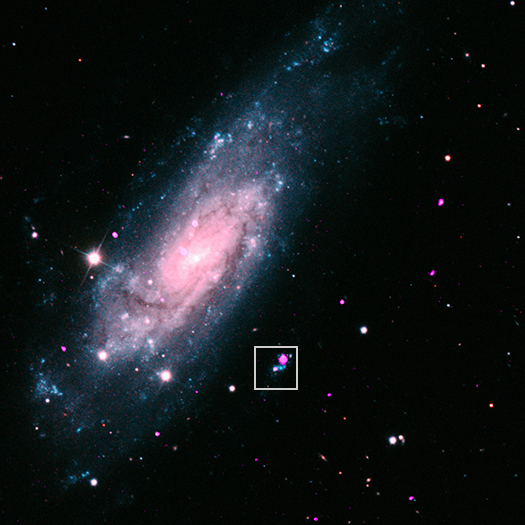
AT 2016blu is a luminous blue variable, a class of hot, massive stars known for changing brightness. The best-known example is Eta Carinae. What sets AT 2016blu apart is how extreme and how regular the swings are: the spikes in brightness are so strong they resemble a supernova explosion, the collapse of a massive star that hurls material outward into space. A supernova destroys the star. AT 2016blu survives each flare and comes back for another, which is why astronomers also call it a supernova impostor. The star holds at least 33 times the mass of the Sun, and it sits near the outer edge of NGC 4559, a spiral galaxy shown at a sharp angle in the new composite image.
The companion is the part nobody could see. It travels an oval-shaped orbit around the giant star, and once per orbit, at closest approach, it strips material from its neighbour. That stolen gas gets captured and circles the compact object at very high speeds, close to the speed of light, growing so hot that it shines brightly in X-rays. The dense gas around the system is heated by those X-rays and then glows in visible light, which is what the optical telescopes have been recording as the repeated flares. This is the first X-ray detection of this class of erupting star, and the first of these objects found with a black hole or neutron star companion. The study was led by Mojgan Aghakhanloo of the University of Virginia, with co-authors Núria Torres-Albà, also of the University of Virginia, and Nathan Smith of the University of Arizona.
Catching the cycle in X-rays took careful timing. The team needed Chandra to look while the star was in outburst, and Chandra was the only X-ray telescope with vision sharp enough to pick AT 2016blu out from another bright X-ray source nearby. Optical telescopes did the watching: the Katzman Automatic Imaging Telescope, the Las Cumbres Observatory Global Supernova Project, and observations from the American Association of Variable Star Observers, including more than 30 amateur astronomers, tracked the star's brightness. When those observations showed an outburst starting in early 2026, Chandra observations were triggered and obtained in March 2026 under the observatory's Target of Opportunity program, built for exactly this kind of event. Chandra made five observations that month, totalling 26 hours and 30 minutes with its ACIS instrument, under observation IDs 31041 and 32254 through 32257.
The March 2026 data settled it. AT 2016blu was at least 100 times brighter in X-rays than in Chandra data from 2001 to 2002, taken before the outbursts began. That jump matches the picture of material falling onto a compact companion at each close pass. The same Chandra data also make AT 2016blu bright enough in X-rays to count as a candidate ultra-luminous X-ray source, a rare class of bright X-ray sources that astronomers have yet to fully understand. Current thinking is that some of these sources contain neutron stars and others hold black holes.
The result reaches past one star. The new observations suggest a link between ultra-luminous X-ray sources and the kind of violent stellar eruptions seen in AT 2016blu, especially because many ultra-luminous X-ray sources swing widely in X-ray brightness. The discovery may also help studies of stars that change in brightness before they explode as supernovae. Astronomers suspect that much of that pre-explosion behaviour comes from systems where a massive star orbits a compact object or another massive star, and AT 2016blu is now a worked example of the mechanism.
The image that comes with the release is a composite of the whole galaxy. Chandra's X-rays appear in magenta, and optical light from the Sloan Digital Sky Survey supplies the red, green, and blue. The frame spans about 12 arcminutes of sky, which works out to about 130,000 light-years across at the galaxy's distance. NGC 4559 sits in the constellation Coma Berenices, at right ascension 12 hours 35 minutes 52.2 seconds and declination plus 27 degrees 55 minutes 55.9 seconds. Near the outer edge of the spiral, close to the centre of the frame, a small group of pink and blue dots is outlined with a white square. The smallest pink dot in the square is AT 2016blu. The much brighter X-ray source inside the same square is unrelated to the star, a reminder that the field is crowded and that Chandra's sharp vision was what made the separation possible.
Chandra itself is run from the United States: NASA's Marshall Space Flight Center in Huntsville, Alabama, manages the Chandra program, the Smithsonian Astrophysical Observatory's Chandra X-ray Center controls science operations from Cambridge, Massachusetts, and flight operations run from Burlington, Massachusetts. The paper, titled AT 2016blu: Accretion-powered Outbursts in a Luminous Blue Variable and Compact Object Binary, is published in The Astrophysical Journal, with the reference Aghakhanloo and colleagues, 2026. Fifteen years of watching a star pretend to explode, and the answer turned out to be a dark companion tugging at it on a 113-day clock.
Source: NASA/Chandra X-ray Center, "NASA's Chandra Finds Source of Star's Mysterious Outbursts," November 9, 2026 (Mojgan Aghakhanloo, University of Virginia; Núria Torres-Albà, University of Virginia; Nathan Smith, University of Arizona). Paper: Aghakhanloo et al., "AT 2016blu: Accretion-powered Outbursts in a Luminous Blue Variable and Compact Object Binary," The Astrophysical Journal, published November 9, 2026, DOI 10.3847/1538-4357/ae9a86.
Image credit: X-ray: NASA/CXC/Univ. of Virginia/M. Aghakhanloo et al.; Optical: SDSS; Image Processing: NASA/CXC/SAO/P. Edmonds
Cover: ~/workspace/goals/starpixels-studio-feed-articles/hidden_files/at2016blu-composite.jpg
As an Amazon Associate I earn from qualifying purchases. If you buy through an active affiliate link, StarPixels may earn a commission at no additional cost to you.