
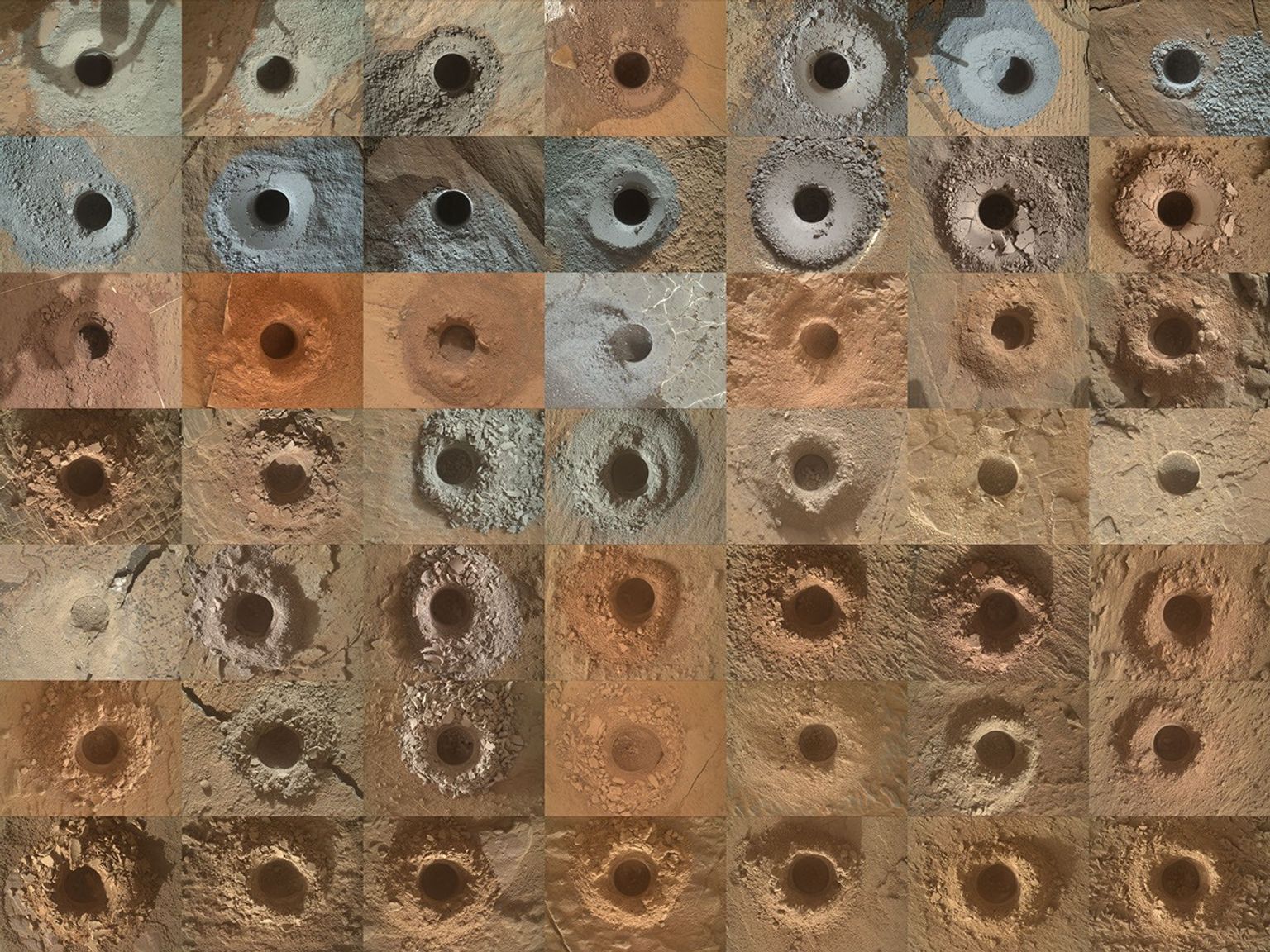
NASA has released a single image that sums up 14 years of work on Mars: a seven-by-seven grid of 49 drill holes, each one a place where the Curiosity rover bored into Martian rock and collected a sample. The collage, published November 16, 2026, shows every hole the rover has drilled as of November 2026, each photographed from directly above by the Mars Hand Lens Imager, a camera on the end of the rover's robotic arm. Each hole is 0.63 inches across, about 16 millimetres, ringed by small mounds of pulverised rock dust in grey, brown or reddish-orange.
The drill sits at the end of Curiosity's 7-foot robotic arm. It grinds rock into a fine powder, then drops the powder into instruments inside the rover's body, which analyse its chemical and mineral make-up. The rover carries 10 science instruments, 17 cameras and a laser that can vaporise small spots of rock at a distance. The drill is the tool that turns a rock face into a laboratory sample, and the collage is the record of every time it has done that job.
Each hole is a data point in a record that stretches across more than a decade of driving up the layers of Gale Crater, the impact basin where Curiosity landed. The rover hunts for rocks that formed in water and for signs of organic compounds, the chemical building blocks of life. Drilled samples have already paid off: a sample Curiosity drilled and analysed held the largest organic compounds found on Mars so far, reported in the journal Astrobiology and thought to be possible fragments of fatty acids preserved in ancient mudstone in Gale Crater. The researchers found that non-biological sources they considered could not fully account for how much organic material the sample held.
Curiosity is still climbing. On August 26, 2026, the rover marked an elevation gain of 1 kilometre since leaving the floor of Gale Crater, climbing the slope of Mount Sharp, the layered mountain at the crater's centre. The rover is about the size of a small SUV, 10 feet long, 9 feet wide and 7 feet tall, not counting its arm, and weighs 1,982 pounds in Earth gravity. It was built by NASA's Jet Propulsion Laboratory, which is managed by Caltech in Pasadena, and JPL leads the mission for NASA's Science Mission Directorate as part of the Mars Exploration Program. At launch, Curiosity was the largest and most capable rover ever sent to Mars, and it also collects soil and air samples for onboard analysis. The Mars Hand Lens Imager was built by Malin Space Science Systems in San Diego. The collage stops at 49 holes. Curiosity keeps climbing Mount Sharp, and the next sample will add one more square to the grid.
Source: NASA Photojournal, "A Collage Showing 49 Drill Holes Made by NASA's Curiosity Mars Rover," November 16, 2026; NASA, Mars Science Laboratory: Curiosity Rover mission page.
Image credit: NASA/JPL-Caltech/MSSS
As an Amazon Associate I earn from qualifying purchases. If you buy through an active affiliate link, StarPixels may earn a commission at no additional cost to you.