
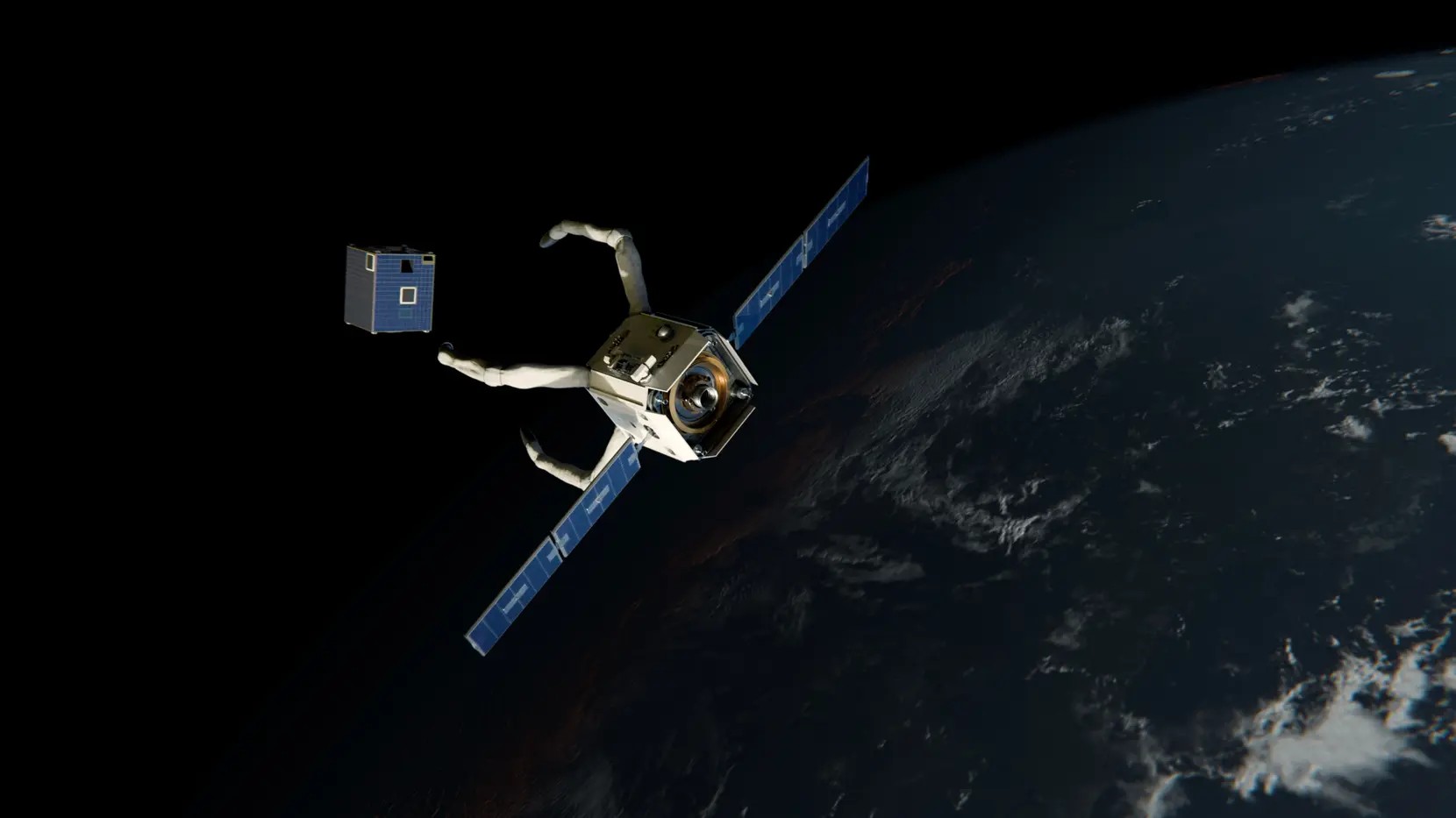
The European Space Agency has signed the contract to build ClearSpace-1, a spacecraft designed to catch a dead satellite and drag it out of orbit. ESA and prime contractor OHB System marked the start of the mission's construction phase with a contract signature on November 17, 2026, at the Space Tech Expo Europe in Bremen, Germany. The mission is Europe's first attempt to remove a real, unprepared satellite from orbit rather than one built to be caught.
The target is ESA's own Proba-1 satellite. Proba-1 launched in 2001 and ended its regular operations in 2022, after more than 20 years in service. It weighs 95 kilograms and measures about 0.6 by 0.6 by 0.8 metres. ClearSpace-1 will approach it, capture it with four robotic arms, and guide both spacecraft into a controlled re-entry so they burn up in the atmosphere. Launch is scheduled for 2030.
The catch is hard because Proba-1 was never designed to be serviced. It will not help its captor: it does not communicate with the approaching vehicle, and it was built with no grappling points or docking aids. ClearSpace-1 will have to track the satellite's motion on its own, using optical and radio-based sensors, then close in and grab a tumbling object that cannot cooperate. ESA describes it as the first time a spacecraft will approach, capture and safely bring down an unprepared and uncooperative satellite for re-entry.
The industrial team is a consortium led by OHB SE, with ClearSpace SA, Indra and OHB Sweden as sub-contractors. ClearSpace, the Swiss start-up that led the mission's earlier phase, keeps responsibility for the close-proximity and capture operations. Christian Steimle, the ClearSpace-1 project manager at ESA, said the mission remains very complex, technically and industrially, and that after overcoming several challenges and completing a re-design phase, the project is now going full speed.
The reason for the mission is the growing pile of dead hardware overhead. Thousands of satellites and rocket bodies have been left in orbit during humanity's short time in space so far. Each one is a collision risk, and a collision can break a satellite into fragments that raise the risk for everything else. Active debris removal technology is the proposed answer: go up, grab a dead object, and bring it down before it can be hit.
ClearSpace-1 is a cornerstone mission of ESA's Space Safety Programme, run through the agency's Operations Directorate. It sits inside ESA's wider effort to develop active debris removal and in-orbit servicing capabilities in Europe, known as ADRIOS. It also feeds ESA's Zero Debris ambition, a commitment that all future ESA missions, programmes and activities leave no debris behind by 2030. ESA says the mission will show regulators that a working, affordable remedy for stranded spacecraft now exists, where none was available before.
The mission has already changed shape once. In December 2020, ESA signed an 86 million euro contract with an industrial team led by Swiss start-up ClearSpace SA to buy the first debris-removal service. The original target was a different object: the upper part of a Vega Secondary Payload Adapter, known as VESPA, left in orbit after the second flight of Europe's Vega launcher in 2013. That adapter weighed 112 kilograms. The mission was later redesigned around Proba-1, and in April 2024 ESA announced that OHB would take over leadership of the restructured project. The November 2026 contract makes OHB System the prime contractor for the implementation phase, turning the design into a flight-ready spacecraft.
Rolf Densing, ESA's Director of Operations, said making active debris removal a viable option is crucial to enabling future policies and regulations that support sustainability in space. Chiara Pedersoli, chief executive of OHB System, said the consortium will prove that active debris removal is not just possible on paper, but possible in space. If ClearSpace-1 works, the next step is a market: companies paid to clean up orbit, one dead satellite at a time.
Source: ESA, "ClearSpace-1 ready to be built," November 17, 2026; ESA ClearSpace-1 mission page; ESA, "ESA purchases world-first debris removal mission from start-up," December 1, 2020.
Image credit: ESA
As an Amazon Associate I earn from qualifying purchases. If you buy through an active affiliate link, StarPixels may earn a commission at no additional cost to you.