
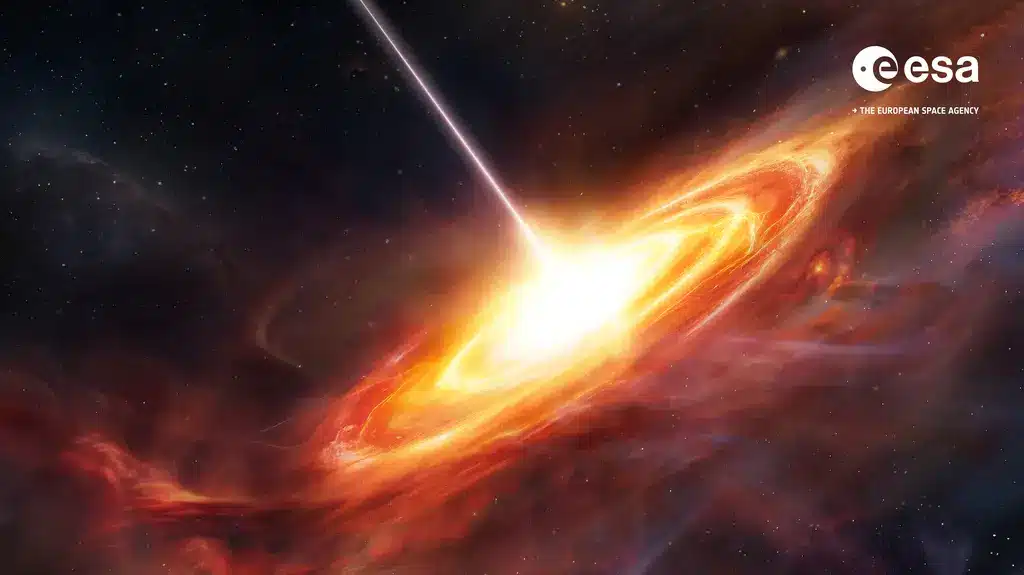
The European Space Agency's Euclid space telescope has found 31 of the most ancient quasars ever seen — and two of them are the earliest quasars anyone has ever observed. They were already shining when the universe was about 670 million years old, roughly 5 percent of its current age. Their light has taken some 13 billion years to reach us.
A quasar is the bright core of a young galaxy, powered by a black hole feeding so fast that the gas falling into it glows with the light of a trillion suns. The puzzle is how black holes got that big that early. The universe had barely started, and already some black holes weighed as much as a billion suns. Every new example from that era is a clue to how they grew so fast.
Euclid found these 31 in the first year and a half of its Wide Survey, which so far covers about 3,000 square degrees and will eventually map more than a third of the sky. The telescope's wide view and sharp infrared vision let it pick out faint, distant objects that earlier searches missed. Astronomers then confirmed 31 of 123 candidates with spectrographs on the Keck, Magellan, and Large Binocular telescopes. The paper, led by Daming Yang of Leiden University, was published July 6, 2026, in Astronomy & Astrophysics.
Twelve of the 31 sit at a redshift of 7 or higher, placing them inside the universe's first 770 million years. That more than doubles the number of quasars known from that early era. Astronomers needed more than a decade to find about 10 quasars beyond redshift 7. Euclid found 12 in one year.
Two of them set records. The most distant, EUCL J172902.75+641018.1, has a redshift of 7.77. Close behind it, EUCL J125308.55+705432.3 sits at 7.69. The previous record holder, found in 2021, had a redshift of 7.64. Redshift is a measure of how much the universe has stretched a distant object's light on its way to us — the higher the number, the earlier the light left its source.
What makes this haul matter is not just the records. Earlier searches mostly caught the brightest outliers, the quasars so luminous they were hard to miss. Euclid is finding the fainter ones too, the ordinary members of the ancient quasar population that previous telescopes struggled to see. That changes the census: instead of a handful of freaks, astronomers now have a sample big enough to start asking how common these early giants were, and how they grew.
The answer is still open. The paper is a census, not an explanation. How a black hole reaches a billion solar masses within a few hundred million years of the Big Bang remains one of the sharpest questions in astronomy, and this sample is meant to help answer it. The search is not finished either — follow-up spectra are still scarce in the southern sky, and a formal account of how complete the selection is has not yet been published. More quasars from this same survey are likely on the way.
Euclid launched in 2023 to map the dark universe — dark matter and dark energy, the invisible stuff that shapes how galaxies grow. Finding the earliest quasars was not its main job. It turned out to be very good at it anyway.
Source: ESA, "Euclid discovers the most ancient quasar in the Universe," July 6, 2026; D. Yang et al., Astronomy & Astrophysics, DOI: 10.1051/0004-6361/202658883.
Image credit: dailygalaxy.com (credit unverified)
As an Amazon Associate I earn from qualifying purchases. If you buy through an active affiliate link, StarPixels may earn a commission at no additional cost to you.