
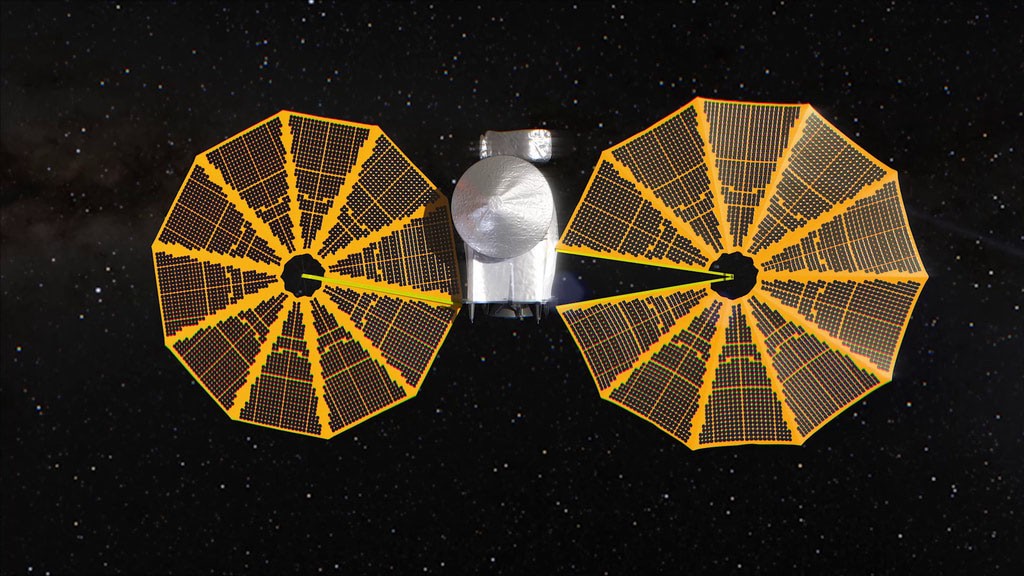
Having traveled more than 2.2 billion miles since it launched on October 16, 2021, NASA's Lucy is the first spacecraft to enter a region of primitive solar-system bodies known as the Jupiter Trojan asteroids. Mission engineers know Lucy is approaching Jupiter's Lagrange point 4 (L4) by tracking its location through radio signals and images of surrounding stars. Lucy will visit asteroids in both Trojan groups. Its first encounter, with the Trojan Eurybates, comes August 11, 2027, followed by Polymele in September 2027, Leucus in April 2028, and Orus in November 2028. The spacecraft then returns to Earth in 2030 for a gravity assist toward Jupiter's trailing Trojan group, where it will explore the binary pair Patroclus and Menoetius in March 2033. Scientists expect that studying Trojans up close will help hone theories on how the solar system's planets formed 4.5 billion years ago.
Source: NASA Science, Lucy mission blog, October 28, 2026.
Image credit: Artist's rendering: NASA. The cover image is an artist's rendering, not a photograph.
As an Amazon Associate I earn from qualifying purchases. If you buy through an active affiliate link, StarPixels may earn a commission at no additional cost to you.