
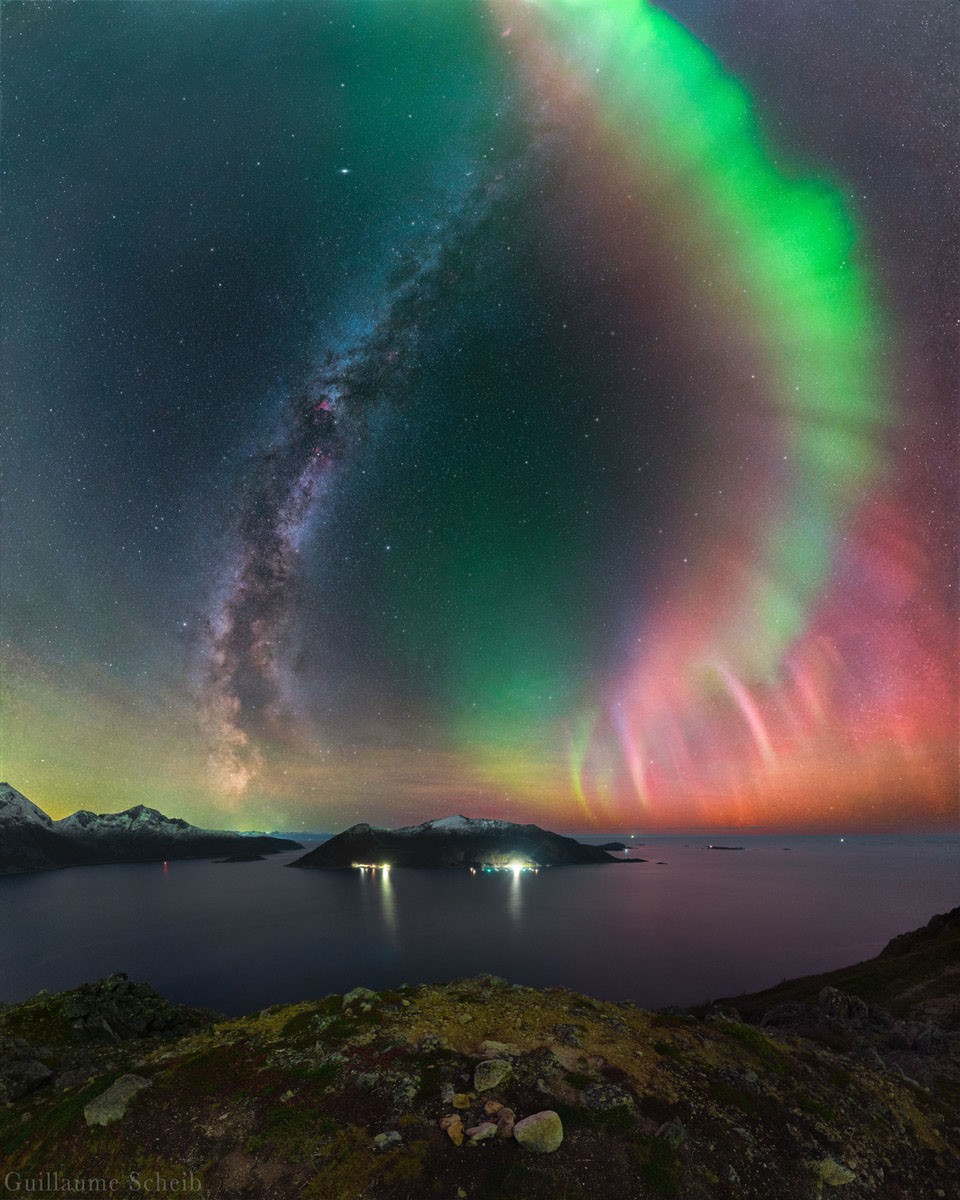
Two great arches stand over the same stretch of water in the Astronomy Picture of the Day for November 17, 2026, and they could hardly be more different. The arch on the left is the central band of the Milky Way, our own galaxy, an ancient system of stars, gas and dust that predates Earth and lies very far away. The arch on the right is an aurora, a ribbon of energized atoms and molecules glowing in Earth's upper atmosphere, only hours old. They look like rivals for the sky. They are a chance alignment, two structures at wildly different distances lined up by luck.
The two arches share one thing: the Sun. The Sun is itself a member of the Milky Way, one star among the band's billions, and it ejects the energetic particles that create auroras. The same star that sits inside the galaxy on the left powers the glow on the right. The Milky Way is ancient and far away. The aurora is hours old and close by, made in our own sky when solar particles struck atoms and molecules high above the ground.
Look closely at the frame and there is more to find. The Milky Way's arch is textured, thick with stars and dark lanes of dust. The aurora's ribbon is smoother, a clean curve of green and red light. Behind the middle of the auroral arch sits the Big Dipper, the familiar star pattern. Farther in the distance, near the top of the frame and just left of center, a bright spot marks the Andromeda galaxy. Three depths sit in one photograph: our atmosphere, our galaxy, and another galaxy beyond it.
The photograph was taken about a month before its November 17, 2026 publication, from Kvaløya in northern Norway, above water and islands under a dark sky. The Milky Way rises on the left of the frame and the aurora sweeps down on the right, and both arches bend toward the same horizon. Guillaume Scheib took the picture. The Astronomy Picture of the Day is a service of the Astrophysics Science Division at NASA's Goddard Space Flight Center, with NASA Science Activation and Michigan Technological University, and the editors are Robert Nemiroff, Jerry Bonnell, Cecilia Chirenti and Keighley Rockcliffe.
What makes the picture work is the contrast in age and distance. The galaxy on the left formed long before Earth existed. The aurora on the right was born the same night, from particles the Sun had thrown out hours earlier. A single exposure holds both: the oldest thing a camera in Norway can point at, and one of the freshest. The Sun ties them together, a star of the Milky Way whose own outbursts light the sky above the ground it shines on.
Source: NASA Astronomy Picture of the Day, November 17, 2026, "Milky Way versus Aurora"; editors Robert Nemiroff, Jerry Bonnell, Cecilia Chirenti, Keighley Rockcliffe.
Image credit: Guillaume Scheib
As an Amazon Associate I earn from qualifying purchases. If you buy through an active affiliate link, StarPixels may earn a commission at no additional cost to you.