
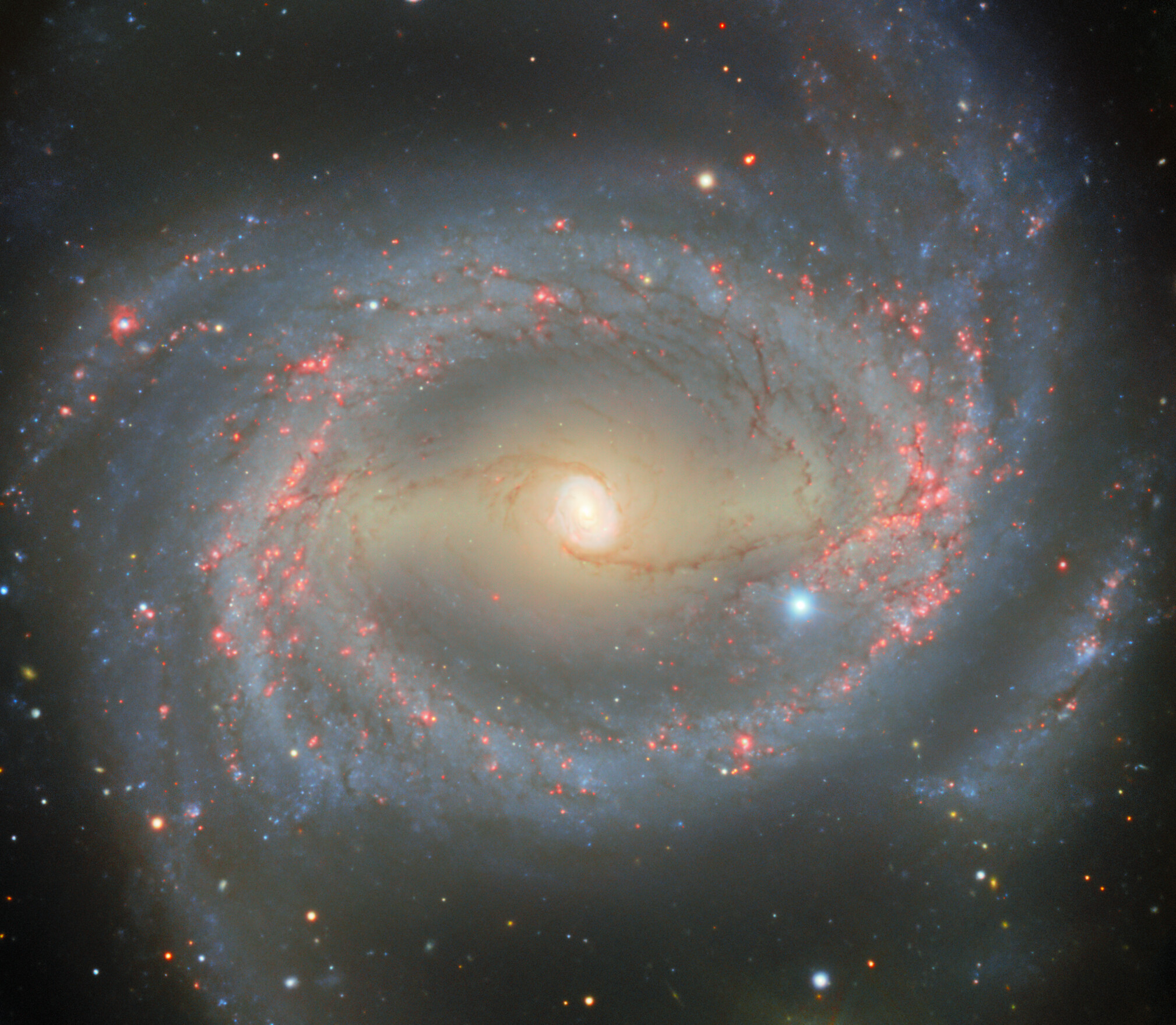
A star's explosive death has added a bright new point of light to NGC 1433, a barred spiral galaxy about 50 million light-years away in the southern constellation Horologium, the Pendulum Clock. The supernova, SN 2026ahvu, was caught early and is still climbing toward its expected maximum brightness, giving astronomers a rare chance to watch a stellar explosion unfold from its first days. New images from the Dark Energy Camera and the International Gemini Observatory show the explosion against its galactic surroundings, changing in appearance from night to night.
The Asteroid Terrestrial-impact Last Alert System, known as ATLAS, discovered the object on November 2, 2026, at about 04:20 UTC, through a cyan filter. It was first designated AT 2026ahvu. Spectroscopic observations with the Keck II telescope's DEIMOS instrument on November 3, 2026, classified it as a young Type Ia supernova, an explosion of a white dwarf that has accreted matter from a close companion star, and it received the designation SN 2026ahvu. At discovery its apparent magnitude was about 17. Within days, observations reported it at magnitude 13.5. On the magnitude scale astronomers use, smaller numbers mean brighter objects, so the supernova brightened by a factor of roughly 25 in its first days.
The supernova is expected to reach a maximum brightness of magnitude 10.5 to 12.1 between November 18 and 23, 2026. Its discovery well before peak brightness, combined with its relative proximity, gives astronomers a valuable opportunity to witness the early development of the explosion and gather evidence that can quickly disappear as the expanding debris evolves. This is one of the nearest Type Ia supernovae observed since SN 2011fe was discovered in the Pinwheel Galaxy, Messier 101, in 2011. The supernova sits to the right and slightly below the center of NGC 1433 in the new images.
Type Ia supernovae arise from the thermonuclear destruction of white dwarfs, the dense remnants of stars like the Sun. Astronomers use these explosions to measure cosmic distances, because their intrinsic brightness is well known. Important questions remain about the stellar systems that produce them and precisely how they ignite. Observations during the earliest stages can help distinguish between possible explosion scenarios and search for signs of interaction with a companion star or surrounding material. Watching SN 2026ahvu from its first days through its peak brightness and into its long fade will also improve knowledge of the distance to NGC 1433, since measuring the maximum apparent brightness of a standard candle pins down how far away it sits.
The observing effort spans several facilities. The Dark Energy Camera, known as DECam, is mounted on the Víctor M. Blanco 4-meter Telescope at Cerro Tololo Inter-American Observatory in Chile. Gemini South, one half of the International Gemini Observatory, supplied sharper imaging of the system. NSF NOIRLab is coordinating follow-up observations with Blanco and DECam, Gemini, and the Southern Astrophysical Research Telescope on Cerro Pachón in Chile. Repeated imaging tracks how the supernova's brightness and color evolve, while spectroscopy shows what the expanding material is made of and how fast it is moving. Telescopes on the ground and in space are already turning their attention to SN 2026ahvu, and NOIRLab has invited other observatories to contribute complementary observations across wavelengths and time zones.
DECam also captured images of NGC 1433 before the explosion, during observations for the Dark Energy Survey, a survey led by the Department of Energy's Fermi National Accelerator Laboratory that ran from 2013 to 2019 to investigate the nature of dark energy. Those earlier images let astronomers compare the supernova's environment before and after the explosion. The Gemini data in the release were acquired under Director's Discretionary Program GS-2026B-DD-104 and are publicly available through the Gemini Observatory Archive.
The event is also within reach of amateur astronomers. At its reported brightness, SN 2026ahvu can already be seen in small to moderately sized amateur telescopes under favorable conditions, particularly from southern locations where NGC 1433 rises high in the sky. Its coordinates are right ascension 03h 41m 55.511s and declination minus 47 degrees 13 minutes 39.39 seconds, in J2000 coordinates. Its southern location makes it difficult or impossible to observe from far northern latitudes. To the eye, the supernova appears as a faint point of light, a chance to witness the changing glow of an exploding star in another galaxy.
Source: NSF NOIRLab photo release, "NSF NOIRLab-operated Facilities Capture Brightening Nearby Supernova," November 12, 2026.
Image credit: International Gemini Observatory/NOIRLab/NSF/AURA
As an Amazon Associate I earn from qualifying purchases. If you buy through an active affiliate link, StarPixels may earn a commission at no additional cost to you.