
Eight stories from November 1, 2026: a telescope comes home after 22 years, a decade of full Moons in colour, two Webb results from an interstellar comet, a green comet's last good pass until 2069, a lava world with a rock-cloud sunscreen, slow collisions building the first giant black holes, Mars meeting Jupiter before dawn, and Iceland's steam under the northern lights.
SWIFT — A 22-YEAR MISSION ENDS IN FIRE
NASA's Neil Gehrels Swift Observatory re-entered Earth's atmosphere on Wednesday, November 4, 2026, at 7:39 a.m. EST, over the North Sumatra region of Indonesia, at about 3.4 degrees north latitude and 98.6 degrees east longitude. The U.S. Space Force confirmed the time and place, and NASA updated its Swift blog on November 4, 2026, with the confirmation. Swift launched on November 20, 2004, on a Delta II rocket from Cape Canaveral, built for a two-year prime mission. It worked for almost 22 years instead, hunting gamma-ray bursts with three telescopes. By NASA's count it detected more than 2,000 gamma-ray bursts. Science had already ended on October 20, 2026, when drag at about 275 kilometres stopped steady pointing. NASA expected most of the 3,200-pound spacecraft to burn up. NASA put the risk of harm to anyone on the ground at about 1 in 2,100. "NASA expected most of the spacecraft to burn up as it traveled through the atmosphere, but some components may have survived re-entry," the agency said in its November 4, 2026, update.
MOONS — TEN YEARS OF FULL MOONS IN FULL COLOUR
What colour is the Moon? NASA's Astronomy Picture of the Day for November 1, 2026, answers with a spiral of 48 full-Moon photographs taken by Marcella Giulia Pace over ten years from locations across Italy. It was the third time the work had been chosen, after 2020 and 2022. Outside Earth's atmosphere the Moon shines by reflected sunlight and appears a brown-tinged grey. From the ground, the same Moon changes colour because its light passes through Earth's air. A red or yellow Moon usually sits near the horizon, where its light takes a longer path through the air and loses blue to scattering. A blue Moon is rarer and can mean larger dust in the air. What made the purple Moon is unclear; NASA says it may be a combination of several effects. The last image in the spiral is different again: the total lunar eclipse of July 27, 2018, where the Moon sat in Earth's shadow and glowed faint red.
3I/ATLAS — TWO WEBB RESULTS, TWO PAPERS, ONE COMET
Interstellar comet 3I/ATLAS, only the third object from beyond our Solar System ever identified, produced two separate Webb results. The first, by Nathan X. Roth of NASA Goddard and American University, appeared in Nature Astronomy on October 23, 2026. Webb's spectrograph watched the comet on December 22 and 23, 2025, at about 2.4 AU. The team measured a deuterium-to-hydrogen ratio of 3.18 percent, plus or minus 0.30 percent, in its methane. The paper states plainly: "This D/H ratio exceeds any other value for methane measured in the Solar System." It is about 13 times the value ESA's Rosetta measured in comet 67P, the only other comet with deuterated methane detected. The second, by Silvia Protopapa of the Southwest Research Institute, appeared in The Astrophysical Journal Letters on October 26, 2026. Webb observed it three times between August 2025 and April 2026. The spectra show water ice in grains about a micron across or smaller, mixed with dark, rocky dust: a strong band near 3 microns, faint ones near 1.5 and 2.0 microns. Its grains match some icy worlds beyond Neptune better than most comets. One caution: the often-quoted 10-to-12-billion-year age is an interpretation, not a measured age, and models cannot yet reproduce the deuterium number.
HARTLEY-IRAS — LAST GOOD LOOK UNTIL 2069
Comet 161P/Hartley-IRAS reaches perihelion on November 27, 2026, at 1.27 AU. It is a Halley-type comet with a 21.5-year period, discovered in 1983 by Malcolm Hartley and the IRAS spacecraft, and last seen in 2005. It passed closest to Earth on October 2, 2026, at 0.505 AU. Northern-hemisphere observers can follow it in the evening sky through late November 2026, low in Aquila. Two corrections. First, brightness: the original article gave 10th magnitude, but the Association of Lunar and Planetary Observers puts it near magnitude 11 in early November, fading toward 12 by perihelion. Second, the source: the original article cited only "Astronomy" with no author or article named, and no such article could be pinned down, so the facts here rest on ALPO and Minor Planet Center data instead. The green coma is the comet's signature: sunlight makes diatomic carbon in the gas fluoresce green. Imagers have recorded a dust trail along its orbit and a coma 16 arcminutes across. The comet comes back in about 21.5 years, but the viewing geometry is poor, and the next favourable look does not come until 2069. Dark skies help most before the full Moon on November 24, 2026.
TOI-561 B — A LAVA WORLD THAT REFLECTS THREE-QUARTERS OF ITS STARLIGHT
TOI-561 b is a rocky planet about 280 light-years away, about 1.4 times Earth's width and 2.2 times its mass, circling its star in under 11 hours. Its dayside is hot enough to be molten rock, and astronomers expected a world blasted that hard to have lost any atmosphere billions of years ago. Webb's spectrograph watched it for 37 hours in May 2024, covering nearly four orbits and mapping its glow between 3 and 5 microns. The result is a Bond albedo of 0.74, plus or minus about a tenth: the planet sends back roughly three-quarters of the starlight that hits it, a brightness comparable to Venus. The paper appeared in The Astronomical Journal on September 29, 2026. First author is Samuel Boucher of the Université de Montréal, project lead is Lisa Dang of the University of Waterloo, and co-author Anjali Piette is at the University of Birmingham. "Our discovery challenges current theories," Piette said. "We would expect a heavily irradiated rocky planet like TOI-561 b to have lost its atmosphere billions of years ago." Climate models point to clouds of silicate minerals, silicon dioxide and magnesium silicate, forming where rock vapour cools. One caution: the clouds come from models, not a direct detection. The dayside measures about 2,050 Kelvin.
SLOW COLLISIONS — HOW THE FIRST GIANT BLACK HOLES MAY HAVE STARTED
Supermassive black holes show up less than a billion years after the Big Bang, too early for black holes that grow slowly from single stars. A UCLA-led study offers a head start. In the early universe, star clusters were far denser than the ones around us now. The work, led by UCLA doctoral student Claire Williams as corresponding author, with professor Smadar Naoz leading the research, appeared in The Astrophysical Journal on October 26, 2026. The team modelled Webb's "little red dots," no more than 1,280 light-years across, as ultra-dense star clusters. When two stars meet slowly, they merge instead of shattering. Repeat that over and over and runaway growth builds a single monster star. "Perhaps the strangest outcome of our simulations is that stars can merge repeatedly within the cluster until they form one gigantic star with a mass equal to that of an entire cluster," Williams said. "When a star this huge reaches the end of its life, models suggest that it may have no option but to collapse into itself and form a massive black hole." Fast collisions do the opposite, tearing stars apart. The Milky Way's centre holds the same ingredients, a supermassive black hole inside a dense star cluster. This is a simulation result, not an observation. The test is finding middleweight black holes, heavier than any single star should leave behind but lighter than the supermassive ones.
MARS AND JUPITER — CLOSE IN THE MORNING SKY ON NOVEMBER 15 AND 16
On the mornings of November 15 and 16, 2026, Mars and Jupiter appear about 1.2 degrees apart in the southeastern sky before sunrise, a little more than the width of two full Moons side by side. Jupiter is the brighter point of light, Mars the reddish one beside it, and both are easy to see with the naked eye. That is NASA's What's Up for November 2026, presented by Raquel Villanueva of the Jet Propulsion Laboratory. The closeness is a line-of-sight effect only: the planets stay far apart in space. The pair sits near the Sickle in Leo, and Mars shines at magnitude 0.7 while Jupiter shines at magnitude minus 2.1. Mercury and Venus join the morning sky through November 20, 2026. The same month brings the Leonid meteors, peaking on the night of November 17 and 18, 2026. Mars and Jupiter meet this closely roughly once every 2.2 years, and will not look this close again until July 2029.
AURORA — ICELAND'S STEAM MEETS THE NORTHERN LIGHTS
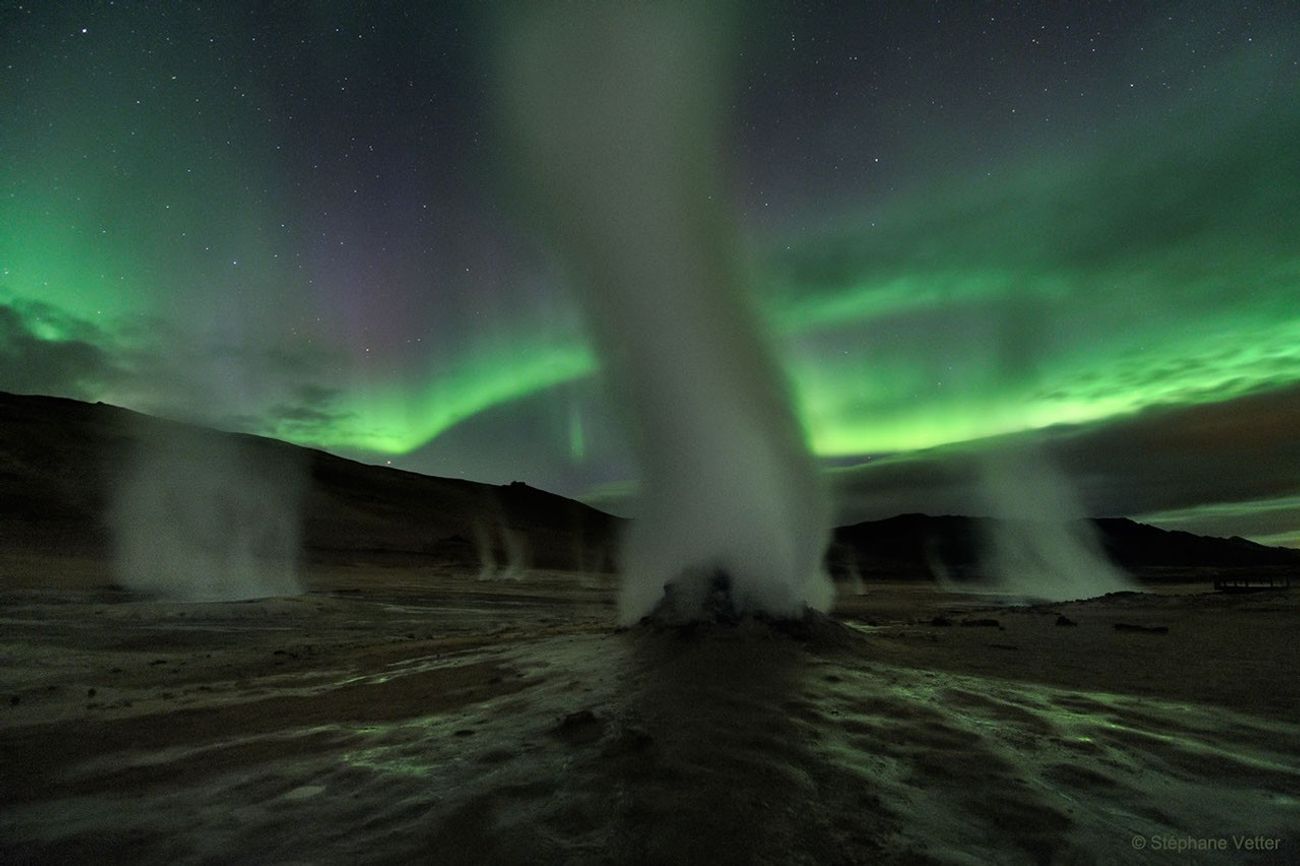
The Astronomy Picture of the Day for October 31, 2026, shows Hverir, a geothermally active area in northeastern Iceland, under green northern lights. Ghostly towers of steam and gas rise from fumaroles, cracks in ground heated from below. The photograph is by Stéphane Vetter, credited as Stéphane Vetter (Nuits sacrées). One correction: the photograph dates to 2013, and NASA has featured the same image before, on October 29, 2017, and October 30, 2022. It was re-featured on October 31, 2026, not taken on that date. The physics is real either way. Geomagnetic storms release energetic particles trapped in Earth's magnetic field, and those particles reach the upper atmosphere at high latitudes and light up the sky. The green comes from oxygen high above. NASA notes auroral activity remains high as the Sun enters the early phases of decline from the peak of its cycle. Iceland sits under the auroral oval, the ring where auroras appear most often. Texas needed a storm of the May 2024 class to see the aurora from Denton, and nothing in this photograph promises one.
Source: (1) Swift — NASA Swift blog, Alise Fisher, November 2, 2026, updated November 4, 2026: NASA's Swift Observatory Re-Entered Atmosphere — https://science.nasa.gov/blogs/swift/2026/11/02/nasas-swift-observatory-to-re-enter-atmosphere/ ; legacy figures (2,000+ bursts, 1-in-2,100 risk) per Spaceflight Now, November 4, 2026 — https://spaceflightnow.com/2026/11/04/nasas-neil-gehrels-swift-observatory-reenters-over-western-indonesia/
Source: (2) Full moons — NASA Astronomy Picture of the Day, November 1, 2026, Colors of the Moon — https://science.nasa.gov/image-article/apod-2026-november-1-colors-of-the-moon/
Source: (3) 3I/ATLAS — Roth et al., An enriched methane D/H ratio in the interstellar object 3I/ATLAS, Nature Astronomy, published October 23, 2026, DOI 10.1038/s41550-026-03002-5 — https://doi.org/10.1038/s41550-026-03002-5 ; Protopapa et al., JWST Reveals Refractory-rich Water Ice in Interstellar Comet 3I/ATLAS, The Astrophysical Journal Letters 1011: L11, published October 26, 2026, DOI 10.3847/2041-8213/aea60d — https://doi.org/10.3847/2041-8213/aea60d ; Southwest Research Institute release, October 26, 2026 — https://www.swri.org/newsroom/press-releases/swri-led-study-uses-webb-compare-interstellar-comet-3i-atlas-icy-bodies-our-solar-system
Source: (4) Hartley-IRAS — Association of Lunar and Planetary Observers, ALPO Comet News for November 2026 — https://alpo-astronomy.org/Comets ; Minor Planet Center ephemeris via MPEC 2026-T250. NOTE: the original article cited only "Astronomy" with no author or article named; no such article could be pinned down. Magnitude corrected from 10th to about 11th per ALPO.
Source: (5) TOI-561 b — University of Birmingham release, October 27, 2026, Shiny lava planet challenges astronomers' expectations — https://www.birmingham.ac.uk/news/2026/shiny-lava-planet-challenges-astronomers-expectations ; Boucher et al., A Highly Reflective Atmosphere on the Lava World TOI-561 b Revealed by JWST/NIRSpec Phase Curve, The Astronomical Journal 172(4), article 239, published September 29, 2026, DOI 10.3847/1538-3881/ae9763 — https://doi.org/10.3847/1538-3881/ae9763
Source: (6) Slow collisions — UCLA Newsroom, Stellar collisions may have been common when the universe was young, October 26, 2026 — https://newsroom.ucla.edu/releases/stellar-collisions-common-when-universe-young ; Williams et al., The Astrophysical Journal, 2026.
Source: (7) Mars and Jupiter — NASA What's Up: November 2026 Skywatching Tips from NASA, Raquel Villanueva, Jet Propulsion Laboratory, published November 2, 2026 — https://science.nasa.gov/solar-system/skywatching/whats-up-november-2026-skywatching-tips-from-nasa/
Source: (8) Aurora — NASA Astronomy Picture of the Day, October 31, 2026, Night on a Spooky Planet — https://science.nasa.gov/image-article/apod-2026-october-31-night-on-a-spooky-planet/
Image credit: (1) Swift — NASA (artist's concept). VERIFIED agency image.
Image credit: (2) Full moons — Credit & Copyright: Marcella Giulia Pace, via NASA APOD. VERIFIED image.
Image credit: (3) 3I/ATLAS — NO verified agency image with credit found. NO COVER for this item.
Image credit: (4) Hartley-IRAS — NO verified image with credit found. Original article credited only "Astronomy". NO COVER for this item.
Image credit: (5) TOI-561 b — University of Birmingham (artist's concept). VERIFIED image.
Image credit: (6) Slow collisions — UCLA (simulation illustration). VERIFIED image.
Image credit: (7) Mars and Jupiter — Chart: NASA/JPL-Caltech. VERIFIED image.
Image credit: (8) Aurora — Credit & Copyright: Stéphane Vetter (Nuits sacrées), via NASA APOD. VERIFIED image.
Cover: Aurora over Hverir — Stéphane Vetter (Nuits sacrées), via NASA APOD, October 31, 2026 (verified image; the Pace moon spiral is the alternate cover)
As an Amazon Associate I earn from qualifying purchases. If you buy through an active affiliate link, StarPixels may earn a commission at no additional cost to you.