
Nine stories from October 30, 2026, on galaxies, black holes, and the early universe: a galaxy that may leak most of its light into space, a dust-shrouded black hole already a billion suns heavy in the universe's first billion years, nearly 3,000 supernovae nudging at dark energy, a gamma-ray burst watched from the side, two stellar nurseries caught in the act, a ghost cloud that is really a nursery, a radio structure shaped like a treble clef, and three new ghosts in Cassiopeia nobody can yet explain.
EBG-1 — A GALAXY THAT MAY LEAK MOST OF ITS LIGHT
A galaxy called EBG-1, watched with the James Webb Space Telescope, looks like a strong candidate for the bright side of a long-running question: which galaxies lit up the early universe. The team, led by Yunjing Wu of the University of Tokyo, spent 14 hours on it with Webb's NIRSpec spectrograph and posted the result to arXiv on October 16, 2026. EBG-1 sits at redshift 9.244, seen as it was about 530 million years after the Big Bang, magnified by the gravity of a foreground cluster called MACS0647. It is one of the bluest galaxies yet recorded at that distance. The spectrum is strange: weak emission lines overall, a clear oxygen signal, a faint hydrogen signal, and no carbon at all. From the oxygen-to-hydrogen ratio the team puts its oxygen at only about 3 percent of the Sun's, which fits a galaxy that has not yet built up heavy elements. The key number is the escape fraction, the share of ionizing photons that get out instead of being absorbed inside. Comparing the spectrum with model galaxies, the team found the best match at about 85 percent escaping, with a lower limit near 75 percent. One caution: this is a single galaxy.
J1440+0019 — A DUSTY BLACK HOLE ALREADY A BILLION SUNS HEAVY
Some black holes in the early universe were already enormous when the cosmos was less than a billion years old. A new study of a quasar called J1440+0019 adds a kind that old searches tended to miss: not hidden completely, just reddened by dust. The work, led by Daming Yang of Leiden Observatory and posted to arXiv on October 9, 2026, combines Webb's NIRSpec spectrum of the quasar's core with ALMA observations of the host galaxy's cold gas and dust. The object sits at redshift 6.5488 and holds a black hole of about 1.1 billion solar masses. It is radiating at about 80 percent of its Eddington luminosity. Gas is streaming out at up to 3,600 kilometres per second, a sign of powerful outflows driven by the feeding. The host galaxy is exceptionally bright in ionized carbon emission, holds about 400 million solar masses of dust, and is forming stars at up to about 1,330 solar masses a year. The object was first found by the Subaru SHELLQs survey, and ALMA needed only about five and a half minutes to pick out the gas and dust clearly, so the same approach can hunt for more reddened quasars like it.
SUPERNOVAE — NEARLY 3,000 EXPLODING STARS PRESS ON DARK ENERGY
Type Ia supernovae are the yardsticks of the universe: white dwarfs that explode at a known brightness, so their faintness tells astronomers how far away they are. A team led by Ryan Camilleri, a PhD candidate at the University of Queensland, has put 2,884 of them into one consistent framework and posted the result to arXiv on September 8, 2026. The set combines the Pantheon+ compilation with the Dark Energy Survey's five-year sample, rebuilding three decades of observations taken with different telescopes, cameras, and calibrations. "We've rebuilt 3 decades of astronomical observations into a single, consistent framework," Camilleri said. The cleaner expansion history it produces does not quite fit the standard model. Lambda-CDM, the standard picture, assumes dark energy is a cosmological constant, the same strength everywhere and at every time. The combined supernovae prefer dark energy that changes over time, at 3.3 sigma. The honest summary is the one the original article already gave: a tension, not an overturn. Two cautions: the work is a preprint, so it has not yet been through peer review, and supernovae alone do not prove the standard model wrong.
GRB 260310A — A SIDE-ON BURST HID A MONSTER JET
On March 10, 2026, NASA's Fermi telescope caught a 53-second burst called GRB 260310A. Nothing about the flash looked special. Then its afterglow kept brightening for weeks, climbing into the brightest one percent of afterglows ever recorded, until it outshone its entire host galaxy. A team led by Yu-Han Yang of the University of Rome Tor Vergata, published in The Astrophysical Journal Letters on October 28, 2026, argues the reason is geometry: the jet was pointing away from Earth, and we were watching it from the side. "We looked at it from a side angle," Yang said. The models point to a narrow core about 0.8 degrees wide, viewed from about 10 degrees off its axis. At redshift 0.153, its gamma-ray output was only about 3.5 times 10 to the 50th ergs, modest for a long burst. Calar Alto linked it to a broad-lined Type Ic supernova. The core's energy is near 2 times 10 to the 54th ergs, roughly a billion years of the Sun's energy output. One burst is one case, but others like it are likely out there.
N159 — A TURBULENT NURSERY BREWING STARS IN WAVES
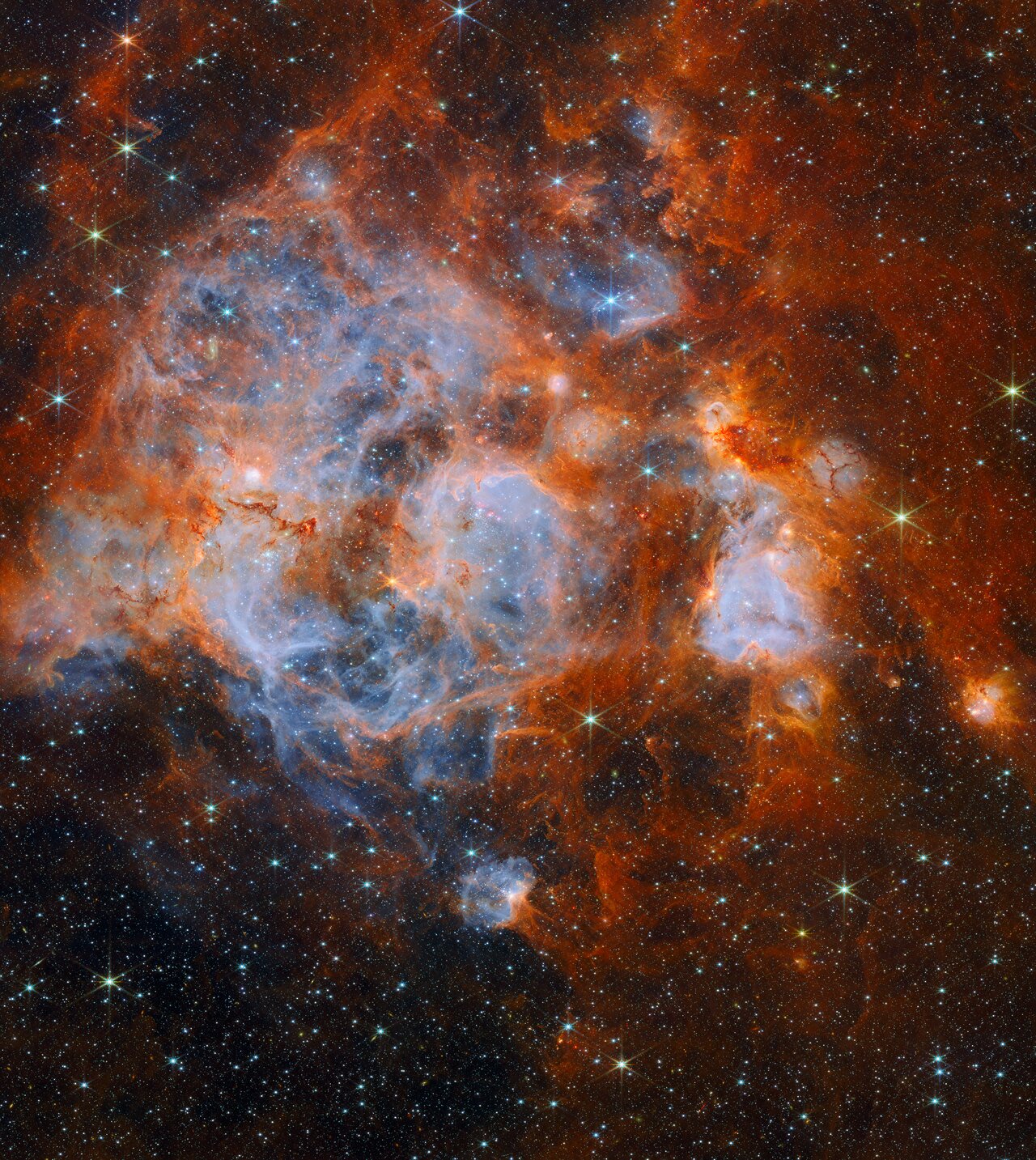
Webb's new view of N159, a star-forming region in the Large Magellanic Cloud, is one item here because two of the thin articles it replaces were the same October 22, 2026, ESA/Webb Picture of the Month image. N159 sits about 161,000 light-years away in the constellation Dorado and spans about 230 light-years. It is less than 3 million years old, one of the youngest star-forming regions in the Large Magellanic Cloud, and it holds thousands of stars at their earliest stages. The science behind the image, by Nolan Habel of NASA's Jet Propulsion Laboratory and Caltech with colleagues, was posted to arXiv on September 22, 2026. Using ten filters, the team measured more than 300,000 point sources across the cloud, including stars less than a tenth as massive as the Sun. The headline finding is a sequence: the eastern side holds older, more developed stars, while the western side is packed with newer ones still buried in dust, so star formation is sweeping across the cloud. The region's low metallicity is the other reason it matters: it is a stand-in for the conditions of the first stars. One caution: the Habel paper describes itself as initial results and is still a preprint.
NGC 7129 — YOUNG STARS AND THE JETS THEY FIRE
Webb's Near-Infrared Camera has pulled back the dust on another stellar nursery, NGC 7129, about 3,300 light-years away in the constellation Cepheus. NASA released the image on October 6, 2026. The frame is crowded: more than 130 stars less than a million years old, at different stages of growth, sit side by side in glowing gas, with jets and outflows from the youngest colliding with the material around them. At the centre sits LkH-alpha 234, a pre-main-sequence star of roughly 5 to 8 solar masses, the heaviest and most mature in the cluster. Its light and outflows have carved a cavity of glowing gas about 3.5 light-years across. Elsewhere are bow shocks where stellar winds pile into the gas, a ridge where ultraviolet light breaks molecules apart, and a protostar whose disc casts a shadow on the cloud behind it. The image combines six NIRCam filters from 1.15 to 4.7 micrometres, taken on December 17, 2025. Spitzer studied the region before, and Webb's sharper view shows far more structure. Young stars are hidden because they are born wrapped in the material that made them.
COSMIC GHOST — A HAUNTED SHAPE THAT IS REALLY A NURSERY
An eerie structure resembling a ghostly figure has been captured by NASA's Chandra X-ray Observatory and the James Webb Space Telescope, and the Chandra blog published it on October 28, 2026, just before Halloween. The phantom sits in the Carina Nebula, about 7,500 light-years away. The glowing ghost is an isolated cloud of gas and dust with a hooded head and a sweeping, cape-like tail, spanning about 4.3 arcminutes of sky, which works out to about 9.4 light-years across at that distance. Astronomers call such objects cometary globules, though they have nothing to do with comets. The shape is probably erosion: powerful radiation from massive stars outside the frame, including Eta Carinae, eats away the thin gas and leaves the dense parts standing. The X-rays, shown pink, pick out the young stars directly, because young stars glow in X-rays. Webb's infrared view sees through the dust to the stars still buried inside. The Chandra data are old: the telescope pointed at this field on August 28, 2008, and the data sat in public archives until this combination was made. The cloud looks like a ghost, but it is a nursery, and the young stars inside it are the story.
TREBLE CLEF — A RADIO PHOENIX SWITCHED BACK ON
A cloud of charged particles stretching over 2 million light-years, shaped like a treble clef, got its full portrait in NASA's Astronomy Picture of the Day for October 19, 2026. The object, catalogued as VLSS J0318.9+5755, was first examined in 2004, but its nature stayed unclear for more than two decades. The composite shows radio emission in red and newly detected X-rays in blue, with infrared in white. The X-rays come from Chandra and eROSITA, and the radio from LOFAR. The work, by Andrea Botteon and colleagues, was published in Astronomy and Astrophysics, and NASA's Chandra team released the result on October 14, 2026. The working idea is a radio phoenix: long ago, a supermassive black hole blew this cloud of particles out of its galaxy, the radio glow faded, and a shock wave from two colliding galaxy clusters switched it back on. The X-rays support the collision story: they were brightest to the left and right of the centre and faintest in the middle, suggesting the clusters collided along that direction. The explanation is a well-supported interpretation, not a closed case. APOD calls it a hypothesis, and the paper labels some elements as tentative. The next observations will test whether it holds.
CASSIOPEIA GHOSTS — THREE NEW PHANTOMS NOBODY CAN EXPLAIN YET
It took about 100 hours of observation and a special oxygen filter to pull three new phantoms out of the dark around gamma Cassiopeiae, and NASA's Astronomy Picture of the Day for October 21, 2026, shows them. IC 59 and IC 63, near the gamma Cassiopeiae system, are the original Ghosts of Cassiopeia, glowing red where the hot star's light ionizes their hydrogen. The three newly revealed structures, labelled Objects 1, 2, and 3, appear as blue phantoms, revealing ionized oxygen. The image is the work of Louis Leroux-Géré, Thibault Rouillée, Vincent Martin, and Cédric de Decker of Starfront Observatories. The filter passes only the light of doubly ionized oxygen, the same blue-green glow that colours planetary nebulae. Without it, the phantoms drown in starlight. What supplies the energy is still a mystery. Gamma Cassiopeiae may pile up material as it moves, like a boat pushing water, and Object 3 might be oxygen compressed and heated in such a bow shock. Object 1 could be a planetary nebula, but that needs a central white dwarf to be found. The three structures do not yet have settled identities, and no single obvious source accounts for all three. The discovery is real, and what the ghosts are is still open.
Source: (1) EBG-1 — Wu et al., Can Blue UV-Bright Galaxies Drive Reionization at Cosmic Dawn? An M_UV = −19.6 Galaxy with f_esc ≈ 0.85 at z = 9.244, arXiv:2610.24092, submitted October 16, 2026, submitted to The Astrophysical Journal Letters — https://arxiv.org/abs/2610.24092
Source: (2) J1440+0019 — Yang et al., A dust-reddened quasar in a [C II]-luminous host at z = 6.55, arXiv:2610.13758, posted October 9, 2026 — https://arxiv.org/abs/2610.13758
Source: (3) Supernovae — Camilleri et al., Supernovae Unite: Combining Pantheon+ and DES-SN5YR, arXiv:2609.05053, September 8, 2026 — https://arxiv.org/abs/2609.05053 ; companion paper Lee et al., Supernovae Unite: Host-Galaxy Mass Measurements of Type Ia Supernovae and Their Impact on Cosmology, arXiv:2609.05321 — https://arxiv.org/abs/2609.05321 ; University of Queensland news release, September 8, 2026 — https://news.uq.edu.au/2026-09-big-supernova-dataset-challenges-dark-energy-theory
Source: (4) GRB 260310A — Yang et al., An Extremely Bright Slow-rising Afterglow from an Off-axis Jet in GRB 260310A, The Astrophysical Journal Letters, published October 28, 2026, DOI 10.3847/2041-8213/aea990 — https://doi.org/10.3847/2041-8213/aea990
Source: (5) N159 — Habel et al., Sequential Star-Formation and the Near-Infrared Stellar Populations within N159, arXiv:2609.27126, posted September 22, 2026 — https://arxiv.org/abs/2609.27126 ; ESA/Webb Picture of the Month, October 22, 2026, "Stars brewing in a nebulous cauldron" — https://esawebb.org/images/potm2610b/
Source: (6) NGC 7129 — NASA/ESA/Webb release weic2620, Webb Captures Commotion From Nebula's Stellar Jets, October 6, 2026 — https://esawebb.org/news/weic2620/ ; NASA image page: NGC 7129 (NIRCam Image) — https://science.nasa.gov/asset/webb/ngc-7129-nircam-image/
Source: (7) Cosmic ghost — Chandra X-ray Center blog, Helpful Cosmic Ghost Brings Stellar Birth, Not Death, October 28, 2026 — http://chandra.harvard.edu/blog/index.php/node/977
Source: (8) Treble Clef — NASA Astronomy Picture of the Day, October 19, 2026, Treble Clef: Unusual X-ray Hot Radio Source — https://science.nasa.gov/image-article/apod-2026-october-19-treble-clef-unusual-x-ray-hot-radio-source/ ; Botteon et al., The Treble Clef radio phoenix and its old nonthermal filaments, arXiv:2607.06659 — https://arxiv.org/abs/2607.06659 (NASA Chandra release, October 14, 2026)
Source: (9) Cassiopeia ghosts — NASA Astronomy Picture of the Day, October 21, 2026, New Ghosts Revealed in Cassiopeia — https://science.nasa.gov/image-article/apod-2026-october-21-new-ghosts-revealed-in-cassiopeia/
Image credit: (1) EBG-1 — Data figure: Yunjing Wu et al., arXiv:2610.24092 (2026). NO photograph — the paper's figure is a scientific data figure, not an agency image. NO COVER for this item.
Image credit: (2) J1440+0019 — Data figure: Daming Yang et al., arXiv:2610.13758 (2026) — ALMA [C II] integrated intensity map and 249.3 GHz continuum map. Scientific data figure, not a photograph. NO COVER for this item.
Image credit: (3) Supernovae — NO verified agency image with credit found. NO COVER for this item.
Image credit: (4) GRB 260310A — Artist's impression: Fortuna/Yang/ERC BHianca, CC BY 4.0. VERIFIED artist's impression, labelled as such.
Image credit: (5) N159 — ESA/Webb, NASA & CSA, E. Sabbi, M. Zamani (ESA/Webb); Acknowledgement: M. H. Özsaraç. VERIFIED image.
Image credit: (6) NGC 7129 — NASA, ESA, CSA, STScI; Image Processing: Alyssa Pagan (STScI). VERIFIED image.
Image credit: (7) Cosmic ghost — X-ray: NASA/CXC/SAO; Optical: CTIO/NOIRLab/NSF/AURA/N. Smith (University of Minnesota); Infrared: NASA/ESA/CSA/STScI; Image Processing: NASA/CXC/SAO/L. Frattare. VERIFIED image.
Image credit: (8) Treble Clef — X-ray: NASA/CXC/INAF-IRA/A. Botteon et al.; Infrared: UKIDSS-GPS; Radio: ASTRON/LOFAR; Image processing: NASA/CXC/SAO/N. Wolk. VERIFIED image.
Image credit: (9) Cassiopeia ghosts — Image Credit & Copyright: Louis Leroux-Géré, Thibault Rouillée, Vincent Martin, Cédric de Decker (Starfront Observatories), via NASA APOD. VERIFIED image.
Cover: N159, Webb NIRCam view — "Stars brewing in a nebulous cauldron", ESA/Webb Picture of the Month, October 22, 2026. Credit: ESA/Webb, NASA & CSA, E. Sabbi, M. Zamani (ESA/Webb); Acknowledgement: M. H. Özsaraç. Image page: https://esawebb.org/images/potm2610b/
As an Amazon Associate I earn from qualifying purchases. If you buy through an active affiliate link, StarPixels may earn a commission at no additional cost to you.