
Eight stories from the week of October 20–31, 2026: Venus grew glowing horns as it passed between Earth and the Sun, thirteen spooky deep-sky targets stood above the horizon at midnight on Halloween, a spiral galaxy and its "fleas" rode high in Pegasus, Halley's dust put on its October show, Andromeda hugged the horizon in the southern spring, the Hunter's Moon lit up the last full weekend of October, the Orion Nebula glowed in a deep new portrait, and a SpaceX rocket painted a jellyfish across the dawn sky over Florida.
VENUS HORNS — A CRESCENT THAT WRAPS PAST HALF
Venus does something the Moon cannot do. Like the Moon, Venus has phases, and as it neared inferior conjunction on October 24, 2026, it shrank to a thin crescent seen almost directly between the Sun and the Earth. But the new Moon is dark, and Venus is not. Its thick, carbon-dioxide atmosphere bends and scatters the sunlight, and the glowing arc stretches beyond 180 degrees, past the midpoint of the disk. The tips of that arc are called the horns. NASA's Astronomy Picture of the Day for October 29, 2026, shows them in a photograph by Thierry Legault, credited to Legault alone. Venus reaches this alignment about once every year and a half. The crescent can be picked up with a small telescope or binoculars in twilight, and people with very sharp eyesight can sometimes catch it unaided. The phases of Venus changed history: Galileo watched them in 1610, and they were some of the first evidence that the planets circle the Sun. Mikhail Lomonosov went further during the transit of 1761, when the planet's atmosphere showed itself in a faint ring of light. One warning carries over from every guide to this sight: Venus sits very close to the Sun in this position, so never point binoculars or a telescope anywhere near the Sun.
SPOOKY TARGETS — THIRTEEN GHOSTS AT MIDNIGHT ON HALLOWEEN
The Northern Berkshire Astronomical Society's guide of October 12, 2026, lists thirteen deep-sky objects with spooky nicknames, and all thirteen stood above the horizon at midnight on Halloween, October 31, 2026, for observers at mid-northern latitudes. The original article promised thirteen and named five, so here they are in full, in the order the guide gives them. NGC 6781, the Ghost of the Moon; NGC 6939, the Ghost Bush Cluster; NGC 6960, the Witch's Broom; NGC 6995 and IC 1340, the Bat Nebula; Sh2-136, the Ghost of Cepheus; NGC 7380, the Wizard Nebula; NGC 7790, the Widow's Web Cluster; NGC 246, the Skull Nebula; IC 63, the Ghost of Cassiopeia; NGC 404, Mirach's Ghost; NGC 457, the Owl Cluster, also called the E.T. Cluster; IC 2118, the Witch's Head Nebula; and M 78, Casper the Ghost Nebula. The sweep runs from Aquila to Orion, an evening's observing in one list. Three of them are genuinely reachable with modest gear, the guide notes: NGC 457 is bright and easy, a fine binocular cluster on its own, and NGC 6939 and NGC 7790 also show well. The rest are fainter, and several of the nicknames only emerge in long exposures rather than at the eyepiece.
NGC 7331 — A SPIRAL GALAXY AND ITS FLEAS, HIGH IN PEGASUS
Astronomy magazine's Sky Today entry for Tuesday, October 20, 2026, calls NGC 7331 the biggest galaxy in the Deer Lick Group, and that week it stood highest around 10 P.M. local daylight time, more than 80 degrees above the southwestern horizon. It glows at 10th magnitude, just 4.4 degrees north of the 3rd-magnitude star Matar, Eta Pegasi, in northern Pegasus. The galaxy stretches about 11 arcminutes long and 4 wide, a nearly edge-on spiral with a large, bright nucleus and no bar, wrapped in delicate spiral arms. Larger scopes show fine detail in those arms. NGC 7331, also catalogued as Caldwell 30, lies about 40 million light-years away and spans roughly 100,000 light-years, a Milky Way-sized spiral. It is not alone in the eyepiece. A telescope of 11 inches or more can show at least three of the group's other members, nicknamed the "fleas" because they look much smaller than NGC 7331: NGC 7335 at magnitude 13.4, about 310 million light-years away, NGC 7340 at magnitude 14.9, NGC 7336 at magnitude 15.0, and NGC 7337 at magnitude 15.2. The fleas are not companions at all, but background galaxies hundreds of millions of light-years farther out. The group takes its name from Deer Lick Gap in North Carolina, where amateur astronomer Tomm Lorenzin named it after a good night's observing. The galaxy also hosted the strange supernova SN 2014C.
ORIONIDS — HALLEY'S DUST, UNDER A BRIGHT MOON
The Orionid meteor shower peaked on the night of October 21–22, 2026, and the numbers were honest rather than spectacular. The shower was active from October 2 to November 7, 2026, with a zenithal hourly rate of about 20 — the count one observer would make under a perfectly dark sky with the radiant overhead. NASA's field estimate is 10 to 20 meteors an hour under dark skies, and the original article's 15 to 18 sits inside that range. The catch in 2026 was the Moon: a waxing gibbous, 74 to 83 percent lit on the peak night, hung in the sky for most of the night, so the best window ran after moonset, around 3 a.m. to first light, when the radiant in Orion stood high. Orionid meteors are fast, about 66 kilometres per second, and they streak away from a radiant near the upraised club of Orion. The advice from the guides holds for any year: look 40 to 60 degrees away from the radiant, wherever the sky is darkest, and let your eyes adapt. The origin story is the best of any annual shower. The meteors are dust shed by comet 1P/Halley, which rounds the Sun about every 76 years, last visited in 1986, and does not return until 2061. For the next 35 years, the Orionids are the closest anyone gets to seeing Halley material burn overhead. Next year, the Moon will be kinder.
ANDROMEDA — LOW IN THE SOUTHERN SPRING SKY
From Mullion, New South Wales, Australia, the Andromeda Galaxy never climbs more than a few degrees above the horizon, but during the southern spring it is highest around midnight. NASA's Astronomy Picture of the Day for October 23, 2026, shows it there, in a telephoto scene photographed by Lucy Yunxi Hu on the nights of October 10 and 11, 2026. Multiple tracked and stacked exposures reveal the spiral in detail as it climbed above rolling Australian hills, combined with a foreground shot into one deep composite. Andromeda, also known as M31, is one of the brightest objects in the Messier catalogue, but to the unaided eye it is only a small, faint, fuzzy patch. The photographs tell a different story: the closest large spiral galaxy spans nearly six full moons across the sky in this image. Andromeda sits about 2.5 million light-years away and measures roughly 220,000 light-years across, larger than our own Milky Way. It is the nearest large spiral to us, and the picture catches it at its southern-spring best, low in the north from Australia, where most northern observers would never think to look for it. The full credit is Lucy Yunxi Hu, via NASA APOD, and the date of the picture is October 23, 2026.
HUNTER'S MOON — FULL ON MONDAY, OCTOBER 26
October's full Moon, the Hunter's Moon, peaked at 12:12 a.m. Eastern Daylight Time on Monday, October 26, 2026, which was 11:12 p.m. Central on Sunday, October 25. The best viewing nights were Sunday, October 25, when the Moon rose near sunset already nearly full, and Monday, October 26, when it rose again about an hour after sunset, slightly past peak but still visibly round. The name is about sequence, not the month: the Hunter's Moon is the first full Moon after the Harvest Moon, the full Moon closest to the autumn equinox. In 2026 the Harvest Moon fell on September 26, so the next one, October 26, took the Hunter's name. Astronomy magazine's Sky This Week for October 23–30, 2026, carries the same date. On the evening of Tuesday, October 27, the Moon passed in front of the Pleiades. By Saturday, October 31, the Moon was a waning gibbous about two-thirds lit, rising several hours after sunset — bright enough to wash out faint deep-sky targets, but a spectacle of its own low in the east. The Hunter's Moon is not a supermoon and it is not red; the old name comes from the season when hunters worked the fields after harvest, under a Moon bright enough to see by. The next full Moon after it, the Beaver Moon, arrives November 24, 2026.
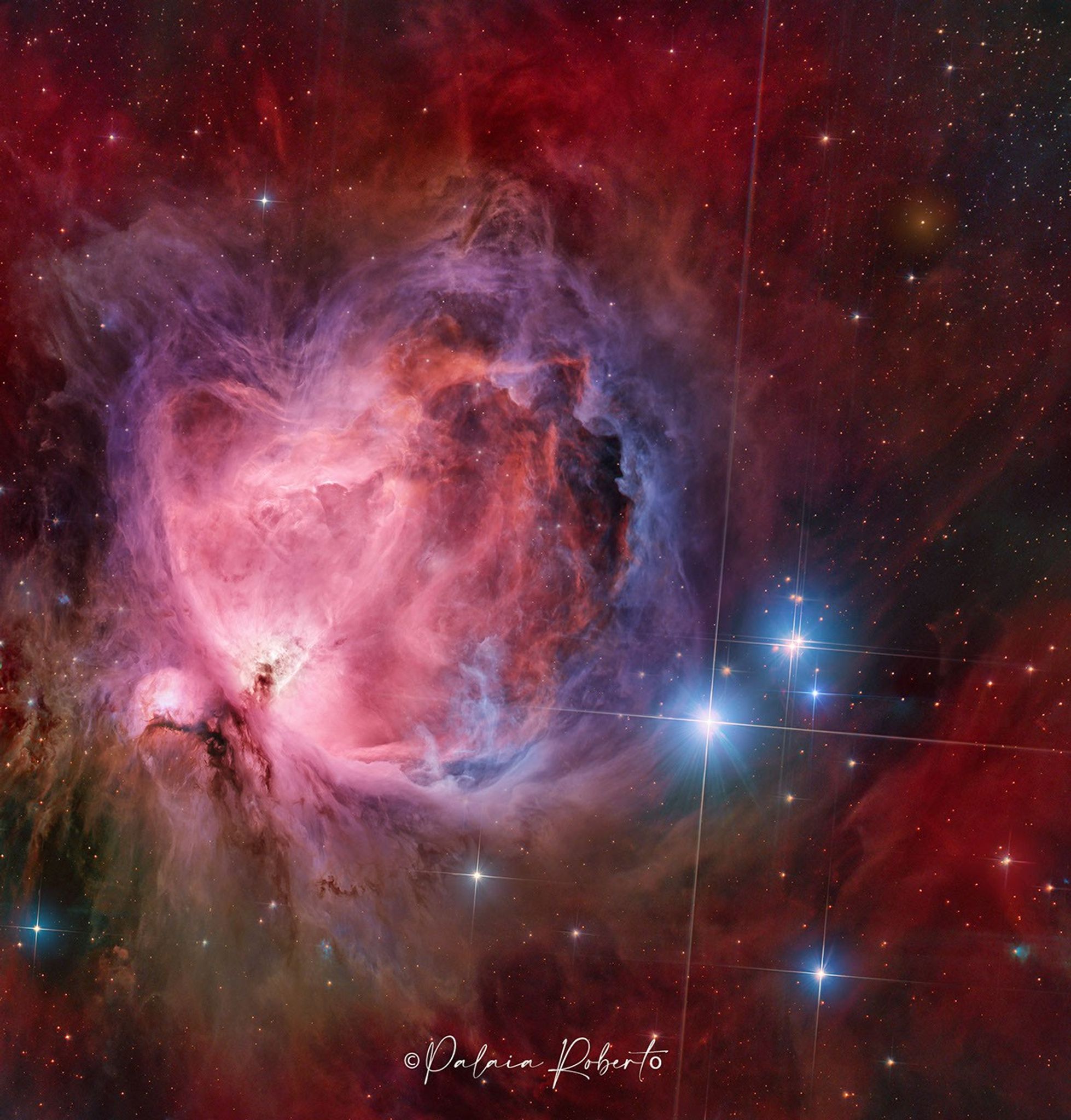
M42 — THE GREAT NEBULA IN ORION, IN A DEEP NEW PORTRAIT
NASA's Astronomy Picture of the Day for October 26, 2026, shows the Great Nebula in Orion in a deep image by Roberto Palaia, credited to Palaia alone — the full name the original article's "NASA Science / Palaia" credit was missing. M42 is one of the most famous of all astronomical nebulas, an immense, nearby starbirth region about 1,500 light-years away, spanning about 40 light-years. Glowing gas surrounds hot young stars at the edge of an immense interstellar molecular cloud, and in this image, rendered in assigned colours that highlight hydrogen emission, wisps and sheets of dust and gas stand out in detail. The nebula sits just below and to the left of Orion's belt of three stars, in the middle of the Hunter's sword, and it can be found with the unaided eye as a small fuzzy patch. A telescope shows more: the Trapezium, a tight knot of four young, hot stars at the nebula's heart, whose light sculpts the gas around them, and the proplyds, disks of gas and dust around newborn stars, first recognised in M42. The Orion Nebula is the nearest region of massive star formation to Earth, and the whole cloud complex will slowly disperse over the next 100,000 years. For observers in the northern hemisphere, late October is when Orion climbs into good evening position, and M42 is the first deep-sky target most beginners learn to find.
SPACEX JELLYFISH — A ROCKET PAINTS THE DAWN OVER FLORIDA
On Tuesday, October 20, 2026, at 7:04 a.m. Eastern Time, a SpaceX Falcon 9 lifted off from Space Launch Complex 40 at Cape Canaveral Space Force Station on the Bandwagon-5 rideshare mission, and it painted a jellyfish across the brightening pre-sunrise sky. The effect is geometry, not weather. Minutes after liftoff, the rocket climbs into thinning air where its exhaust plume expands and catches sunlight from below the horizon, while the ground is still in darkness. The plume blooms into a bright bell with trailing tendrils, and it only happens in a narrow window, within roughly an hour of sunrise or sunset. This one was smaller than the jellyfish from the NASA CRS-35 resupply launch a week earlier, on October 13 at 6:35 a.m., because the Bandwagon-5 liftoff, delayed about 34 minutes, came closer to sunrise under a brighter sky. The mission underneath the sky show carried 32 payloads, small satellites sharing one Falcon 9, including cubesats, microsats, and reentry vehicles, among them a SpaceX Starfall reentry capsule. The first-stage booster, B1085, was flying for the 19th time and touched down on the droneship A Shortfall of Gravitas just short of nine minutes after liftoff. The launch was the 60th orbital launch of 2026 from Cape Canaveral and Kennedy Space Center combined, and it had slipped a day, from Monday, October 19, because of poor local weather and high winds and waves. The jellyfish photograph that carries the story was taken from Titusville, Florida, by Ken Kremer for SpaceUpClose.
Source: (1) Venus horns — NASA Astronomy Picture of the Day, October 29, 2026, The Horns of Venus — https://science.nasa.gov/image-article/apod-29-october-2026-the-horns-of-venus/ ; inferior conjunction time per National Astronomical Observatory of Japan ephemeris — http://eco2.mtk.nao.ac.jp/cgi-bin/koyomi/cande/phenomena_fy_en.cgi
Source: (2) Spooky targets — Northern Berkshire Astronomical Society, Spooky Astronomy: Objects for Halloween, October 12, 2026 — https://nbasastro.org/articles/2026/10/spooky-astronomy-objects-for-halloween/
Source: (3) NGC 7331 — Astronomy magazine, The Sky Today, Tuesday, October 20: Lovely spiral NGC 7331, Alison Klesman, October 20, 2026 — https://www.astronomy.com/observing/the-sky-today-tuesday-october-20-2026/ ; flea magnitudes per Astronomy magazine, The Sky Today, Friday, September 11: Visit the Deer Lick Group — https://www.astronomy.com/wp-json/wp/v2/posts/176190
Source: (4) Orionids — American Meteor Society, 2026/2027 Meteor Shower Calendar — https://www.amsmeteors.org/calendar/ ; NASA, Orionid Meteor Shower (rate 10–20 per hour under dark skies, parent comet 1P/Halley)
Source: (5) Andromeda — NASA Astronomy Picture of the Day, October 23, 2026, Andromeda in Southern Spring — https://science.nasa.gov/image-article/apod-2026-october-23-andromeda-in-southern-spring/
Source: (6) Hunter's Moon — Astronomy magazine, The Sky This Week, October 23–30: Gaze at the Full Hunter's Moon, October 2026 — https://www.astronomy.com/the-sky-this-week/the-sky-this-week-from-october-23-to-30-2026/ ; peak time 12:12 a.m. EDT October 26, 2026 (04:12 UTC) per StarWalk full Moon calendar — https://starwalk.space/en/news/full-moon-october
Source: (7) M42 — NASA Astronomy Picture of the Day, October 26, 2026, M42: The Great Nebula in Orion — https://science.nasa.gov/image-article/apod/2026-october-26-m42-the-great-nebula-in-orion/
Source: (8) SpaceX jellyfish — Ken Kremer, SpaceUpClose, Smaller Space Jellyfish Forms after Sunrise Launch, SpaceX Falcon 9 on Bandwagon-5, October 20, 2026 — https://www.spaceupclose.com/2026/10/smaller-space-jellyfish-forms-after-sunrise-launch-spacex-falcon-9-on-bandwagon-5-rideshare-mission-with-32-payloads-including-starfall-photos/ ; Florida Today, See photo gallery of SpaceX 'jellyfish' launch from Cape Canaveral, October 20, 2026 — https://www.floridatoday.com/story/tech/science/space/2026/10/20/space-jellyfish-spacex-florida-launch-canaveral-nasa-kennedy/92342411007/
Image credit: (1) Venus horns — Credit & Copyright: Thierry Legault, via NASA APOD October 29, 2026. VERIFIED image.
Image credit: (2) Spooky targets — NO verified image with credit found. The NBAS guide is a table, not a photo. NO COVER for this item.
Image credit: (3) NGC 7331 — NO verified image with credit found. NO COVER for this item.
Image credit: (4) Orionids — NO verified image with credit found. NO COVER for this item.
Image credit: (5) Andromeda — Credit & Copyright: Lucy Yunxi Hu, via NASA APOD October 23, 2026. VERIFIED image.
Image credit: (6) Hunter's Moon — NO verified image with credit found. NO COVER for this item.
Image credit: (7) M42 — Credit & Copyright: Roberto Palaia, via NASA APOD October 26, 2026. VERIFIED image.
Image credit: (8) SpaceX jellyfish — Space Jellyfish forms after launch of SpaceX Falcon 9 rocket on Bandwagon-5, October 20, 2026, 7:04 a.m. ET, from Titusville, FL. Credit: Ken Kremer/SpaceUpClose.com. VERIFIED photo.
Cover: M42, the Great Nebula in Orion — Credit & Copyright: Roberto Palaia, via NASA APOD October 26, 2026 (verified image; the strongest visual in the set). Alternates: Venus horns (Thierry Legault, APOD October 29, 2026) or Andromeda (Lucy Yunxi Hu, APOD October 23, 2026).
As an Amazon Associate I earn from qualifying purchases. If you buy through an active affiliate link, StarPixels may earn a commission at no additional cost to you.