
Nine stories from October 30, 2026: a planet that sets off its own star, a moon candidate circling a failed star, the first green star, a nova's 650-light-year hole, two rings around a dead star, the engine behind Kepler's wildest flares, metal-rich gas at the heart of the galaxy, hidden rings in the tiniest planet-forming disks, and a giant planet's first steps inside a cosmic hamburger.
HIP 67522 B — A PLANET THAT SETS OFF ITS OWN STAR
Star-planet interaction usually runs one way: the star blasts the planet. HIP 67522 b runs it in reverse. The planet's magnetic field reaches out and couples into the magnetic field of its young host star, and the connection triggers radiation bursts on the star, on the side facing the planet. It is the first such case ever seen. The work, led by Ekaterina Ilin of the Max Planck Institute for Solar System Research, appeared in Nature in 2025. HIP 67522 is a 17-million-year-old G dwarf about 415 light-years away in Centaurus, and its planet is a young gas giant on a seven-day orbit inside the star's magnetic field. Five years of TESS and CHEOPS photometry tracked 15 flares, clustering near the planet's transit rather than firing at random. Disturbances travel along the link and set off flares where it meets the star's surface. The planet inflicts on itself a flare rate six times higher than it would suffer without the connection, and the radiation may explain the extended atmosphere Webb later saw.
EXOMOON — A MOON CANDIDATE AROUND A FAILED STAR
No moon beyond our Solar System has ever been confirmed. The strongest candidate yet circles not a planet but a brown dwarf, a failed star too heavy to be a planet and too light to burn hydrogen, which in turn orbits a small red star. The system is CD-35 2722, about 73 light-years away in Columba. The team, led by Kevin Hoy, a doctoral student at the European Southern Observatory in Chile, reports the find in Nature on July 22, 2026. The host star has about half the Sun's mass, and its brown dwarf companion, CD-35 2722 B, weighs about 37 times as much as Jupiter. The candidate has a minimum mass of about 0.9 Jupiter masses and circles the brown dwarf once every 170 days. The detection is a wobble: the CRIRES+ spectrograph on ESO's Very Large Telescope measured tiny shifts in the brown dwarf's spectrum between October 2023 and February 2026. Candidate is the honest word. It has not been imaged or caught passing in front of the brown dwarf, and the wobble gives only a minimum mass, since the true mass depends on the orbit's tilt. The authors call it an exosatellite, and note no accepted definition of an exomoon exists yet.
GREEN STAR — THE FIRST STAR THAT WOULD LOOK GREEN
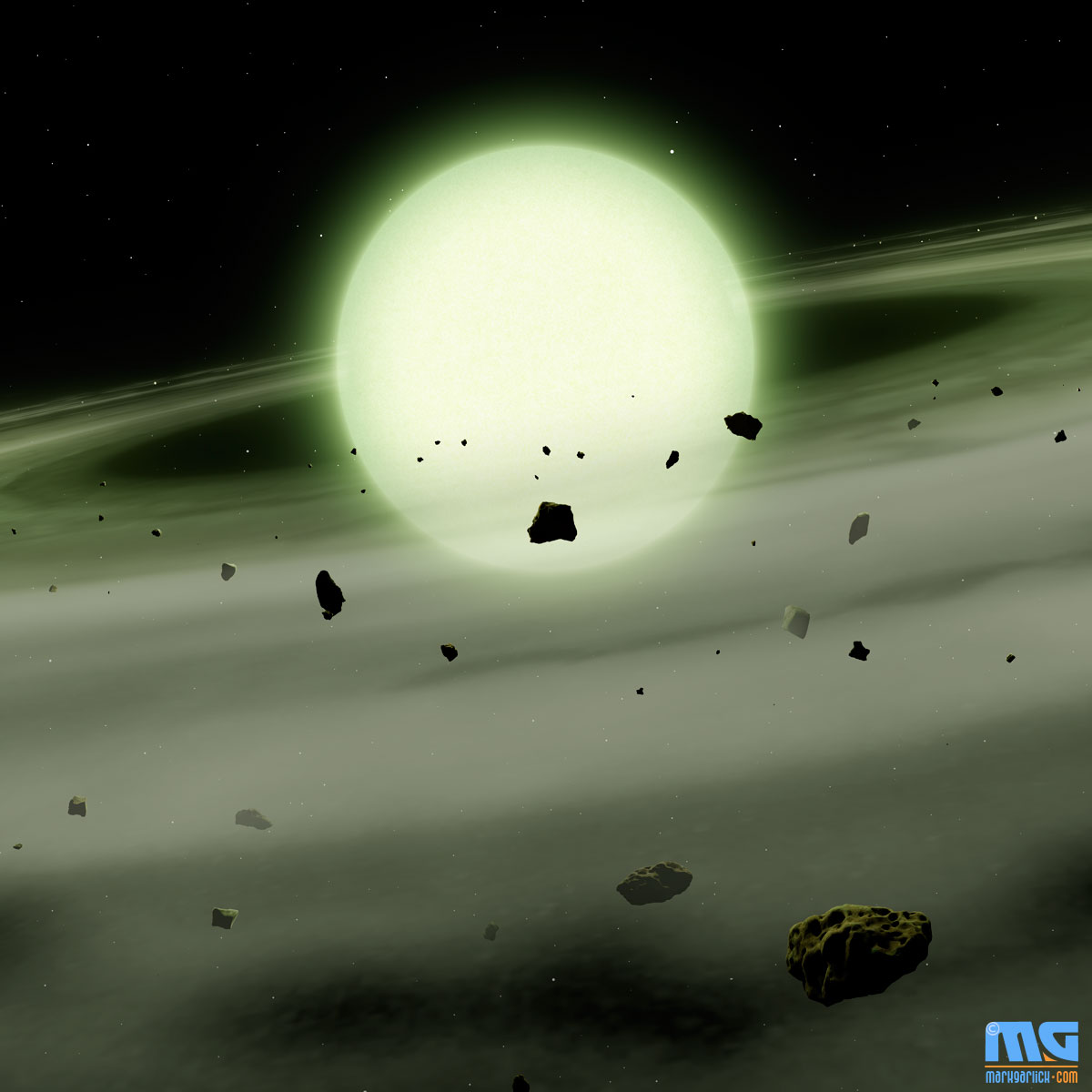
Astronomers had never credibly reported a green star. A white dwarf called WD J1330+6435 is the first. Nobody has seen it glow green: the colour comes from its spectrum, run through a model of human colour vision by a team at the University of Warwick led by Mark Hollands. The work appeared in RAS Techniques and Instruments, and NASA featured it as the Astronomy Picture of the Day on October 22, 2026. WD J1330+6435 is an Earth-sized stellar ember about 325 light-years away, with a surface near 4,000 degrees Celsius. Like almost 2,000 known polluted white dwarfs, it carries the chemical fingerprints of its own planetary system: fallen rocky material enriched its atmosphere with calcium, lithium and sodium. In this star the sodium absorbs the orange part of the spectrum, leaving a chartreuse green. "The traces of sodium in the atmosphere of this white dwarf absorb the orange part of the spectrum, leaving behind a ghostly green glow," Hollands said. The star is far too faint to see by eye, and its spectrum is noisy, so its exact shade could differ from the model. The team also found two paler greenish white dwarfs, including WD J0851+1543. One correction: the designation is WD J1330+6435, with a plus sign, not a minus.
T PYXIS — A RECURRENT NOVA'S 650-LIGHT-YEAR HOLE
T Pyxidis cannot stop exploding. It steals gas from a companion star, and roughly every two decades the stolen gas ignites: eruptions in 1890, 1902, 1920, 1944, 1967 and 2011, after a classical nova around 1866 started the cycle. Now astronomers have found what those eruptions left behind. Digging through infrared maps from the 1980s IRAS mission, Michael Healy-Kalesh and Matthew Darnley found a peanut-shaped cavity around the star, a double bubble about 650 light-years long, reported in Research Notes of the American Astronomical Society in 2026. The cavity is a nova super-remnant: thousands of eruptions over millennia swept thin gas aside and piled it at the edges, digging a hole tens of parsecs across. T Pyx sits about 3.6 kiloparsecs away, and its white dwarf weighs about 1.33 solar masses with a companion orbiting every 1.83 hours. A similar cavity was first found in 2019 around a recurrent nova in Andromeda, 300 by 450 light-years across. One caution: the cavity is a candidate super-remnant, framed as evidence, not proof. The star may now be entering about 13,000 years of quiet.
DEBRIS RINGS — TWO RINGS AROUND A DEAD STAR
Every white dwarf gas disc known until now showed two peaks in its spectral lines, the mark of a single rotating ring. WD J1328-1450 shows four. The quadruple-peaked lines mean two separate rings of glowing gas, and the find is the first of its kind. The paper, led by Nicola Pietro Gentile Fusillo of the University of Trieste and INAF, appeared in Nature Astronomy in 2026, studying a white dwarf about 1,600 light-years away. X-shooter spectra from ESO's Very Large Telescope show an inner ring from 0.14 to 0.34 solar radii, about 100,000 to 240,000 kilometres out, and an outer ring from 0.54 to 1.93 solar radii, about 375,000 kilometres to more than 1.3 million. The structure stayed stable for more than two years, from May 2021 to May 2023. The gas is calcium, oxygen, magnesium and iron, the mix of rocky material, but only the inner ring shows magnesium. The team proposes two surviving planetary bodies, each inside its own ring, keep the structure intact, from a few kilometres across to the size of Pluto. One caution: neither body has been seen directly, the sizes are upper limits, and a single disc shadowing itself cannot be fully ruled out. The rings foreshadow what may happen here after the Sun dies.
KEPLER FLARES — THE ENGINE BEHIND THE WILDEST FLARES
KIC 2852961 breaks that expectation completely. The red giant, about 12 times the Sun's radius, is the Kepler field's most explosively active star, and its record superflares dwarf even the strongest solar flares. A new study led by Zsolt Kovari of the Konkoly Observatory, posted to arXiv on October 8, 2026, explains the engine. A faint dwarf companion orbits close by, raising tides on the giant the way the Moon raises tides on Earth. The tides nearly synchronized the giant's spin but did not finish the job, and that leftover difference matters. The giant's equator still spins faster than its poles, and the shear winds up the magnetic field, driving a dynamo deep inside the star. "Differential rotation plays a dual role," Kovari said. "On one hand, it helps generate and sustain huge starspots on the surface. On the other, it twists and shears the coronal magnetic field lines above those spots, and when these tangled, highly stressed magnetic field lines reconnect, the result is a superflare." The companion's role is indirect: the flares show no pattern tied to orbital phase. The team catalogued 59 flares in an earlier 2020 study. One caution: the new paper is a preprint, and its findings should be read as preliminary until peer review completes.
SGR A* — METAL-RICH GAS AT THE GALAXY'S CENTRE
The gas circling Sagittarius A*, the supermassive black hole at the heart of the Milky Way, is rich in metals, probably supplied by stars that exploded over time. The work, led by Nicole M. Ford, a PhD student at McGill University's Trottier Space Institute, appeared in The Astronomical Journal on October 19, 2026. The team used Webb's MIRI spectrograph to map the central 0.1 parsec, separating the heat signatures of individual gas clouds in the Galactic Center Minispiral, a structure of warm ionized gas and dust. The gas measures about 1.8 times the Sun's metal abundance, and its composition resembles the stars orbiting the black hole, suggesting gas and stars may have formed together. Wolf-Rayet stars light the gas, and the team also found compact, fast-moving clumps, one of them, X7, racing at more than 600 kilometres per second within 0.05 parsec of the black hole. Sgr A* weighs about four million Suns and is the nearest quiescent supermassive black hole. One caution, from a companion study led by Mayura Balakrishnan: the gas is shaped by local conditions, so it cannot reliably record the black hole's past outbursts.
TINY DISKS — HIDDEN RINGS IN THE SMALLEST DISKS
The smallest planet-forming disks looked smooth. They were not missing their rings and gaps. They were too small to see. Using ALMA at its longest baselines, a team led by Pietro Curone of CATA and the University of Chile observed 11 compact disks in Lupus at 0.9 millimetres, reaching 0.02 arcseconds, about two astronomical units. The paper appeared in The Astrophysical Journal Letters on October 14, 2026. Four of the 11 disks show clear rings, gaps or cavities within 10 astronomical units of their stars, and three more show hints. The neatest find is Sz 112, an M5 star of 0.14 solar masses: a central cavity out to 1.6 astronomical units, with a ring peaking at 2.6, a gap a planet of 1.6 Earth masses could have opened. Van der Marel's team had predicted that cavity in 2016, yet a 2022 ALMA image at about 5 astronomical units resolution missed it. Where observations can resolve them, structures appear in about 44 percent of disks 3 to 10 astronomical units across, 55 percent of those 10 to 30, and over 90 percent above 30. One caution: rings and gaps are not direct planet detections, and Sz 112's cavity has rivals, including the star's own radiation and a close brown dwarf.
GOHAM — A GIANT PLANET'S FIRST STEPS IN A COSMIC HAMBURGER
Gomez's Hamburger, catalogued as IRAS 18059-3211 and nicknamed GoHam, is a young star wrapped in a disk seen almost exactly edge-on from Earth, and ALMA has now caught what looks like the earliest phase of giant planet formation inside it. The paper, led by Charles J. Law of the University of Minnesota, appeared in The Astrophysical Journal on October 19, 2026, after a press conference at the American Astronomical Society's 247th meeting. The disk is enormous: its carbon monoxide gas stretches to almost 1,000 astronomical units in radius and several hundred in height, one of the largest known planet-forming disks. The edge-on view lets astronomers map gas and dust at their own heights, like layers in a sandwich. The key find is a narrow, one-sided arc of sulfur monoxide emission just outside the bright dust, on one side only, peaking near a dense clump found earlier and named GoHam b. Sulfur molecules build up where gas is shock-heated or ice turns to vapour, so the arc reads as heating around an early-stage giant protoplanet or a disk fragment. The team puts the star at 2.2 suns and the distance at 139 parsecs, at the edge of the Scorpius-Centaurus association. One caution: the arc does not prove a planet. It proves a hot spot in the right place, with the right motion. More observations will say whether the clump is collapsing or just passing through.
Source: (1) HIP 67522 b — Ilin et al., Close-in planet induces flares on its host star, Nature 643, 645-648 (2025), DOI 10.1038/s41586-025-09236-z — https://doi.org/10.1038/s41586-025-09236-z ; arXiv:2507.00791 — https://arxiv.org/abs/2507.00791
Source: (2) Exomoon — Hoy et al., Planetary-Mass Exosatellite Detected Around a Star's Substellar Companion, Nature, July 22, 2026, DOI 10.1038/s41586-026-10751-w — https://doi.org/10.1038/s41586-026-10751-w ; ESO press release eso2610, July 22, 2026 — https://www.eso.org/public/news/eso2610/
Source: (3) Green star — Hollands et al., Any colour you like: The diverse chromaticities of white dwarfs, RAS Techniques and Instruments, vol. 5, rzag069 ; University of Warwick press release, October 15, 2026 ; NASA Astronomy Picture of the Day, October 22, 2026, The First Green Star, WD J1330+6435 — https://science.nasa.gov/image-article/apod-2026-october-22-the-first-green-star-wd-j13306435/
Source: (4) T Pyxis — Healy-Kalesh & Darnley, Infrared Cavity Surrounding T Pyxidis: Evidence of a Nova Superremnant?, Research Notes of the AAS 10, 277 (2026) — https://researchonline.ljmu.ac.uk/id/eprint/29635/contents
Source: (5) Debris rings — Gentile Fusillo et al., A double debris disc around a white dwarf sculpted by two planetary bodies, Nature Astronomy (2026), DOI 10.1038/s41550-026-03004-3 — https://doi.org/10.1038/s41550-026-03004-3 ; University of Warwick press release, October 27, 2026
Source: (6) Kepler flares — Kovari et al., What powers the most energetic flares in the Kepler field? Revisiting the superflaring star KIC 2852961, arXiv:2610.11799 (posted October 8, 2026) — https://doi.org/10.48550/arxiv.2610.11799
Source: (7) Sgr A* — Ford et al., Ionization Structure and Metal Enrichment of the Galactic Center Minispiral Observed with JWST, The Astronomical Journal 172, 267 (2026), DOI 10.3847/1538-3881/ae994d — https://doi.org/10.3847/1538-3881/ae994d ; arXiv:2605.13995 — https://arxiv.org/abs/2605.13995 ; McGill University release, October 19, 2026 (via EurekAlert)
Source: (8) Tiny disks — Curone et al., Probing Planet Formation within 10 au: Dust Substructures in Extremely Compact Protoplanetary Disks, The Astrophysical Journal Letters, October 14, 2026 ; CATA / ALMA release, October 15, 2026 — https://cata.cl/en/structures-potentially-associated-with-the-formation-of-super-earths-and-mini-neptunes-have-been-detected-in-compact-disks/
Source: (9) GoHam — Law et al., The ALMA View of the Edge-on Gomez's Hamburger System, The Astrophysical Journal, October 19, 2026, arXiv:2609.09290 — https://arxiv.org/abs/2609.09290 ; ALMA release via Newswise, October 20, 2026 — https://www.newswise.com/articles/cosmic-hamburger-has-the-secret-ingredients-for-giant-planet-formation-that-is/? sc=c138
Image credit: (1) HIP 67522 b — NO verified image with credit found. NO COVER for this item.
Image credit: (2) Exomoon — NO verified image with credit found. NO COVER for this item.
Image credit: (3) Green star — Illustration: Mark A. Garlick / University of Warwick, via NASA APOD October 22, 2026. VERIFIED image (illustration, not a photograph).
Image credit: (4) T Pyxis — Figure: Healy-Kalesh & Darnley, 2026 (IRAS 60-micron map, peanut-shaped cavity). VERIFIED data figure.
Image credit: (5) Debris rings — NO verified image with credit found. NO COVER for this item.
Image credit: (6) Kepler flares — NO verified image with credit found. NO COVER for this item.
Image credit: (7) Sgr A* — NO verified image with credit found. NO COVER for this item.
Image credit: (8) Tiny disks — ALMA images of the 11 compact disks (comparison with HL Tau and Sz 112), via CATA/ALMA release. VERIFIED image.
Image credit: (9) GoHam — NO verified credit found for the artist's impression. NO COVER for this item.
Cover: The first green star, WD J1330+6435 — illustration by Mark A. Garlick / University of Warwick, via NASA APOD October 22, 2026 (verified image; the APOD page is https://science.nasa.gov/image-article/apod-2026-october-22-the-first-green-star-wd-j13306435/). Alternate: the ALMA Sz 112 / HL Tau disk comparison image via CATA.
As an Amazon Associate I earn from qualifying purchases. If you buy through an active affiliate link, StarPixels may earn a commission at no additional cost to you.