
Nine stories from October 30, 2026: two asteroids that slipped past with almost no warning, Rubin's first dwarf planet candidate, Euclid's first comet, weather on the coldest brown dwarf, a case against comets seeding life, Japan's Mars-moons launch, and Hera's braking burns and first two-asteroid portrait.
ASTEROID 2026 UE2 — SPOTTED 30 HOURS OUT, PAST AT 80,500 MILES
A rock 3 to 5 metres across passed Earth on October 29, 2026, at about 80,500 miles (129,600 kilometres), roughly a third of the distance to the Moon. It was spotted only about 30 hours before closest approach, by S. R. Smith using the Catalina Sky Survey's telescope 703 in Arizona. The Minor Planet Center published the orbit as MPEC 2026-U91 on October 28, 2026, based on 21 observations from six stations, including Kitt Peak in Arizona and Baihuashan in Beijing. The circular gives a closest approach of 0.000866 astronomical units and an absolute magnitude of 29.46 — the basis for the 3-to-5-metre size. At magnitude 16.1 it was far too faint to see without a telescope, and a rock that small burns up high in the atmosphere even if it ever did come straight in. Thirty hours sounds short, but for something this small it is normal — and the short track was still good enough for a firm all-clear.
ASTEROID 2026 UA1 — THREE DAYS' NOTICE, 0.58 LUNAR DISTANCES
Asteroid 2026 UA1 was first observed on October 20, 2026, and passed Earth on Friday, October 23, at about 17:31 UTC, at 221,538 kilometres (137,664 miles) from Earth's centre — 0.58 times the distance to the Moon. It is an Apollo-type object with an absolute magnitude of 27.91, giving an estimated size of roughly 5 to 16 metres, about the size of a school bus, though no direct diameter measurement exists. Its orbit is preliminary, carrying a condition code of 7, but three days of tracking was enough to predict the pass and confirm it was safe. Potentially hazardous is a formal label, not a feeling, and UA1 never met it: too small, on a safe path, or both. UA1 had three days' notice; UE2, six days later, had thirty hours — the warning system working as designed.
RUBIN — FIRST DWARF PLANET CANDIDATE, 2026 ED138
The Vera C. Rubin Observatory has found its first dwarf planet candidate, provisionally designated 2026 ED138 and announced by the International Astronomical Union's Minor Planet Center on October 27, 2026. It was found by Matthew Holman of the Center for Astrophysics | Harvard & Smithsonian, running Rubin data through a search code he built with Kevin Napier; on the evening of October 13, one moving point stood out for its size and brightness. Rubin recorded it 30 times on 20 nights between March 4 and July 11, 2026. ED138 sits about 46 astronomical units from the Sun, beyond Pluto's average distance of 40, on an orbit tilted almost 25 degrees, suggesting Neptune's gravity disturbed it long ago. Based on its distance, brightness, and an assumed reflectivity, the team estimates 600 to 1,500 kilometres across, and icy bodies that large are expected to be round. "If confirmed as a dwarf planet, ED138 would join a very small family of worlds," Holman said. Infrared observations are still needed to confirm its size; if it passes, it would become the sixth recognised dwarf planet, joining Pluto, Ceres, Eris, Haumea, and Makemake. It was found in a crowded patch of sky near the plane of the Milky Way, where millions of stars make a moving dot hard to pick out.
EUCLID — FIRST COMET, C/2026 S1, FROM A GALAXY TELESCOPE
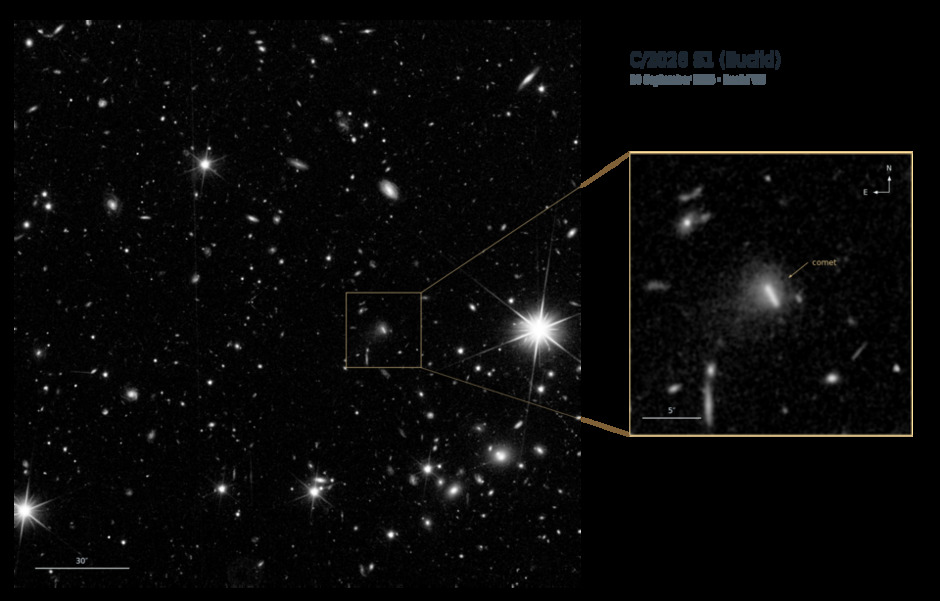
A telescope built to photograph faraway galaxies has found a comet nobody knew about. It was flagged by Mikko Pöntinen, a doctoral student at the University of Helsinki, whose software finds streaks in Euclid's images. The streak appeared in exposures from September 16 to 24, 2026, in the Euclid Deep Field North survey: a single 560-second exposure showing the comet as a short streak wrapped in its coma. Pöntinen recovered it in five image sets, 16 exposures in all, found no match in the catalogues, and reported it to the Minor Planet Center on September 29. The Center confirmed it as a new comet on October 8, and ESA announced it on October 19. The comet is about 1.3 billion kilometres from Earth, roughly between the orbits of Jupiter and Saturn, on an orbit tilted about 85 degrees to the plane of the planets. It will fly out to 9,786 astronomical units — 1.5 trillion kilometres — and will not come back for about 345,000 years, its last visit falling in the late Middle Pleistocene. At magnitude 20.6 it is far too faint to see with the eye or binoculars.
WISE 0855 — WATER CLOUDS THICKEN AND THIN ON THE COLDEST BROWN DWARF
The coldest brown dwarf known has weather, and the James Webb Space Telescope has watched it change. WISE 0855, full name WISE J085510.83−071442.5, is a Jupiter-sized world about 7.4 light-years away in the constellation Hydra, the fourth-closest known system to the Sun. A team led by Brittany Miles of the University of Arizona's Steward Observatory pointed Webb at it for 11 hours on December 2, 2023, recording 44 spectra, one every 15 minutes. The study, by Miles and 26 co-authors, is posted as arXiv:2609.20664 and accepted for publication in The Astrophysical Journal. At about 265 kelvin, roughly minus 8 degrees Celsius, WISE 0855 is cold enough for water to condense high in its air, and the spectra show patchy water clouds thickening and thinning as it turns. "This is the first time we've been able to confirm that water clouds are becoming thinner and thicker on a nearby world," Miles said. Below the clouds, carbon monoxide swings by up to 10 percent and phosphine varies too. One caution: the rotation period is still unknown — periods of 5.4 to 5.6 hours fit, but longer ones fit as well.
COMETS — PROBABLY DIDN'T SEED LIFE ON EARTH
It is a romantic idea, and a new study says it almost certainly did not happen that way. Comets carry the molecules life needs, and an early period of cometary bombardment has long been thought to have delivered them to Earth. A team led by Richard J. Anslow of the University of Cambridge's Institute of Astronomy revisited the question with computer models and published the result in Scientific Reports on October 28, 2026. They focused on hydrogen cyanide, HCN, the only feedstock molecule found on solar system comets in concentrations that matter. The problem is getting it there intact: comets arrive fast and steep, and modelling shows most fragile organics are destroyed in the hypervelocity impact. Their Monte Carlo simulations add a second problem: the bombardment faded fast, lasting roughly 500 million years, and fewer than 5 percent of simulations show a successful HCN delivery later than 4.03 billion years ago. Put together, the expected time for prebiotic chemistry to succeed after a strike is longer than the age of the solar system. "It's kind of a romantic idea, but our results suggest it's highly unlikely," Anslow said. This is modelling, not a sample return: it does not rule out delivery, only says it would have been, at best, a one-off fluke. Rosetta did find the amino acid glycine and phosphorus on comet 67P: comets carry the ingredients. Carrying them and delivering them are different problems.
MMX — JAPAN LAUNCHES FOR THE MOONS OF MARS
Japan has launched the first mission to return a piece of a Martian moon. The Japan Aerospace Exploration Agency's Martian Moons eXploration spacecraft, MMX, lifted off on October 26, 2026, on an H3 rocket from the Tanegashima Space Center, and separated from the rocket's upper stage about 71 minutes after liftoff. JAXA reported the spacecraft's first transmission from space the same day. MMX is bound for Phobos, the larger of Mars's two moons, about 22 kilometres across, circling Mars so closely it rises and sets twice a day. It should reach Mars in August 2027, survey both moons, land on Phobos in December 2028, and collect at least 10 grams of surface material before the return capsule brings it back to Earth in 2031. The sample would be the first ever returned from a Martian moon. A French-German rover named Idefix will be deployed on Phobos. The big question is where the moons came from: asteroids captured by Mars's gravity, or debris from something that crashed into Mars long ago. A sample of Phobos should settle it.
HERA — BRAKING HARD FOR THE DART CRASH SITE
The European Space Agency's Hera spacecraft spent the middle of October 2026 slowing down for the hardest part of its flight: matching speed with two asteroids. Hera launched on October 7, 2024, from Cape Canaveral on a Falcon 9, and exactly two years later its camera caught its destination, the Didymos binary system, for the first time — a single bright point, smaller than one pixel, from about 236,500 kilometres away, while moving at more than 12 kilometres per second relative to Earth. The plan was to brake later and harder than first designed, bringing Hera in about a month earlier than first planned. The first big burn, BRM-1, fired three thrusters for 93 minutes without a break on October 15, cutting Hera's speed relative to the asteroids by a few hundred metres per second. The second, BRM-2, fired for about 31 minutes on October 22 and cut another 70 metres per second, leaving Hera moving at 20 metres per second relative to the pair. Three smaller trim burns were planned for October 25, 28, and 31, with arrival 20 to 30 kilometres from the binary system on November 4, 2026. The braking matters because there is almost nothing to brake against at the destination: gravity at Didymos is about 40,000 times weaker than Earth's, and at Dimorphos about 200,000 times weaker, so Hera cannot go into orbit. It will fly hyperbolic arcs around the pair's common centre of gravity at around 12 centimetres per second. The mission's principal investigator is Patrick Michel of the French National Centre for Scientific Research. Hera's job is a close-up crash scene investigation: to measure what NASA's DART impact did to Dimorphos in September 2022.
HERA — TWO ASTEROIDS WHERE THERE WAS ONE DOT
Two weeks of braking paid off in a single picture. On the evening of October 18, 2026, Hera imaged Didymos and Dimorphos with its Asteroid Framing Camera from 1,280 kilometres away, and for the first time the two asteroids appeared as two separate bodies. ESA announced the image on October 27. Until that frame, Hera's camera had only seen the pair as a single point of light. "With this image the smaller Dimorphos asteroid becomes visible for the first time," said mission scientist Michael Kueppers. Didymos is about 780 metres across, a little smaller than Dubai's Burj Khalifa, while Dimorphos, at 151 metres, is about the size of the Great Pyramid of Giza and orbits at 1.15 kilometres. In September 2022, NASA's DART spacecraft struck Dimorphos at 6.1 kilometres per second, shortening the little moon's orbit by about 33 minutes — the first time humans measurably changed the orbit of a solar system object. The first detailed images of Dimorphos are expected on November 25, 2026, once Hera has closed in further.
Source: (1) Asteroid 2026 UE2 — MPEC 2026-U91, IAU Minor Planet Center, published October 28, 2026 (discovery by S. R. Smith, Catalina Sky Survey telescope 703; 21 observations from six stations); orbital and close-approach data: NASA/JPL Center for Near-Earth Object Studies — https://cneos.jpl.nasa.gov/ca/
Source: (2) Asteroid 2026 UA1 — NASA/JPL Center for Near-Earth Object Studies close-approach data and NASA/JPL Small-Body Database (first observed October 20, 2026; passed October 23, 2026, 0.58 lunar distances; H=27.91; Apollo type; condition code 7) — https://cneos.jpl.nasa.gov/ca/
Source: (3) Rubin dwarf planet candidate — NSF–DOE Vera C. Rubin Observatory, "NSF–DOE Vera C. Rubin Observatory Reveals Its First Dwarf Planet Candidate in Our Solar System," October 27, 2026 (Matthew Holman, Center for Astrophysics | Harvard & Smithsonian; Mario Jurić, University of Washington) — https://rubinobservatory.org/news/rubin-first-dwarf-planet-candidate
Source: (4) Euclid comet — Euclid Consortium, "Meet Euclid's first comet discovery: 'C/2026 S1 (Euclid)'" (Mikko Pöntinen, University of Helsinki; Solar System Objects Science Working Group) — https://www.euclid-ec.org/euclids-first-comet-discovery/ ; Caltech Euclid page — https://euclid.caltech.edu/news/euclid-discovers-new-comet
Source: (5) WISE 0855 — Miles et al., "Water Cloud and Chemical Modulations in the Coldest Brown Dwarf," arXiv:2609.20664, submitted September 17, 2026, accepted for publication in The Astrophysical Journal (Brittany E. Miles, University of Arizona Steward Observatory, and 26 co-authors) — https://arxiv.org/abs/2609.20664
Source: (6) Comets didn't seed life — Anslow et al., "Cometary impacts an unlikely pathway towards the origins of life on Earth," Scientific Reports 16:31688, published October 28, 2026, DOI 10.1038/s41598-026-74214-y (Richard J. Anslow, University of Cambridge Institute of Astronomy; Catriona H. McDonald, Amy Bonsor, Paul B. Rimmer, Auriol S. P. Rae) — https://www.nature.com/articles/s41598-026-74214-y.pdf
Source: (7) MMX — Japan Aerospace Exploration Agency, Martian Moons eXploration (MMX) mission pages (launch October 26, 2026, H3 from Tanegashima; first transmission October 26, 2026; Mars arrival August 2027; Phobos sample return 2031) — https://www.mmx.jaxa.jp/en/
Source: (8) Hera braking — Hera-Japan Project (JAXA/ISAS), "Upcoming Observation and Mission Operations Plan for the Hera Spacecraft in the Binary Asteroid Exploration Mission," November 2, 2026 (second braking maneuver October 22, 2026; approach at 20 m/s; arrival November 4, 2026) — https://hera.isas.jaxa.jp/wp-hera/en/4827/
Source: (9) Hera resolves two — ESA, "First light: Hera resolves two asteroids instead of one," announced October 27, 2026 (Asteroid Framing Camera image, evening of October 18, 2026, from 1,280 km; Michael Kueppers; Ian Carnelli) — https://www.esa.int/Space_Safety/Hera/First_light_Hera_resolves_two_asteroids_instead_of_one
Image credit: (1) Asteroid 2026 UE2 — NO verified agency image with credit found. NO COVER for this item.
Image credit: (2) Asteroid 2026 UA1 — NO verified agency image with credit found. NO COVER for this item.
Image credit: (3) Rubin dwarf planet candidate — Orbit visualization on the Rubin Observatory release page. Credit: NSF–DOE Vera C. Rubin Observatory (wording to confirm at publish; the release page carries the visualization).
Image credit: (4) Euclid comet — Credit: ESA/Euclid/Euclid Consortium/NASA, M. Pöntinen et al. 2026. VERIFIED image (stack of eight 90-second VIS exposures showing the comet as a streak).
Image credit: (5) WISE 0855 — NO verified agency image with credit found; the study is a time series of spectra, not a photograph. NO COVER for this item.
Image credit: (6) Comets didn't seed life — NO verified image with credit found; the original article's illustration credit is unverified. NO COVER for this item.
Image credit: (7) MMX — Artist's concept of the MMX spacecraft at Mars. Credit: JAXA. Artist's concept, clearly labelled as such (wording to confirm at publish).
Image credit: (8) Hera braking — Image: ESA (Hera's first glimpse of Didymos, October 7, 2026, a sub-pixel dot from 236,500 km). Credit: ESA.
Image credit: (9) Hera resolves two — Image: ESA (Asteroid Framing Camera image of Didymos and Dimorphos, October 18, 2026). Credit: ESA.
Cover: Euclid comet C/2026 S1 (Euclid) — stack of eight 90-second VIS exposures. Credit: ESA/Euclid/Euclid Consortium/NASA, M. Pöntinen et al. 2026. VERIFIED image with full credit. Release page: https://www.euclid-ec.org/euclids-first-comet-discovery/
As an Amazon Associate I earn from qualifying purchases. If you buy through an active affiliate link, StarPixels may earn a commission at no additional cost to you.