
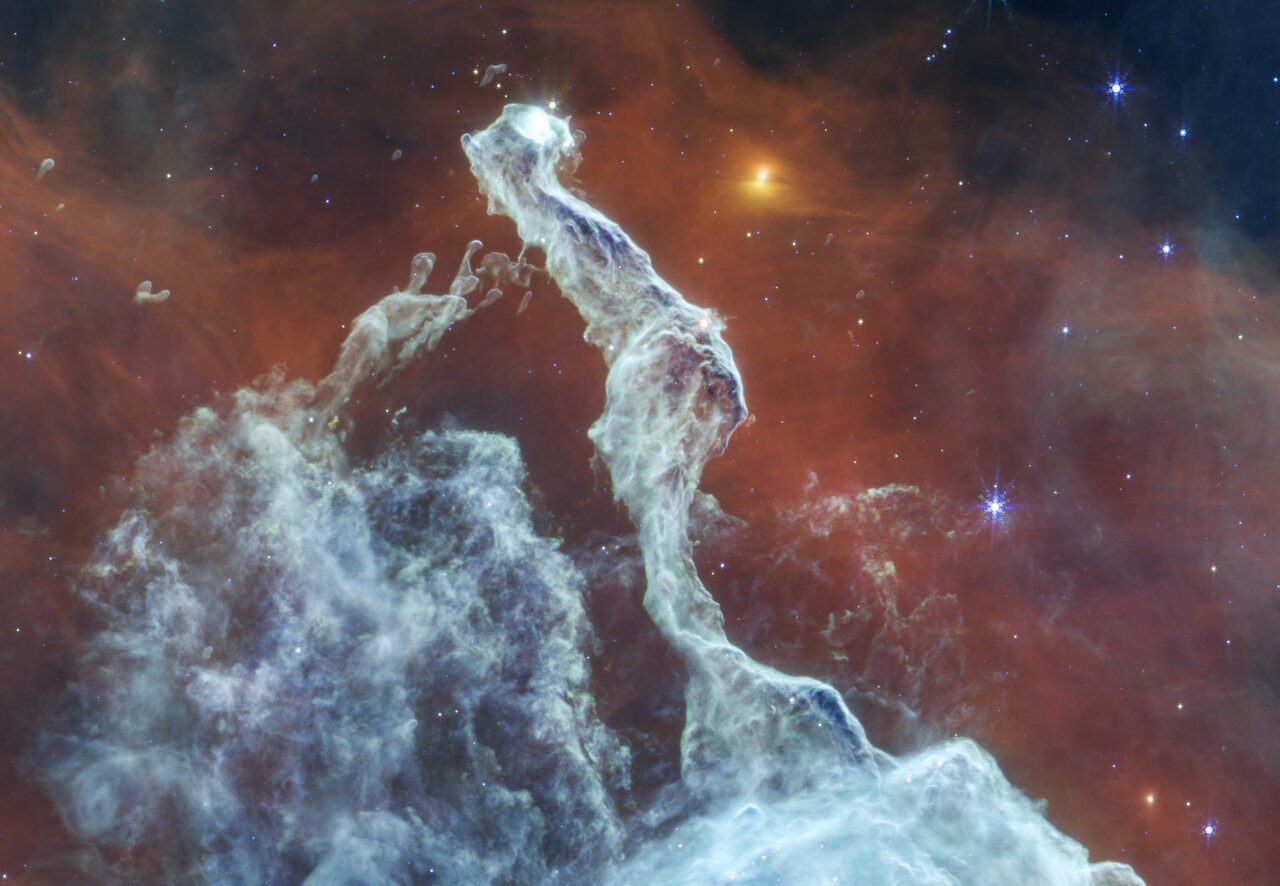
Six stories from October 31, 2026: a ghostly cat in the Carina Nebula seen by two great telescopes, a spacecraft's first step into the Trojan swarm, an interstellar comet's ice matching worlds beyond Neptune, a gas trail pointing to microquasar jets in another galaxy, and the Taurid fireballs to watch in early November.
CAT'S HEAD — THREE VIEWS OF ONE GHOSTLY CAT
The two thin articles this update replaces were two views of a single release, so they become one story here. On October 29, 2026, NASA, ESA, and CSA released three views of the same star-forming scene inside the Carina Nebula, about 7,500 light-years away. A dark pillar of dust and gas has the outline of a cat sitting with its back toward us, head turned to one side. The region is catalogued as NGC 3372, part of the Carina Nebula, and the pillar is also listed as HH 903. The photographed field is about 5.4 light-years across. Hubble's visible-light view, taken January 15, 2026, shows the cat as an opaque, dark brown pillar with a glowing red eye. Webb's near-infrared view, taken May 27, 2026, peers through some of the dust to reveal a dense field of stars, the pillar's complex surface, and faint background galaxies. Webb's mid-infrared view strips away much of the starlight and traces warm dust and carbon-based molecules, excited by starlight, outlining fine structures inside the nebula. The bright spot that forms the eye is most likely a young star still tucked into dust. That is a possibility, not a confirmed identification. One correction from the original articles: they gave two distances, 7,500 and 7,500 to 8,500 light-years. This update uses 7,500, the figure in the October 29 release. The cat is a temporary scene. It will disperse as stars form and evolve, but for now the three views together show how visible and infrared light each reveal a different piece of star formation.
LUCY — FIRST SPACECRAFT INTO THE TROJAN SWARM
NASA's Lucy spacecraft has entered the region of the Jupiter Trojan asteroids, the first spacecraft ever to get there. NASA announced it on October 28, 2026, five years and more than 2.2 billion miles after Lucy launched on October 16, 2021. Lucy is approaching Jupiter's leading Lagrange point, L4, where one of two Trojan groups travels ahead of Jupiter in its orbit. The second group trails behind at L5. The Trojans sit about 484 million miles from Jupiter, roughly as far as Jupiter is from the Sun, and they are spread so thin, more than 6 million miles apart on average, that they will look like pinpricks of light moving against the stars until Lucy closes in on its targets. One correction from the original article: Lucy has entered the region, not arrived at an asteroid. Its first close flyby, of the asteroid Eurybates, is set for August 11, 2027, and lasts only a few hours. Then come Polymele in September 2027, Leucus in April 2028, and Orus in November 2028. Lucy returns to Earth in 2030 for a final gravity assist, then heads for the trailing group and the binary pair Patroclus and Menoetius in March 2033. Eight asteroids in all. The Trojans are leftovers from the planets forming 4.5 billion years ago, and studying them up close should sharpen our picture of how the solar system took shape. Lucy is now more than five times farther from the Sun than Earth, and NASA says the spacecraft and its instruments are working as expected.
3I/ATLAS — ICE THAT MATCHES WORLDS BEYOND NEPTUNE
Interstellar comet 3I/ATLAS, only the third object from beyond our Solar System ever identified, carries water ice in grains about a micron across or smaller, mixed with dark, rocky dust. The result comes from a Southwest Research Institute team led by Silvia Protopapa, published in The Astrophysical Journal Letters on October 26, 2026. Webb's Near-Infrared Spectrograph watched the comet three times between August 2025 and April 2026, before and after its closest approach to the Sun. Water ice leaves fingerprints in infrared light: a strong band near 3 microns, and weaker bands near 1.5 and 2.0 microns. In 3I/ATLAS the 3-micron band is strong, but the shorter bands are very weak or missing, unlike most icy comets, which show all three. Models point to tiny grains of water ice mixed with dust. In such small, dusty grains, light travels only a short distance through the ice, weakening the shorter bands while the 3-micron band stays prominent. The grains also changed over time. By the final observation in April 2026, as the comet moved away from the Sun, the data favored an additional population of ice-rich grains. "We can't yet tell whether the changes over time are the result of the Sun heating the grains differently at each observation, or of new material exposed as the comet's surface eroded near the Sun," said Michael Kelley of the University of Maryland, second author of the paper. The team then compared the comet with Webb spectra of trans-Neptunian objects, icy bodies beyond Neptune. The shape of the 3-micron band resembles several of those worlds, especially ones that also show carbon dioxide ice and organic compounds. "At first glance, 3I/ATLAS looks different from the icy comets we know," Protopapa said. "But when we placed it alongside distant icy worlds in our own solar system, it no longer looked out of place." If it holds, the icy building blocks of planets around other stars may share the same range of grain properties as our own.
LMC P3 — A GAS TRAIL POINTS TO MICROQUASAR JETS
A straight trail of heated molecular gas, 26 light-years long and three light-years wide, points to jets from a microquasar in another galaxy. The trail sits beside LMC P3, inside the supernova remnant DEM L241 in the Large Magellanic Cloud, about 163,000 light-years away. The work, led by Yasuo Fukui of Nagoya University with colleagues at Gifu University, appeared in The Astrophysical Journal Letters on October 30, 2026. Starting in 2022, the team used the ALMA observatory in Chile to measure carbon monoxide emission from the cold gas around the system, at wavelengths around 1.3 millimetres and 0.87 millimetres. What they found was a strikingly straight, narrow trail of gas warmed to 35 to 60 kelvin, against about 15 kelvin for the surrounding gas. "We discovered a gigantic molecular jet," Fukui said. The temperature over a large fraction of the cloud makes a very strong case that the gas is interacting with a high-energy jet from the compact object, the kind of jet that can also power LMC P3's gamma rays. LMC P3 is the most luminous gamma-ray binary known, and the first found outside the Milky Way, discovered in 2016. It pairs a compact object, either a black hole or a neutron star, with a massive star more than 30 times the Sun's mass. The new result settles the geometry, not the identity. No telescope has directly detected the jet itself, and the compact object's identity is still unresolved. The high gamma-ray output gives very strong support for a black hole over a neutron star, Fukui said, but very strong support is not proof. What the trail shows is the jet's effect: something in LMC P3 has been firing a powerful, steady jet long enough to carve a 26-light-year scar.
HALLOWEEN FIREBALLS — TAURIDS TO WATCH NOVEMBER 4-5
The Taurids are two weak showers, the Southern and Northern Taurids, that run from late September into early December, and they are known for slow, bright fireballs. The American Meteor Society lists the Southern Taurids as active September 20 to November 20, 2026. The shower has two parts: an annual component that peaked around October 14, and a fireball-swarm component that peaks on the night of November 4-5, 2026. The Northern Taurids run October 20 to December 10, peaking on the night of November 11-12. Each branch produces only about five meteors an hour under dark skies, but a high share of them are bright, slow fireballs, which is why the shower is also called the Halloween fireballs. The parent body is comet 2P/Encke. The meteors enter the atmosphere at about 27 kilometres per second, among the slowest of any annual shower. A fireball, by the American Meteor Society's definition, is a meteor generally brighter than magnitude minus 4, about the brightness of Venus. One correction from the original article: its "this weekend" framing pointed at October 31, but the best nights come days later. Halloween falls during the overlap of the two streams, so it is worth watching, but the Southern peak is November 4-5, with the Moon a thin waning crescent 25 percent lit, rising late. The Northern peak follows on November 11-12, with the Moon only about 5 percent lit. 2026 is a normal year. The American Meteor Society forecasts no enhanced swarm, and the next predicted Taurid fireball swarm is not until 2032. Expect a few bright, slow meteors, not a storm.
Source: (1) Cat's Head — ESA/Hubble release heic2614, Ghostly Cat's Head Nebula lurks within sight of Hubble and Webb, October 29, 2026 — https://esahubble.org/news/heic2614/ ; ESA/Webb release weic2622 — https://esawebb.org/news/weic2622/ ; NASA image pages: Cat's Head Nebula (Webb MIRI Image) — https://science.nasa.gov/asset/hubble/cats-head-nebula-webb-miri-image/
Source: (2) Lucy — NASA Lucy mission blog, Katherine Kretke (Southwest Research Institute), NASA's Lucy Reaches Trojan Asteroid Region 5 Years After Launch, October 28, 2026 — https://science.nasa.gov/blogs/lucy/2026/10/28/nasas-lucy-reaches-trojan-asteroid-region-5-years-after-launch/
Source: (3) 3I/ATLAS — Protopapa et al., JWST Reveals Refractory-rich Water Ice in Interstellar Comet 3I/ATLAS, The Astrophysical Journal Letters 1011: L11, published October 26, 2026, DOI 10.3847/2041-8213/aea60d — https://doi.org/10.3847/2041-8213/aea60d ; Southwest Research Institute release, October 26, 2026 — https://www.swri.org/newsroom/press-releases/swri-led-study-uses-webb-compare-interstellar-comet-3i-atlas-icy-bodies-our-solar-system
Source: (4) LMC P3 — Fukui et al., ALMA Observations of DEM L241/LMC P3 in the Large Magellanic Cloud: Evidence for the Formation of Cool Molecular Jets Driven by a Microquasar, The Astrophysical Journal Letters, published October 30, 2026, DOI 10.3847/2041-8213/aea0cb — https://doi.org/10.3847/2041-8213/aea0cb
Source: (5) Taurid fireballs — American Meteor Society, 2026/2027 Meteor Shower Calendar — https://www.amsmeteors.org/calendar/
Image credit: (1) Cat's Head — Image: NASA, ESA, CSA, STScI; Image Processing: Joseph DePasquale (STScI). VERIFIED image (Hubble WFC3 + Webb NIRCam + Webb MIRI).
Image credit: (2) Lucy — Artist's rendering of the Lucy spacecraft: NASA/SwRI (UNVERIFIED wording — confirm the exact credit line on the NASA Lucy mission blog at publish; the blog page itself carries no image credit in its text fetch).
Image credit: (3) 3I/ATLAS — NO verified agency image with credit found. NO COVER for this item.
Image credit: (4) LMC P3 — ALMA figure: Fukui et al., 2026, Astrophysical Journal Letters (imaging: ALMA). VERIFIED figure per the paper.
Image credit: (5) Taurid fireballs — NO verified image with credit found. The original article's photo was a Taurid fireball photographed November 9, 2015, photographer unknown. NO COVER for this item.
Cover: Cat's Head Nebula, Webb MIRI view — Image: NASA, ESA, CSA, STScI; Image Processing: Joseph DePasquale (STScI), released October 29, 2026. (Alternate: the Hubble visible-light view of the same pillar, same credit.) Image page: https://esawebb.org/images/weic2622d/
As an Amazon Associate I earn from qualifying purchases. If you buy through an active affiliate link, StarPixels may earn a commission at no additional cost to you.