
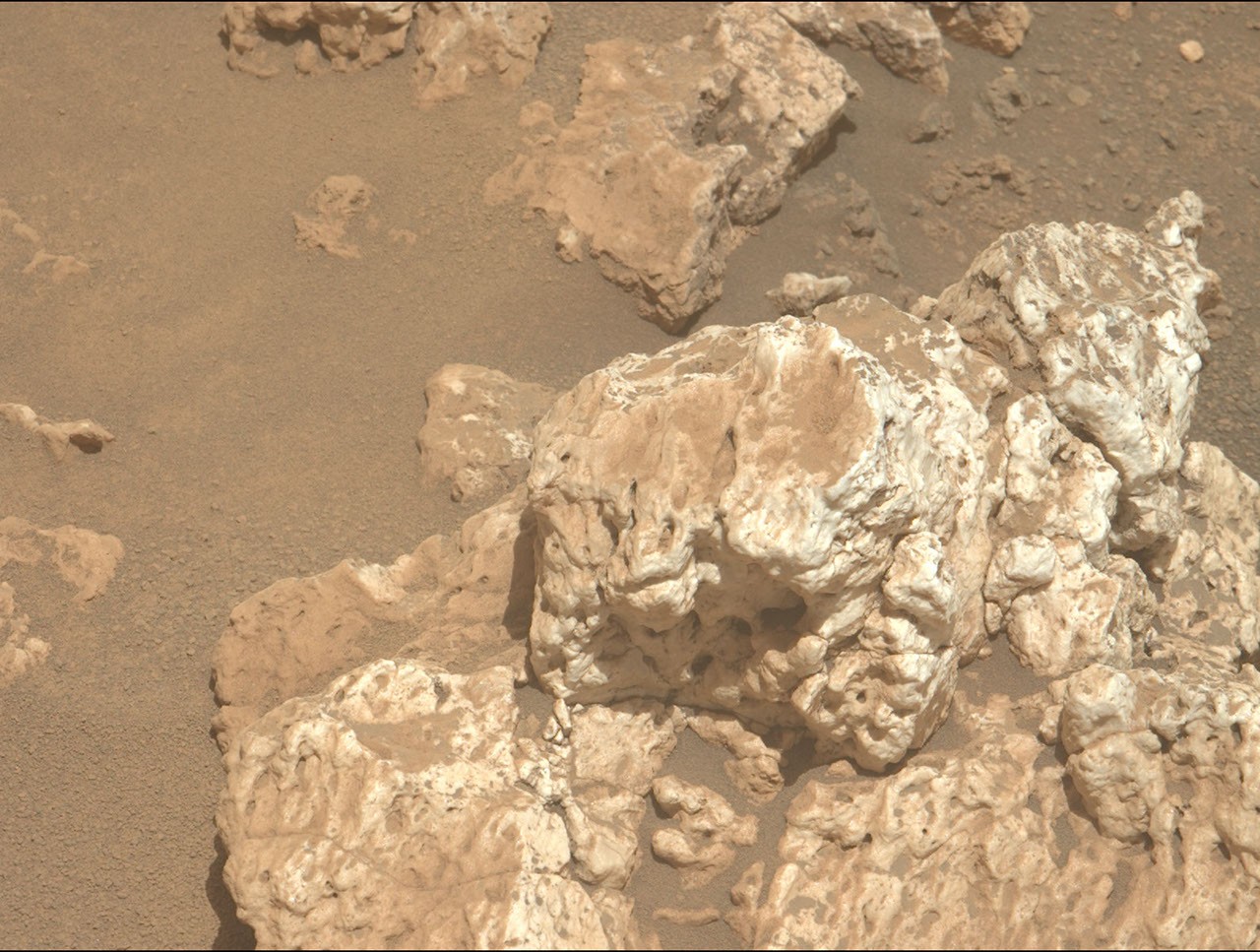
NASA's Perseverance rover has found a cluster of bright, light-toned rocks in an area called Idubi, in the Lac de Charmes region outside Jezero crater. The rocks sit in ancient Martian crust and stand out sharply against the darker, dust-covered ground around them, brighter even than the igneous and impactite rocks the rover team investigated before. New data from the rover's SuperCam instrument confirmed the pale fragments are not igneous in origin. They are rich in hydrated silica, a mineral that forms where water has been at work.
Idubi sits outside Jezero crater, in a stretch of ancient crust laid bare in the Lac de Charmes region. The bright fragments are pieces of that old crust, exposed where the darker surface has worn thin. Their pale color is what first caught the rover team's attention: on a landscape of dark rock and dust, a patch of light-toned stone is hard to miss, and the team directed Perseverance to take a closer look. The SuperCam results gave the answer the color hinted at. These rocks were shaped by water, not by fire.
On Earth, hydrated silica forms in several kinds of watery settings: hydrothermal systems, soils shaped by water, and groundwater systems. Several of those settings could have supported life, which is why a silica deposit is worth a closer look. Hydrated silica also has a second quality that matters to the search for ancient life. It is good at preserving microfossils, the tiny traces of organisms locked in rock. A silica deposit is a place where evidence of past life could survive long after the water itself is gone. That makes these deposits prime targets for reading Mars' water history: where the water went, how long it stayed, and what kind of chemistry it carried. The question the rover team is now asking is whether these pale remnants of an old Martian water system hold any such signs.
Perseverance has met silica before. On the inner rim of Jezero crater, the rover found silica-rich rocks, but those deposits were too small to use the proximity science instruments that gather high-resolution chemical and mineralogical data. Without that detail, the team could not pin down how the deposits formed or how well they might preserve traces of life. The rocks at Idubi are different because of their scale. They are large enough to work with, and a detailed proximity science campaign is already underway.
The photograph with the report was taken by the rover's left Mastcam-Z camera on October 29, 2026, the mission's Sol 2023, at 13:03:53 local mean solar time. It shows the pale, pitted rock against fine reddish sand. The update was written by Candice Bedford, a research scientist at Purdue University, and published on November 16, 2026, by the Mars 2020 mission team.
Source: NASA Science blog, "Perseverance Update: The Ghostly Rocks of 'Idubi' — Bright Remnants of Aqueous Systems from Long Ago," by Candice Bedford, Purdue University, November 16, 2026.
Image credit: NASA/JPL-Caltech/ASU
As an Amazon Associate I earn from qualifying purchases. If you buy through an active affiliate link, StarPixels may earn a commission at no additional cost to you.