
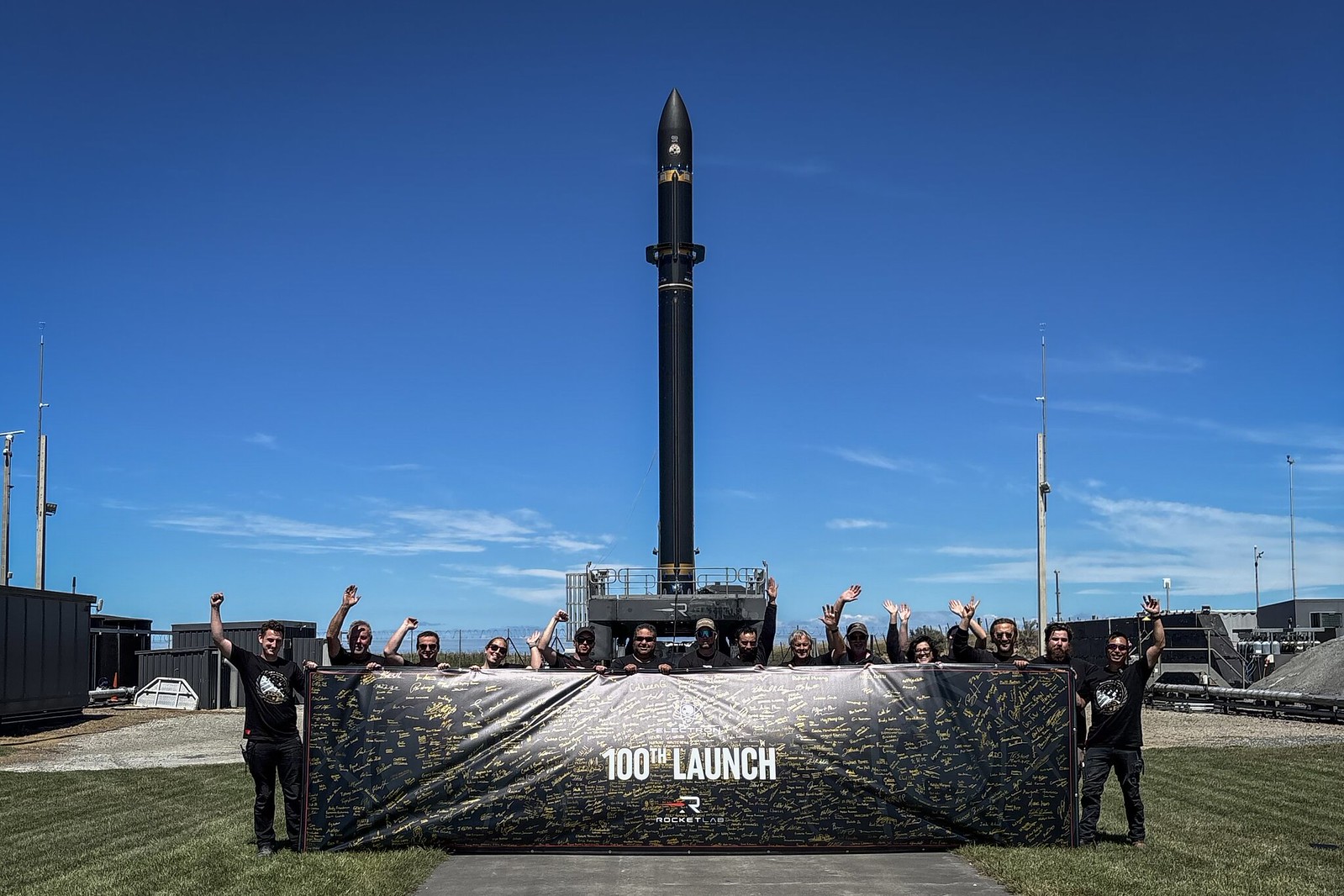
Rocket Lab's Electron rocket flew for the 100th time on November 14, 2026, and the company says no commercially developed rocket has reached 100 launches faster. The milestone flight, named "The Mountain God Rises," lifted off from Launch Complex 1 on New Zealand's Mahia Peninsula at 6:30 p.m. local time and carried a Japanese radar satellite into low Earth orbit.
The payload was YAMATSUMI-II, a synthetic aperture radar Earth-imaging satellite built for the Institute for Q-shu Pioneers of Space, known as iQPS. It was placed into a 575-kilometre low Earth orbit. The flight was Rocket Lab's 11th Electron launch for iQPS, with a 100 percent mission success record for the customer since 2023. iQPS has booked seven more dedicated Electron launches through 2030 to complete its satellite constellation.
Electron's first launch was in 2017, so the 100th flight came in under a decade, which Rocket Lab calls a major milestone for commercial spaceflight. The rocket began as the world's first carbon-composite orbital rocket, and the team behind it pioneered 3D-printed rocket engines. Rocket Lab founder and chief executive Peter Beck put the record in plain terms: few rockets reach 100 launches in their total operational lifetime. He credited the pace to the Electron team, saying the record comes down to the relentless dedication of the people behind the rocket, and congratulating everyone who built it. He noted that the next 100 Electron launches are already booked.
Electron has deployed hundreds of satellites for commercial constellation operators, national security agencies, and scientific institutions, flying from launch pads in New Zealand and Virginia. The company points to vertically integrated manufacturing and a manifest stretching well into the next decade. Along the way, the Electron team launched back-to-back missions from two hemispheres and set responsive-space records.
Electron flies in the small-lift class, launching dedicated small satellites on their own schedule instead of sharing rides on larger rockets. Its companion vehicle, HASTE, flies alongside Electron in Rocket Lab's small-lift lineup. Beck thanked the customers who have trusted Electron with their spacecraft across multiple launches, and the record suggests that trust is the point: a small rocket that flies often, on schedule, with the next hundred already booked.
Electron is also the foundation for what comes next. Rocket Lab's next rocket is Neutron, a reusable medium-lift vehicle, and Electron's steady cadence is the operational base it is built on. The company's satellites and components have powered more than 1,700 missions in Earth orbit, as well as deep-space exploration of the Moon, Mars, and beyond. Rocket Lab describes itself as an end-to-end space company, building rockets, satellites, and spacecraft components for commercial, government, and defense missions. Rocket Lab is based in Long Beach, California, and trades on the Nasdaq as RKLB.
Source: Rocket Lab press release, "Rocket Lab Hits 100 Electron Launches, Fastest Commercial Rocket to Reach the Milestone," November 14, 2026.
Image credit: Rocket Lab
As an Amazon Associate I earn from qualifying purchases. If you buy through an active affiliate link, StarPixels may earn a commission at no additional cost to you.