
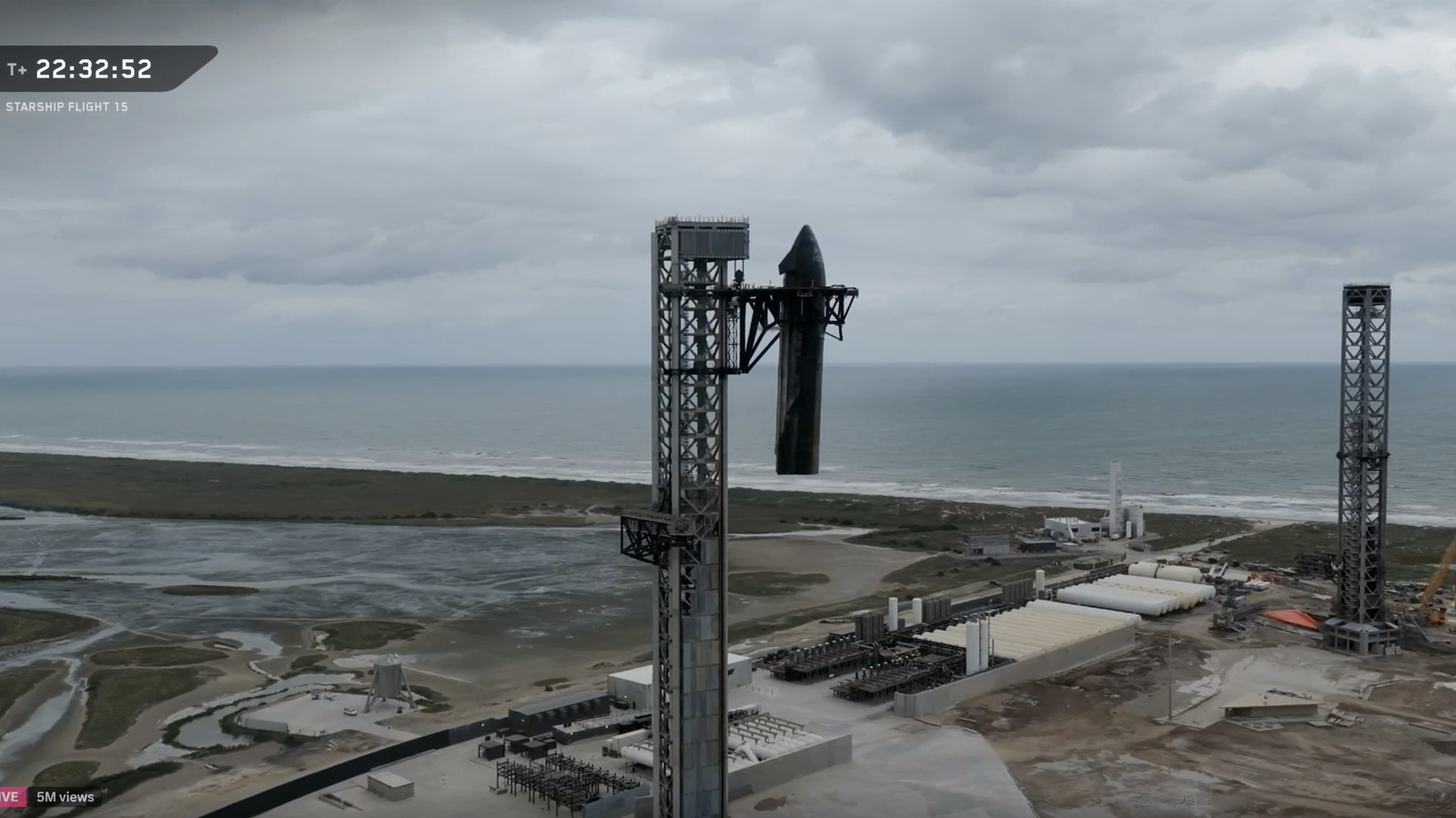
After more than 22 hours in orbit, SpaceX's Starship upper stage came home on Saturday, November 14, 2026, and slid into the launch tower's mechanical arms at Starbase, Texas. It is the first time anyone has caught an orbital-class rocket stage out of the sky and held it in one piece.
THE CATCH
Ship 42 lifted off on Friday, November 13, at 5:47 p.m. Eastern Time, 4:47 p.m. Central, on top of its Super Heavy booster. Flight 15 was the fourth launch of the Starship V3 design. Once in orbit, the Ship deployed 26 Starlink V3 internet satellites, then circled Earth about 14 times over more than 22 hours. That alone made it Starship's longest stay in orbit so far, and only the second time a Starship has reached full orbit at all.
The return began just after 3:30 p.m. Eastern on Saturday, when the Ship fired its engines to drop out of orbit. It flew back through the atmosphere over Mexico, swung out over the Gulf, flipped around, and lit its engines for the final landing burn at 4:20 p.m. Eastern, 3:20 p.m. Central. The Ship performed the belly-flop maneuver SpaceX has practiced for years, turning end over end and pointing its engine plumes down to slow itself, then sliding precisely between the tower's two mechanical arms. The arms, nicknamed Mechazilla's chopsticks, swung closed around it. SpaceX's webcast frame at T+22:32:52 shows the Ship hanging in the arms above the Texas coast.
SpaceX had caught Super Heavy boosters from the air before, but Flight 15 was the first attempt to catch the orbiter itself. The Associated Press called it the first-ever capture of a Starship flying back from space.
THE BOOSTER THAT DID NOT MAKE IT
The day was not a clean sweep. The plan called for both stages to come back to Starbase, but the Super Heavy booster never got its catch. It was expected back about six and a half minutes after liftoff. Instead, after trouble with its engines, it diverted offshore and came down softly over the Gulf, where the flight termination system was triggered and the booster ended in a fireball. SpaceX chief executive Elon Musk said the booster showed slight underperformance from its engines, and that flight telemetry would need review before a definite conclusion.
The diversion was a safety call built into the flight plan. If the catch does not line up, the booster is steered over water rather than back to the tower. The full-reusability goal, recovering both stages intact on the same flight, still waits.
WHY IT MATTERS
Starship is the largest rocket ever built, and its whole point is reuse. SpaceX wants to fly each stage, catch it, and fly it again with a fast turnaround, which would cut the cost and the wait between launches. Musk has projected roughly one Starship launch a week in the first half of 2027. Even a flawless double catch would not have proved that yet: rapid turnaround, inspecting and reflying both stages quickly, is the prize still untested.
The previous flight shows how far the program has come in one step. Flight 14 also reached orbit and deployed a batch of operational Starlink satellites, but it ended early because of an engine issue on the Ship, and SpaceX brought the vehicle down in the Pacific Ocean. Its booster splashed down in the Gulf as planned. Flight 15 kept the Ship up for a full day, delivered its satellites, and brought it home.
The test also feeds directly into NASA's plans to return astronauts to the Moon. A modified Starship is being developed as the Human Landing System that would carry crews between lunar orbit and the surface, and on Artemis III, planned for 2027, a Starship is set to launch to low Earth orbit and dock with the Orion spacecraft as a test. In-space refueling, which the lunar trips will need, is still to be demonstrated.
SpaceX is also moving Starship toward Florida. Pad 39A at Kennedy Space Center is expected to be ready later in November 2026, and two more pads are under construction at Launch Complex 37 at Cape Canaveral Space Force Station. No launch date has been set, and no Starship has arrived in Florida yet.
Source: (1) USA Today / Florida Today, "SpaceX catches Starship for first time in Texas, making space history," November 14, 2026 — https://www.usatoday.com/story/tech/space/2026/11/14/spacex-flight-15-catches-starship-makes-history/92785462007/ ; (2) Scientific American, "Can SpaceX catch its Starship?," updated November 14, 2026 — https://www.scientificamerican.com/article/can-spacex-catch-its-starship/
Image credit: SpaceX webcast still, Starship Flight 15 — Ship 42 hanging in the Mechazilla tower arms at T+22:32:52, November 14, 2026. VERIFIED image (feed hero, SpaceX stream frame).
Cover: SpaceX webcast still of Ship 42 in the tower arms — Credit: SpaceX.
As an Amazon Associate I earn from qualifying purchases. If you buy through an active affiliate link, StarPixels may earn a commission at no additional cost to you.