
A detector buried a kilometre underground in Japan may have caught the faintest signal in neutrino physics: the combined whisper of every core-collapse supernova that has ever exploded. On June 25, 2026, the Super-Kamiokande Collaboration presented the first indication of the diffuse supernova neutrino background at the Neutrino 2026 conference at the University of California, Irvine. The full analysis appeared as a preprint on October 26, 2026. It puts the signal at 2.6 sigma — strong enough to call an indication, not strong enough to call a discovery.
THE BACKGROUND HUM OF EVERY EXPLOSION
Every time a massive star dies in a core-collapse supernova, it throws off a flood of neutrinos. Across the observable universe such explosions happen several times per second. The neutrinos from all of them, from the early universe to the present day, have piled up into a faint, all-sky background: the diffuse supernova neutrino background, or DSNB. Catching it would give astronomers a direct way to measure the history of star formation and the chemical enrichment of the universe, and to test models of how neutron stars and black holes form. The collaboration describes the search as straining to hear faint whispers engraved in cosmic history. The only supernova neutrinos ever caught from a single explosion came from SN 1987A, a star that blew up in the Large Magellanic Cloud in 1987 and was seen by the Kamiokande-II detector. Every search since has returned upper limits, not a signal. This one is the first to report an excess.
THE DETECTOR
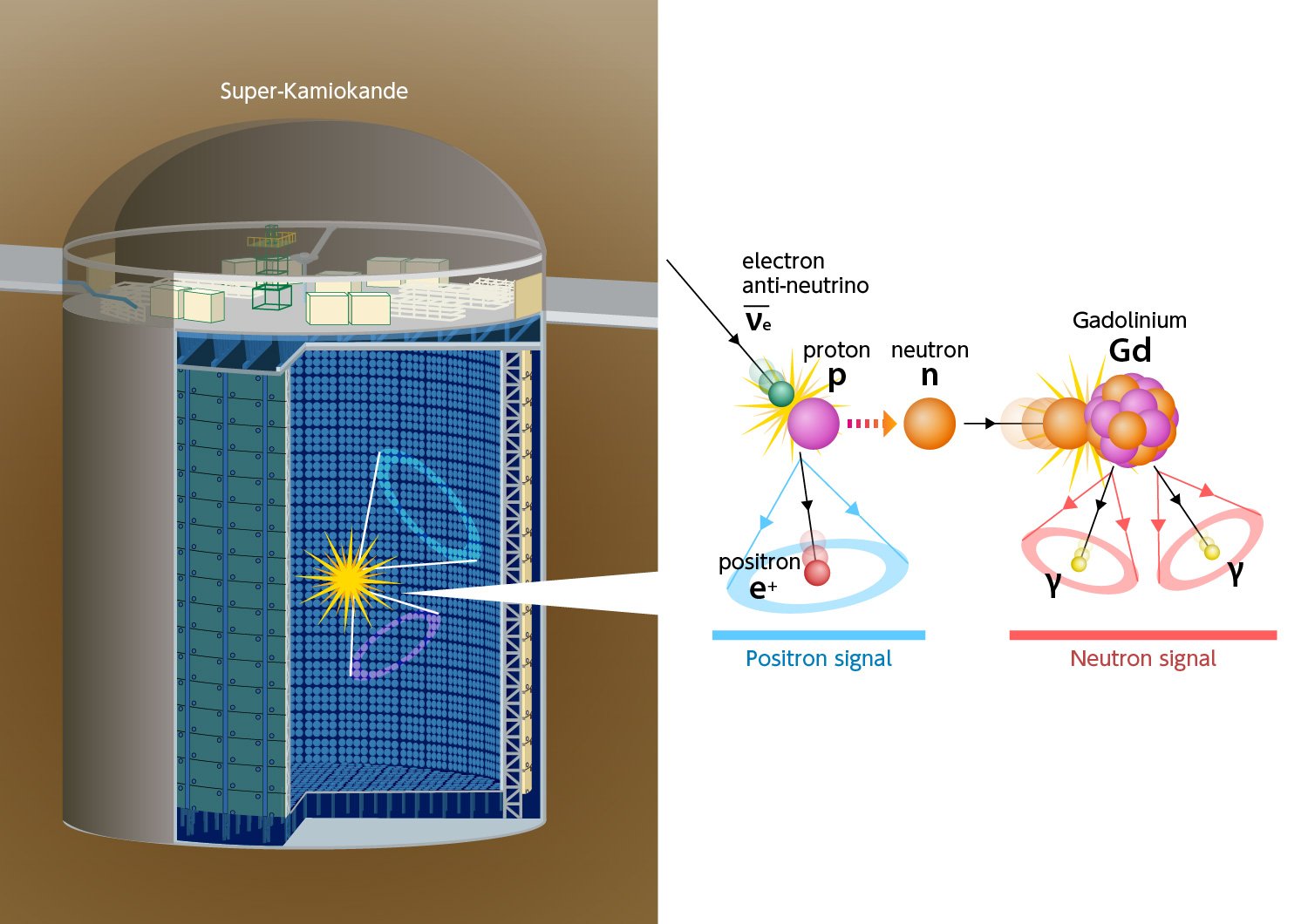
Super-Kamiokande sits 1,000 metres underground in the Kamioka mine in Gifu Prefecture, Japan, where the rock above shields it from cosmic rays. The detector is a tank holding 50,000 tons of ultrapure water, watched by about 13,000 photomultiplier tubes. When a neutrino interacts in the water, it makes a charged particle that moves faster than light does in water, leaving a cone of Cherenkov light that the tubes record. The experiment began operating in April 1996, and the collaboration now counts about 250 researchers from 60 universities and research institutions.
GADOLINIUM MAKES THE SIGNAL VISIBLE
The step that made this result possible is gadolinium, a rare-earth metal dissolved into the water starting in 2020. When an electron antineutrino strikes a proton in the water, it produces a positron and a neutron. The positron gives an immediate flash of Cherenkov light. The neutron wanders off and, in plain water, is hard to catch. Gadolinium grabs the neutron and releases gamma rays, a second, delayed flash. That two-flash signature lets the team pick genuine antineutrino events out of a sea of background. Without it, the signal would stay buried.
WHAT THE TEAM DID
The analysis covers 5,003.0 days of data, from October 2008 to March 2026, across six operating phases: 3,349 days of pure-water running from 2008 to 2020, and 1,653 days with gadolinium-loaded water from 2020 onward. The team fitted the energy spectrum of candidate events and found an excess at neutrino energies from 13.3 to 81.3 MeV, the range where a DSNB signal should sit. Using a representative DSNB model, the best-fit flux is 3.6 antineutrinos per square centimetre per second, plus 1.6 and minus 1.5, for neutrino energies above 13.3 MeV. That number lands inside the range predicted by the Horiuchi and collaborators 2009 model, which gives 2.1 to 3.9 per square centimetre per second. The selection leans on the geometry of the Cherenkov rings, with candidate events clustered near a Cherenkov angle of about 42 degrees, the angle expected for these interactions.
WHAT 2.6 SIGMA MEANS
Particle physics sets the bar for a discovery at 5 sigma. At 2.6 sigma, the no-signal hypothesis is ruled out at 99.5 percent confidence on a one-sided test, but a statistical fluke is still possible at the 0.5 percent level, so the collaboration calls the result an indication rather than a detection. Earlier hints were fainter: the pure-water data alone had shown an excess of about 1.5 sigma, and earlier searches had reported only upper limits. This is the strongest indication of the DSNB yet, and it is also the first time the excess has crossed the line from a limit into a positive claim. "Observing the world's first indication of the Diffuse Supernova Neutrino Background is a deeply meaningful achievement and has been a long-cherished goal since the beginning of the Super-Kamiokande project," said Hiroyuki Sekiya, associate professor at the University of Tokyo and spokesperson for the experiment. The collaboration's own statement keeps the same caution: the first indication "strongly suggests the signal's existence. However, with the current statistical significance at 2.6 sigma, additional data accumulation and further analysis improvements are necessary for a definitive detection."
WHAT IT TELLS US, AND WHAT COMES NEXT
A flux near 3.6 fits the models, and that fit matters. It means the supernova rate and the neutrino output per explosion, as theorised, add up to about this much background — the universe's history of star death is roughly as expected, not wildly higher or lower. The result is also a tool: if the DSNB is real, its spectrum carries information about how many massive stars collapsed into black holes without a bright explosion, and how the elements built up over cosmic time. One caution is that the flux number depends on the DSNB model assumed, and the excess is small. Theorists are already testing other readings of the same excess, including dark matter. That is normal for a 2.6-sigma result: it is a lead, not a verdict. The work is a preprint, not yet peer-reviewed, and the collaboration is clear that more data is needed. "We are already planning on incorporating ongoing observations at Super-Kamiokande together with its successor detector, Hyper-Kamiokande, to further improve sensitivity in future collaborative studies," said Yosuke Ashida, assistant professor at Tohoku University. Hyper-Kamiokande, now under construction near Kamioka with a much larger water target, is built for exactly this kind of measurement. A hint at 2.6 sigma is the first step toward a detection that settles the question.
Source: The Super-Kamiokande Collaboration: K. Abe et al., Indication of Electron Antineutrinos from the Diffuse Supernova Neutrino Background, arXiv:2610.35619, submitted October 26, 2026 — https://arxiv.org/abs/2610.35619 ; Tohoku University / Institute for Cosmic Ray Research, University of Tokyo, Super-Kamiokande reports the first indication of the Diffuse Supernova Neutrino Background, presented June 25, 2026 at Neutrino 2026, University of California, Irvine; press release June 26, 2026 — https://www.tohoku.ac.jp/en/press/superkamiokande_unveils_faint_whispers_imprinted_across_history.html ; ICRR release (PDF) — https://www-sk.icrr.u-tokyo.ac.jp/en/wp-content/uploads/sites/2/2026/06/SK-DSNB-Release-en-web.pdf
Image credit: Diagram of the Super-Kamiokande detector and the gadolinium detection scheme (electron antineutrino + proton → positron + neutron; neutron captured on gadolinium, releasing gamma rays) — Kamioka Observatory, Institute for Cosmic Ray Research, The University of Tokyo, via the Tohoku University release. VERIFIED diagram (not a photograph).
Cover: superk-gadolinium-diagram.jpg — the detector cutaway + gadolinium detection diagram above. The diagram is the story's clearest image: it shows both the detector and how the signal is caught. Credit: Kamioka Observatory, Institute for Cosmic Ray Research, The University of Tokyo.
As an Amazon Associate I earn from qualifying purchases. If you buy through an active affiliate link, StarPixels may earn a commission at no additional cost to you.