
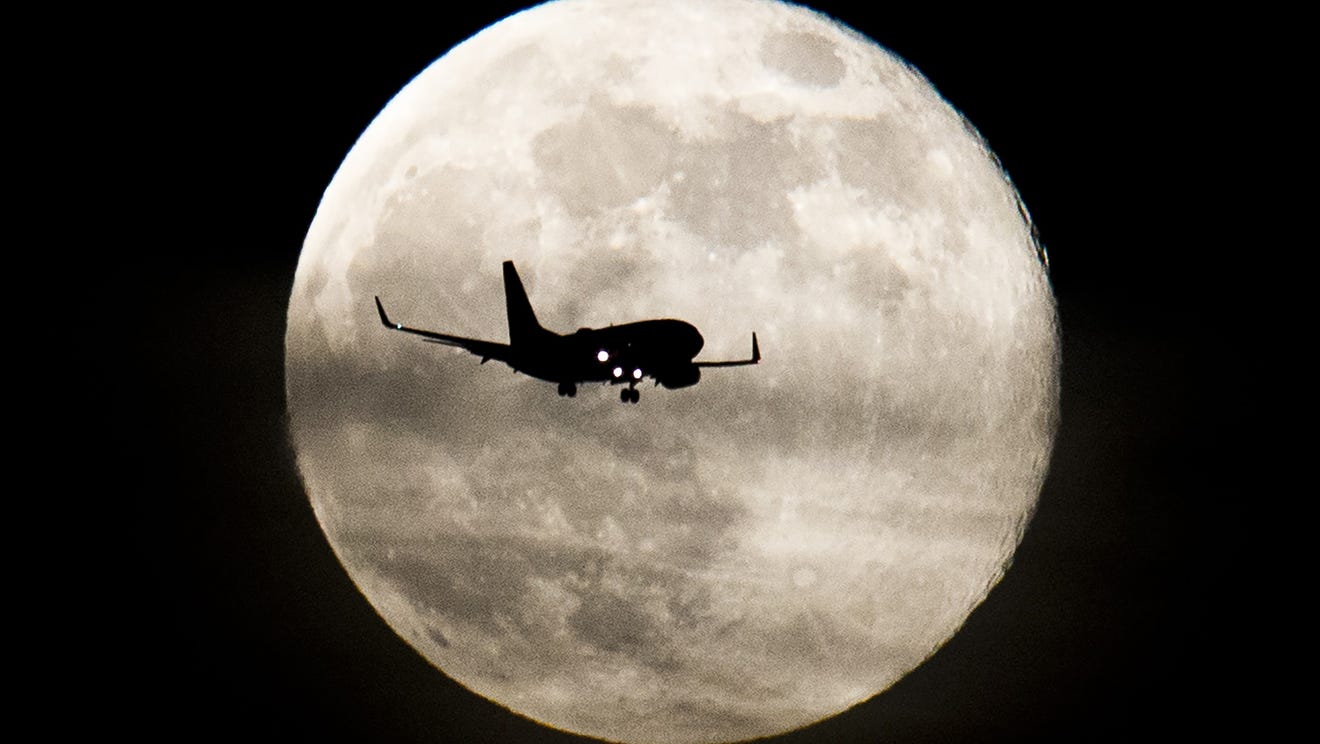
The full Beaver Moon on Tuesday, November 24, 2026, opens a run of three supermoons in a row. It reaches its full phase at 9:53 a.m. Eastern time, and because that moment falls mid-morning, the Moon looks full on the evenings of both Monday, November 23, and Tuesday, November 24.
A supermoon is a full Moon that falls close to perigee, the nearest point in the Moon's orbit. NASA counts a full Moon as a supermoon when it falls within 90 percent of perigee. At that distance the Moon can look up to 14 percent larger and 30 percent brighter than the faintest full Moon of the year, though on its own in the sky the difference is easy to miss. Much of the size you notice at moonrise comes from the Moon illusion, the old trick of perception that makes a low Moon look huge against trees and rooftops.
This Beaver Moon is the second supermoon of 2026. The first came on January 3. At the moment it turns full, the Moon sits about 360,765 kilometres (224,170 miles) from Earth, and it draws closer still the next day, reaching perigee on the afternoon of Wednesday, November 25, about 359,300 kilometres away.
The run keeps going. The Cold Moon follows on Wednesday, December 23, at 8:28 p.m. Eastern, two nights before Christmas and two nights after the winter solstice. At 356,738 kilometres (about 221,700 miles), it is the closest full Moon of 2026. The third, the Wolf Moon, arrives on Friday, January 22, 2027, at 7:17 a.m. Eastern, 357,644 kilometres away, the closest full Moon of 2027 and the year's only supermoon.
Some lists stretch the run to four by adding the Snow Moon on February 20, 2027. At about 363,300 kilometres it sits just outside the usual supermoon line, so NASA counts three. The February Moon is still worth a look: it comes with a penumbral lunar eclipse on the night of February 20 to 21, a faint shading that is easy to miss in a bright sky.
Supermoons arrive in groups because the Moon's orbit is an ellipse, not a circle. Its distance from Earth swings between about 356,500 and 406,700 kilometres over each monthly cycle, and when the close end of that swing lines up with the full phase several months in a row, the supermoons come one after another. The average distance is 238,855 miles.
The November Moon takes its name from the season when beavers finish their lodges for winter, and trappers once set their lines before the freeze. The Cree call it the Frost Moon, and the Tlingit call it the Digging Moon, for animals rooting through fallen nuts in the hardening ground.
For the first one, step outside at moonrise on the evenings of November 23 or 24 and look east. The Moon climbs through Taurus, close to the Pleiades star cluster, and rides high through the long November night. It falls two nights before Thanksgiving, so the timing is easy to remember: the biggest Moon of the autumn is the one just before the holiday.
Source: The Old Farmer's Almanac; NASA.
Image credit: usatoday.com (credit unverified)
As an Amazon Associate I earn from qualifying purchases. If you buy through an active affiliate link, StarPixels may earn a commission at no additional cost to you.