
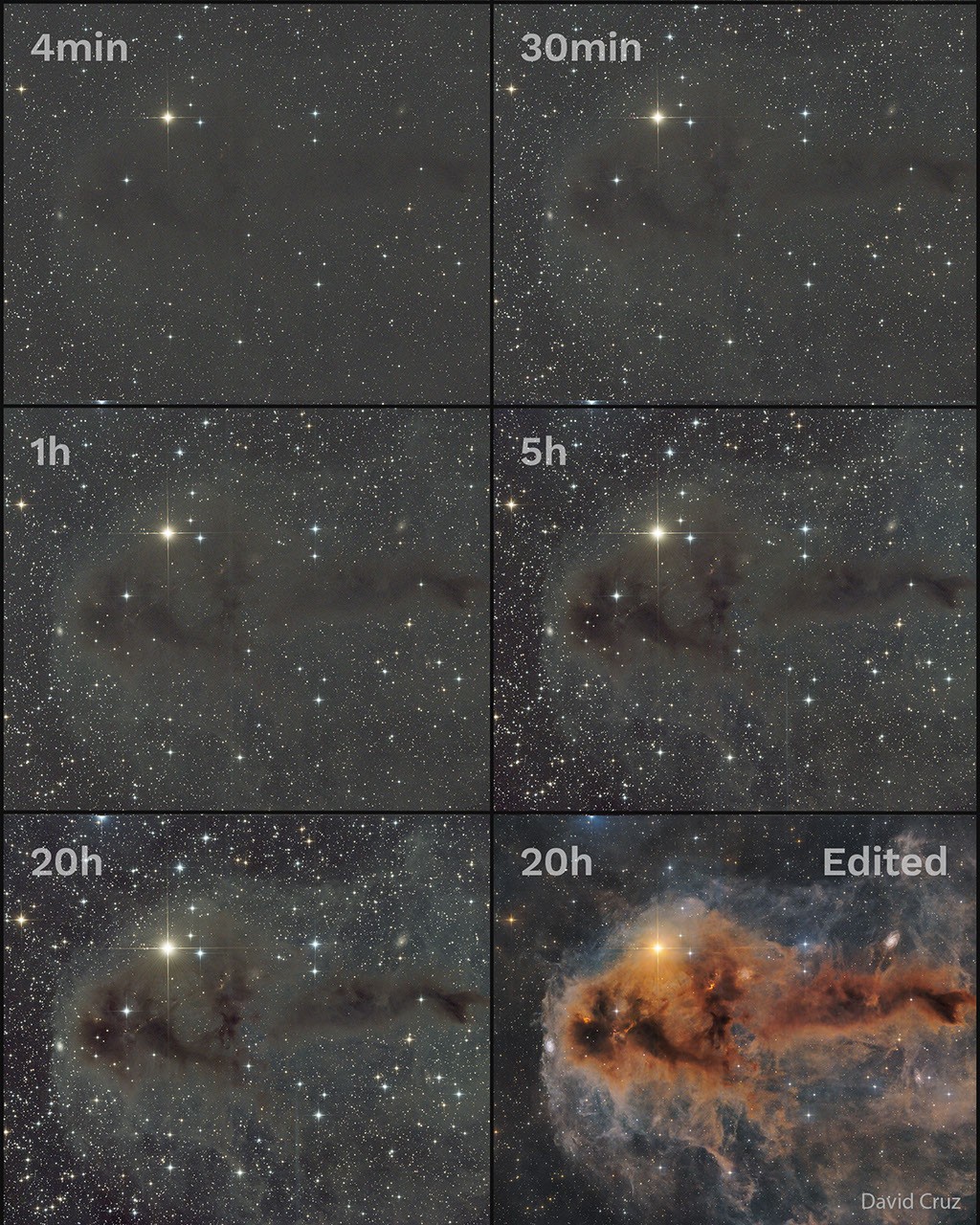
Four minutes into the exposure, the frame looks like any other patch of sky: stars, and nothing else. At thirty minutes, a few dark patches start showing where stars should be. After an hour, then five, then twenty, a strange dark shape keeps growing out of the star field until it fills the frame. The last panel is the same twenty hours, processed: the dust lit up in rust and gold, and the thing has a name. This is Lynds 1251, the Rotten Fish Nebula, as it emerged in NASA's Astronomy Picture of the Day for November 23, 2026.
Lynds 1251 is a dark nebula, a star-forming cloud about 1,000 light-years away in the constellation Cepheus, drifting above the plane of the Milky Way. It belongs to a complex of dark nebulae mapped toward the Cepheus Flare region. The "dark" in its name is literal: the cloud is laced with cold, opaque interstellar dust, grains so thick they block the starlight behind them. What looks like an empty hole in the sky is a cloud dense enough to swallow light.
Behind that dust, stars are forming. The cloud hides the young stars themselves, but their effects leak out into the open: energetic shock waves, fast stellar winds, and narrow jets beamed out from the newborn stars. Where those jets slam into the surrounding gas they light up Herbig-Haro objects, small knots with a telltale reddish glow that hide in the dust. And behind the whole cloud, distant background galaxies lurk in the frame, almost buried behind the dusty expanse.
The name comes in two parts. LDN 1251 is the catalogue number, from Beverly Lynds' 1962 Catalogue of Dark Nebulae, a survey built by inspecting photographic plates for exactly these dark patches. "Rotten Fish" is the community nickname, grown from the object's fish-like silhouette in wide-field photographs. It is not a flattering name, but it has stuck, and it is the one most imagers use.
The six panels are the real story here. Nothing in them is a simulation. The camera collected light for twenty hours, and the dark shape that was invisible at four minutes was there the whole time, waiting for enough photons to arrive. The final panel is digital processing: brightening the image and enhancing the colors, working with light that was genuinely collected. That is the difference between processing and invention, and it is why the sequence works as a picture of patience as much as a picture of a nebula.
Lynds 1251 is not a naked-eye target. It is a long-exposure target for imagers with a telescope and a dark sky, the kind of object that rewards the decision to keep the camera on one patch of sky for a whole night instead of hopping to the next bright thing. Four minutes shows nothing. Twenty hours shows a star-forming cloud a thousand light-years away, with newborn stars, jets, and galaxies hiding behind it.
Source: NASA APOD, "The Emergence of Dark Nebula Lynds 1251," November 23, 2026.
Image credit: David Cruz, via NASA APOD
As an Amazon Associate I earn from qualifying purchases. If you buy through an active affiliate link, StarPixels may earn a commission at no additional cost to you.