
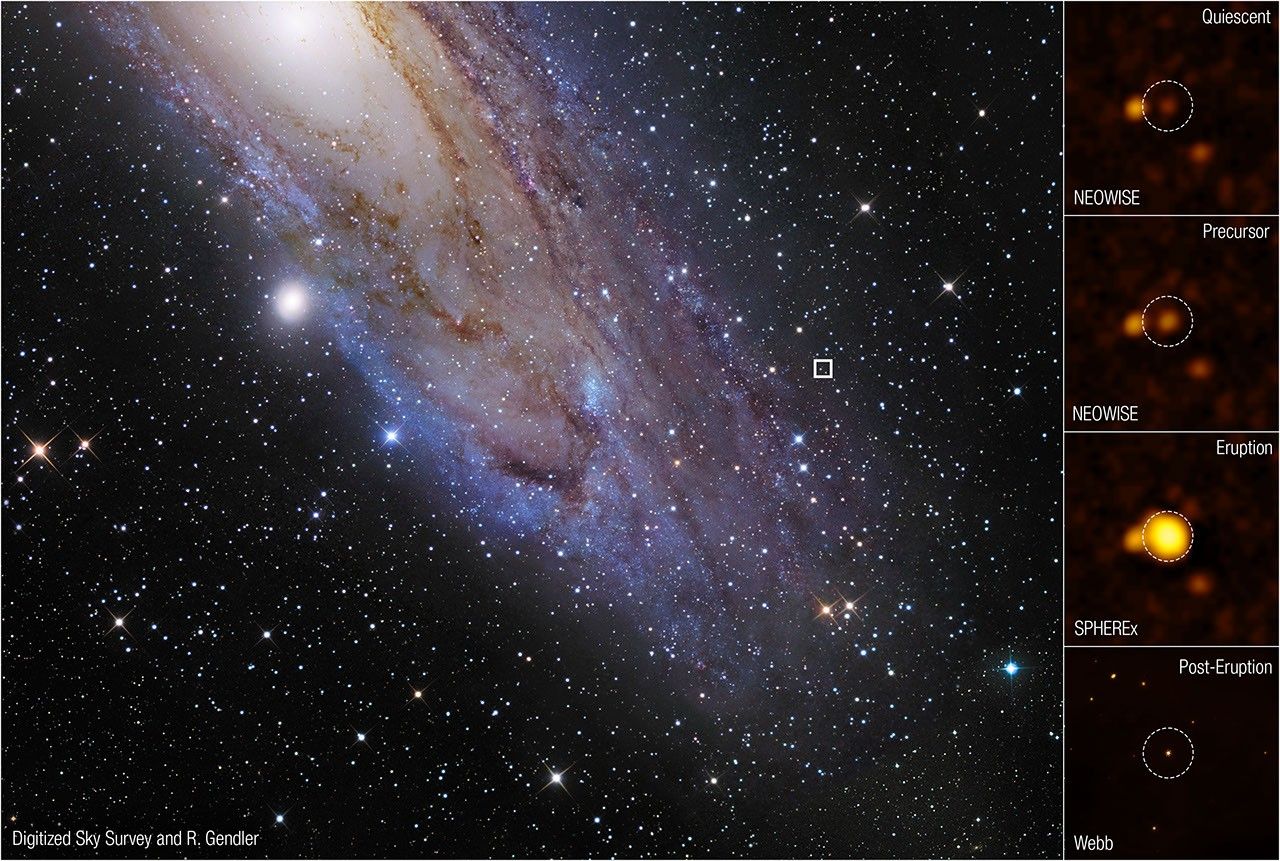
In the outskirts of the Andromeda galaxy, a star slightly less massive than the Sun spiraled into a puffy supergiant star and merged with it. Astronomers have nicknamed the merged star Bao, and the event is the first stellar merger of its kind to be watched as it happened and then reconstructed in full. The discovery was published in Nature on November 18, 2026, and confirmed with observations from NASA's James Webb Space Telescope.
The work was led by Viraj Karambelkar, the first author of the Nature paper and a NASA Hubble Fellow at Columbia University in New York. The discovery was funded in part by NASA, and Webb's follow-up came fast: the telescope observed Bao only 47 days after the stars' eruption peaked, the earliest follow-up ever for an event like this. That speed mattered, because Webb's data let the team piece together what the system looked like before, during, and right after the merger.
Bao first caught the team's attention in February 2023, when they spotted an unusual variable star in data from NASA's retired NEOWISE mission. Before 2018, the object had held a steady brightness. Then it started to change. Observations from the Wide-field Infrared Transient Explorer, known as WINTER, in September 2024 showed Bao beginning to brighten and throw off dust. In July 2025, NASA's SPHEREx telescope caught Bao fading fast in visible light and brightening in infrared light during a routine survey. The Zwicky Transient Facility detected the eruption itself on October 17, 2025, watching the stars brighten sharply and heat up. In November 2025, the team got fast-turn observations from NASA's now-retired Neil Gehrels Swift Observatory and from NOIRLab's Gemini North telescope in Hawaii. Webb's observations followed on December 24, 2025, through the telescope's Director's Discretionary Time program.
Before their transformation, the two stars had spent millennia orbiting each other as a quiet binary pair. Once the smaller star touched the surface of the giant, the end came fast: the pair merged after only seven orbits, about seven years. Other known binary star mergers, involving two smaller stars, took thousands of orbits to finish. The outburst itself was just as abrupt. The team had expected an outburst from such a bloated star to take years to develop. Instead, its brightness started rising one day and peaked within a week, according to co-author Nadia Blagorodnova, an associate professor at the University of Barcelona in Spain.
What happened between the stars is a high-stakes process called common envelope evolution. As the companion star began to interact with the outer surface of the primary star, it produced a slow brightening that the team clearly saw in Bao's data. The companion kept peeling off the primary star's outer layers as it orbited, and that gas flowed away into the surrounding space. The primary star then engulfed the smaller star, and the companion plummeted inward, spiraling through the shared envelope as drag robbed it of orbital energy. Webb's data proved the stars merged, but a merger was not the only possible outcome for a system like this.
In other systems, both stars survive the process. They shed a lot of mass along the way but stay independent in tight orbits, and over time such surviving pairs can turn into neutron stars and black holes, explode as supernovae, produce ripples in space-time known as gravitational waves, and create millisecond pulsars. Measuring how often each outcome happens starts with cases like Bao, where the whole sequence was seen as it unfolded.
The team rebuilt the event by updating their ongoing simulations until one model matched Webb's mid-infrared observations, which recorded the dust shed by the more massive primary star over centuries. The model gave the first mass estimate for the smaller companion, and it also measured the two stars. The primary, nicknamed Big Bao, dwarfed the Sun: seven times as massive, 350 times the radius, and 18,000 times brighter. The companion, Little Bao, was likely less massive than the Sun at about 0.7 solar masses, with a slightly smaller radius and fainter light. The simulations were led by Karel Temmink, a doctoral student at Radboud University in Nijmegen, Netherlands.
The model also raised a question: there might have been enough leftover energy for Little Bao to escape the scene. Further analysis settled it. Little Bao was dragged into Big Bao's core, an encounter co-author Kishalay De, an assistant professor at Columbia University in New York, described as almost like a bomb exploding inside a living star. What the new star, now simply Bao, looks like in the aftermath is still open. Only future observations will show how its mass settles.
The value of Bao goes beyond one dramatic event. Formally known as AT 2025abao, it gave astronomers a way to measure how efficient common envelope evolution is, because they watched the merger in real time and made observations as it happened. In other cases, astronomers have had to work backward from events that may have happened hundreds or even millions of years ago. The team had already published a first paper on the system right before the eruption in 2025, so the record of Bao spans the quiet phase, the brightening, the eruption, and the aftermath in one continuous set of observations across ultraviolet, visible, and near-infrared light from several telescopes in space and on the ground.
More cases like Bao are likely on the way. NASA's recently launched Nancy Grace Roman Space Telescope is about to run vast publicly available surveys, and its Galactic Bulge Time-Domain Survey will turn up a large number of new transient events that could be studied the same way. Karambelkar expects a large influx of similar discoveries just ahead, and each one will test how well the Bao model holds up when a different pair of stars meets the same fate.
Source: NASA, "NASA Data Clinches First-of-Its-Kind Stellar Merger," November 18, 2026; Karambelkar et al., Nature, 2026. Funding in part by NASA's Astrophysics Data Analysis Program.
Image credit: NASA, ESA, CSA, STScI, Viraj Karambelkar (Columbia), Kishalay De (Columbia); image processing: Alyssa Pagan (STScI); acknowledgment: DSS, Robert Gendler
As an Amazon Associate I earn from qualifying purchases. If you buy through an active affiliate link, StarPixels may earn a commission at no additional cost to you.