
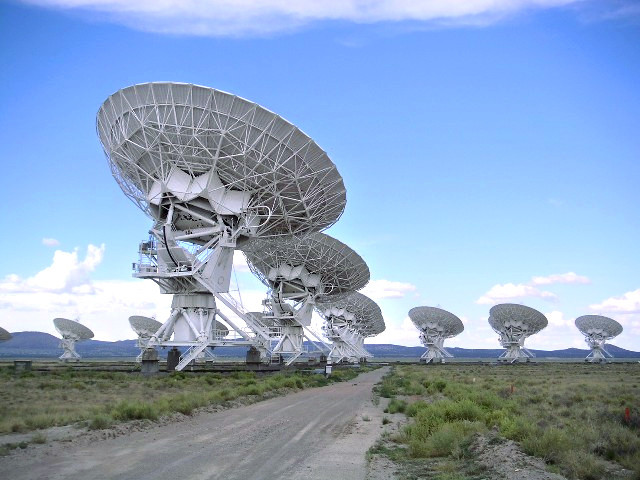

The universe has a hidden layer. Strip away the visible light, and it's been broadcasting in radio waves this whole time.
We think of the night sky as stars and darkness. But that's only what our eyes can see. Shift to radio wavelengths, and the sky transforms into something completely alien — and far more revealing.
What the Radio Sky Looks Like
If your eyes could detect radio waves instead of visible light, the familiar constellations would vanish. In their place:
- The Milky Way would glowwith synchrotron radiation — charged particles spiraling through galactic magnetic fields, emitting radio waves as they go.
- Dead stars would pulse like lighthouses. Pulsars — rapidly spinning neutron stars — sweep twin radio beams across the cosmos with metronomic precision. Some rotate hundreds of times per second.
- The entire sky would hum. In every direction, a faint, uniform glow: the cosmic microwave background (CMB), relic radiation from 380,000 years after the Big Bang. It's the oldest signal in existence.
This isn't hypothetical. Radio telescopes see this sky every night.
The Accidental Discovery
Radio astronomy was born by accident.
In 1932, Karl Jansky was working at Bell Telephone Laboratories in Holmdel, New Jersey. His job was straightforward: find the source of static that was interfering with transatlantic radio communications.
He built a rotating antenna — nicknamed the "merry-go-round" — and began cataloging sources of interference. He found thunderstorms. He found nearby electrical equipment. And he found a persistent hiss that peaked once every 23 hours and 56 minutes.
That period matched the sidereal day — the time it takes Earth to rotate relative to the stars, not the Sun. The static wasn't coming from Earth. It was coming from the center of the Milky Way.
Jansky published his findings. TheNew York Timesran a front-page story. And then... almost nothing happened. Bell Labs reassigned him. The astronomy community largely ignored the discovery. It would take nearly a decade before anyone followed up.
What Radio Telescopes Have Found
Since Jansky's accidental discovery, radio astronomy has revealed objects and phenomena that optical telescopes simply cannot detect:
Pulsars— Discovered by Jocelyn Bell Burnell in 1967, pulsars are the collapsed cores of massive stars. They spin rapidly and emit focused beams of radio waves. The regularity of their pulses is so precise they were initially dubbed "LGM-1" — Little Green Men.
Quasars— Intensely luminous cores of distant galaxies, powered by supermassive black holes consuming matter at extraordinary rates. Many were first identified by their radio emissions.
The Cosmic Microwave Background— Discovered by Arno Penzias and Robert Wilson in 1965 (also at Bell Labs, also by accident), the CMB is the thermal afterglow of the Big Bang. It permeates the entire observable universe and provides a snapshot of the cosmos at just 380,000 years old.
Fast Radio Bursts— Millisecond-duration radio pulses from billions of light-years away. First detected in 2007, their origins are still being investigated. Some repeat; most don't.
The Invisible Majority
Visible light represents a tiny sliver of the electromagnetic spectrum. Radio waves sit at the opposite end — longer wavelengths, lower energies, and a completely different view of the universe.
Some of the most important objects in astrophysics — pulsars, the CMB, neutral hydrogen clouds, galactic magnetic fields — are invisible to optical telescopes. They exist only in the radio sky.
The universe didn't just happen to have a radio layer. It's been broadcasting since before stars existed. We just needed to build the right kind of ears.
Looking Forward
The next generation of radio telescopes — the Square Kilometre Array (SKA), spanning South Africa and Australia — will be the most sensitive radio instrument ever built. It will map the distribution of neutral hydrogen across cosmic time, search for signals from the epoch of reionization, and potentially detect technosignatures from other civilizations.
The universe has always been talking. We're just getting better at listening.
Sources
- NRAO —Karl Jansky and the Discovery of Cosmic Radio Waves
- NASA Science —The Electromagnetic Spectrum: Radio Waves
- ESA/Planck —Cosmic Microwave Background
- NRAO —Pulsars
- NASA —Synchrotron Radiation
Further reading and primary sources
As an Amazon Associate I earn from qualifying purchases. If you buy through an active affiliate link, StarPixels may earn a commission at no additional cost to you.