
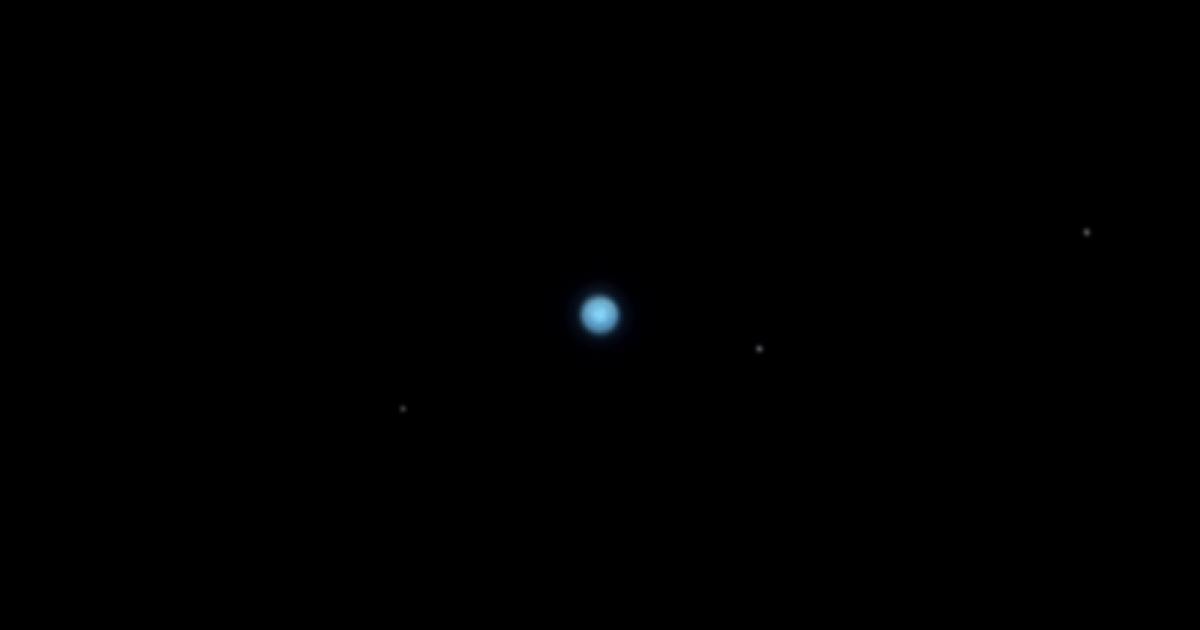
Uranus reaches opposition on Wednesday, November 25, 2026. That is the night Earth sits directly between the Sun and Uranus, so the planet rises around sunset, stays up all night, and shines as bright as it gets all year. It will not get brighter than this until next November.
You will find it in Taurus, midway between the orange star Aldebaran and the Pleiades star cluster. Around 10 p.m. local time it sits about 60 degrees above the southeastern horizon, roughly 1.5 degrees south of the 4th-magnitude star 37 Tauri. The two clusters make it easier to find than in most years: draw a line from Aldebaran to the Pleiades, and Uranus is in the middle of it.
At opposition Uranus is about 1.71 billion miles away, and its disk spans just 4 arcseconds — a tiny dot even in a telescope. It shines at magnitude 5.6, which puts it right at the edge of what the unaided eye can pick out, and only from a truly dark sky. From Denton, binoculars are the honest tool. In binoculars, look for a steady blue-green point of light that does not twinkle the way stars do. A small telescope turns that point into a small greenish-blue disk. That color is real: methane high in the planet's atmosphere soaks up red light and leaves the blue-green behind.
There is a catch this year, and it is a big one. The full Beaver Moon falls on November 24, and on opposition night it sits only about 5 to 6 degrees from Uranus. A full Moon that close washes out a magnitude 5.6 target, and no amount of staring fixes that. Pete Lawrence, writing in BBC Sky at Night Magazine, picks the night of Sunday, November 22 as the better shot instead: Uranus is due south around 00:15 UT at 58 degrees up, and the Moon is a little farther away. If you can only go out on the 24th or 25th, use the Pleiades and the Hyades as signposts and expect a washed-out field — binoculars or a small telescope are not optional those nights.
The Moon is busy in the same patch of sky all week. It passes less than a degree from the Pleiades on November 23 to 25, and on November 24 it occults — passes directly in front of — individual Pleiades stars, an event visible from parts of North America. On November 25 and 26 the waning gibbous Moon joins Aldebaran and Betelgeuse in a near-equilateral triangle spanning roughly 20 degrees a side.
Opposition is the best time to see Uranus, but this year the best night is not the opposition night. Go out on the 22nd if you can. Bring binoculars, find the gap between Aldebaran and the Pleiades, and look for the one blue-green point that refuses to twinkle.
Source: Astronomy.com, "The Sky This Week from November 20 to 27: Uranus at opposition" and "November 2026: What's in the sky this month?"; BBC Sky at Night Magazine, November 2026 stargazing roundup.
Image credit: Astronomy.com (credit unverified)
As an Amazon Associate I earn from qualifying purchases. If you buy through an active affiliate link, StarPixels may earn a commission at no additional cost to you.