
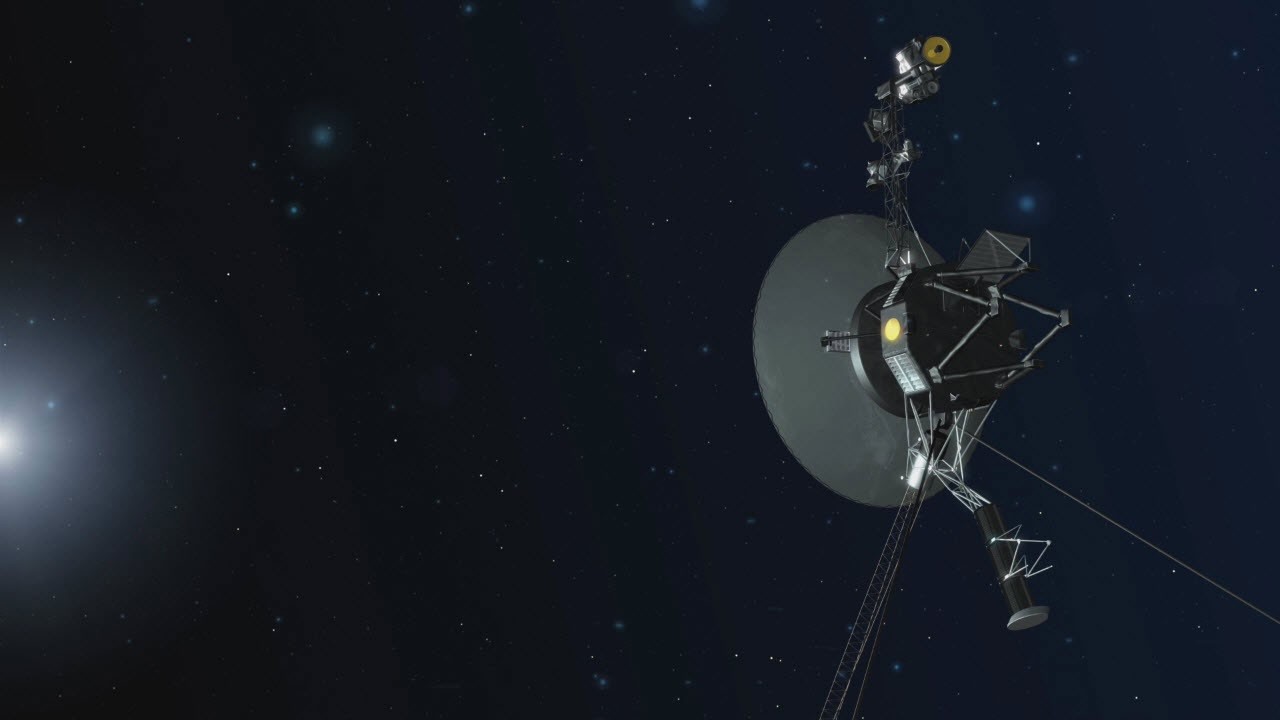
On Wednesday morning, November 18, 2026, Voyager 1 becomes the first human-made object to sit one full light-day from Earth. At 5:16:07 a.m. Eastern Time, 4:16 a.m. Central, the spacecraft crosses 16.094 billion miles from home. A radio signal leaving Earth on that morning takes a full day to reach it, and any answer takes another full day to come back.
THE DISTANCE
A light-day is the distance light covers in 24 hours. Light moves at about 186,282 miles per second, so one light-day works out to roughly 16.1 billion miles. Voyager 1 has been closing on that mark since it left Earth on September 5, 1977, and on November 18, 2026, it gets there, 49 years, two months, and 11 days after launch.
The gap keeps growing. Voyager 1 is moving away from the Sun at roughly 38,000 miles per hour, faster than any other human-made object. Every day adds about 900,000 miles to the distance. A command sent from Earth on a Monday is not answered until Wednesday.
STILL FLYING AFTER 49 YEARS
Voyager 1 was built to last five years. Its job was a flyby of Jupiter in 1979 and Saturn in 1980, and it did both, sending back the first close-up pictures of the two giant planets and their moons. After Saturn, it kept going, climbing out of the plane of the planets and heading for the edge of the solar system.
In August 2012, it crossed into interstellar space, the region between the stars, becoming the first spacecraft to leave the Sun's bubble of charged particles. It still sends data back from there, powered by a radioisotope generator that turns heat from decaying plutonium into electricity. Its twin, Voyager 2, followed into interstellar space in 2018 and trails behind it, the only other spacecraft out there.
NASA engineers have kept Voyager 1 alive by switching off heaters and instruments one at a time as its power fades, stretching what is left. The agency expects to keep hearing from it into the 2030s, though each year the signal gets fainter and the list of working instruments gets shorter.
SAY HELLO ON TUESDAY NIGHT
NASA is marking the milestone with an event called Shine Bright for Voyager's Light-Day. On the night of Tuesday, November 17, 2026, anyone can step outside after sunset and flash the letters V-G-R in Morse code toward the sky with a flashlight or a phone. The flashes will not reach the spacecraft. That is not the point. The point is that millions of people can look up at the same sky on the same night and think about a machine, built before most of them were born, still flying farther than anything else humans have made.
The Jet Propulsion Laboratory hosts a public discussion of the Voyager mission on Thursday, November 19, 2026.
WHY IT MATTERS
Voyager 1 is the farthest thing humans have ever sent anywhere, and it keeps setting firsts nearly half a century after launch. It left Earth when Jimmy Carter was president, when computers filled rooms, and when no one had seen the rings of Saturn up close. It is still flying, still talking, and on November 18, 2026, it reaches a distance measured in days of light. If you said hello on the night of November 17, the answer would not come back until November 19.
Image credit: Artist's concept: NASA/JPL-Caltech.
Source: NASA/JPL-Caltech Voyager mission; EarthSky, November 2026.
As an Amazon Associate I earn from qualifying purchases. If you buy through an active affiliate link, StarPixels may earn a commission at no additional cost to you.