
United Launch Alliance's Vulcan rocket failed on November 15, 2026, about 10 minutes after liftoff from Cape Canaveral Space Force Station in Florida, and the 40 Amazon Leo broadband satellites it carried never reached orbit. ULA confirmed the loss in a statement on November 15, 2026, saying the vehicle "suffered an anomaly 10 minutes into the flight and failed to deliver the Amazon mission to orbit." The flight, designated Vulcan Leo 1 or LV-01, was the first of 38 Vulcan missions Amazon has booked with ULA, and it was Vulcan's return to flight after a solid rocket booster nozzle anomaly during a launch in February 2026.
Liftoff came at 12:40 p.m. EST on November 15, 2026, from Space Launch Complex-41. ULA posted its statement at 1:30 p.m. ET on November 15, 2026, about 50 minutes after liftoff. "Based on data received by our Launch Director, we confirm that the Vulcan vehicle launched from Space Launch Complex 41 suffered an anomaly 10 minutes into the flight and failed to deliver the Amazon mission to orbit," ULA said. "Since the anomaly just occurred, we don't have any specific data yet to understand what occurred today." ULA added that it will work closely with its customer and other appropriate organizations to find the cause, determine the appropriate corrective action, and return to flight as quickly as possible.
Amazon Leo responded on November 15, 2026 with a short statement of its own. "There is risk with any launch, and that's especially true for inaugural missions like LV-01," the company said. "ULA has been a trusted partner for Amazon, and we believe they'll learn from this mission and deliver on their long-term plans for Vulcan." The 40 satellites were the largest single batch of Leo satellites Amazon had loaded onto one rocket, and LV-01 was the opening mission of a 38-launch commercial partnership between Amazon and ULA. Amazon Leo is built around an initial constellation of more than 3,000 advanced low Earth orbit satellites, meant to provide fast, reliable internet to customers and communities around the world, including places unserved or underserved by traditional connectivity.
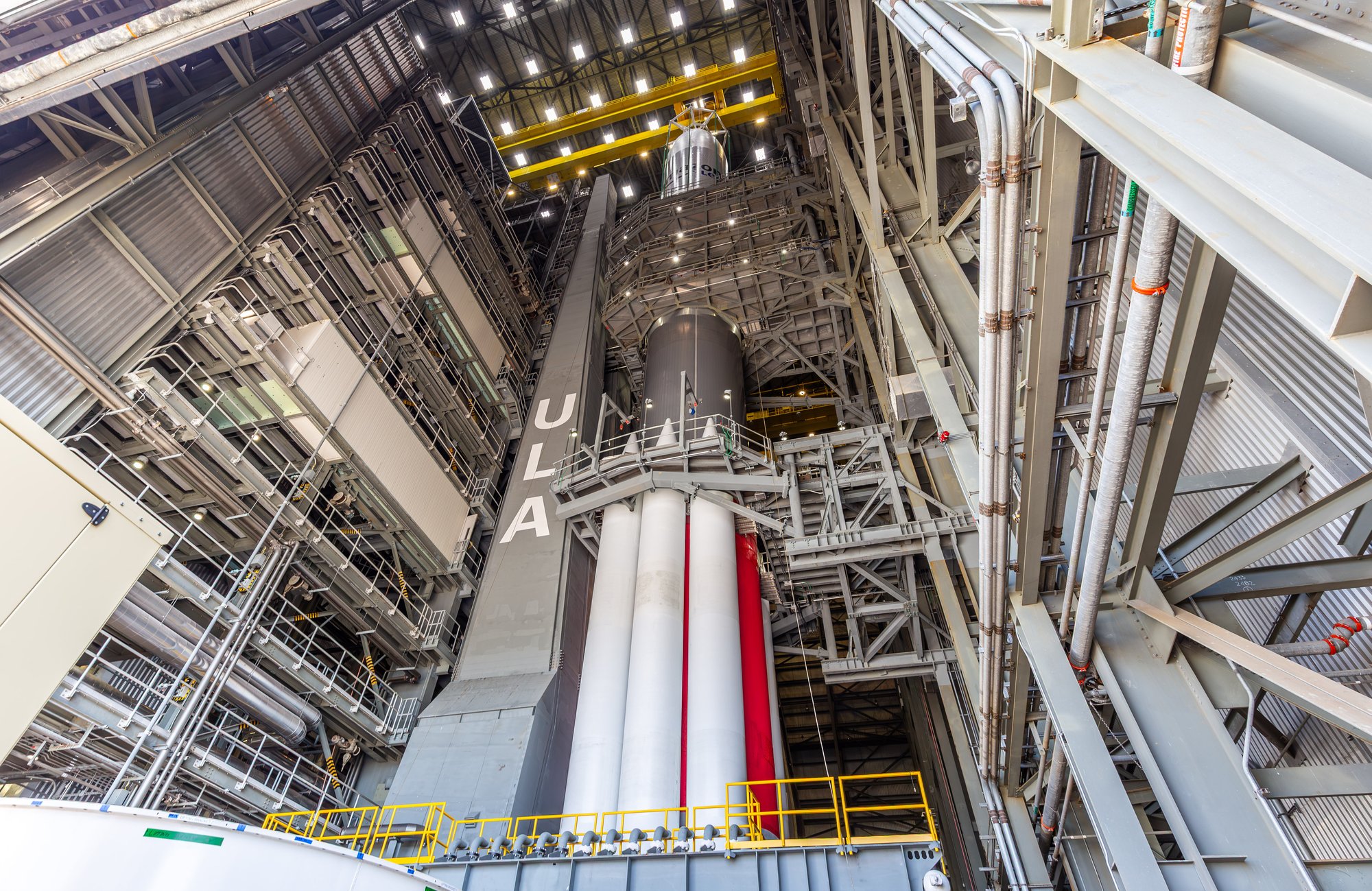
The rocket was Vulcan V-012, flying in the VC6L variant with a full complement of six solid rocket boosters and a longer-length payload fairing. It also carried the first low Earth orbit optimized Centaur V upper stage, built to haul large batches of satellites. The fully assembled rocket stood 215 feet tall (65.5 meters) and weighed 1.99 million pounds (903,500 kilograms) once fueled with cryogenic propellants. At liftoff, its two BE-4 main engines and six side-mounted boosters generated 3.9 million pounds (17.2 megaNewtons) of thrust. Vulcan Leo 1 was set to deliver more than 50,000 pounds (22,700 kilograms) of payload to orbit, a new record for ULA. The rocket was assembled in the Amazon Vertical Integration Facility (VIF-A) aboard the Amazon Vulcan Launch Platform (VLP-A), creating a second launch processing lane for ULA operations at the Cape.
The flight plan called for a fast climb. Vulcan was to go supersonic at 37 seconds and pass the region of maximum dynamic pressure at 55 seconds, heading northeasterly toward a 51.9-degree orbit. Each GEM 63XL solid rocket booster consumes more than 100,000 pounds (45,400 kilograms) of propellant, providing three-quarters of the total liftoff thrust, with burnout about a minute and a half into flight. The first stage was to burn for about five minutes, then shut down and separate east of Charleston, South Carolina. The dual RL10C-1-1A engines on the Centaur V would then ignite, the 70-foot-long (21.3-meter) payload fairing would be jettisoned, and the first Centaur burn would last nearly 12 minutes to reach a preliminary parking orbit. After a 50-minute coast, a second burn at 66 minutes would circularize the orbit at approximately 285 miles, and the satellite deployments would begin at 70 minutes, lasting 25 minutes across 16 separation events: the first four events releasing one satellite each and the final 12 releasing three at a time.
The February 2026 anomaly drove a rigorous investigation by ULA, Northrop Grumman, the U.S. Space Force and other government agencies, including analysis, laboratory-level material testing, component testing and a full-scale hot fire of a GEM 63XL motor in Utah. The team identified three credible causes and took steps to mitigate all three, and those changes to the nozzle, its design and how it was built, were tested thoroughly and incorporated into the boosters on this mission. The investigation continues in parallel, with more analysis and tests planned. The flight was also the first chance to gather flight data on the redesigned booster nozzle. ULA president and CEO Mark Peller said every flight generates data and teaches something: "As with any new rocket, there are risks associated with every launch, and particularly as we are early in this phase of introduction of Vulcan to the market and working to a regular operational tempo." He also noted that during the first four Vulcan missions, the rocket "successfully completed all of those missions, giving the spacecraft both a smooth ride and precise, bullseye orbital injections."
What caused the November 15, 2026 anomaly is unknown, and ULA gave no date for a return to flight. The company said it will work with Amazon and other organizations to find the cause and determine the corrective action. Amazon, for its part, is standing by its launch partner while the investigation runs. The loss takes the opening flight out of the 38-mission Vulcan plan, and the next steps depend on what the flight data shows.
Image credit: United Launch Alliance
Source: United Launch Alliance statement, November 15, 2026 (via @ulalaunch) and ULA mission blog "Vulcan Leo 1: Delivering 40 satellites to space," November 10, 2026; Amazon Leo statement, November 15, 2026.
As an Amazon Associate I earn from qualifying purchases. If you buy through an active affiliate link, StarPixels may earn a commission at no additional cost to you.