
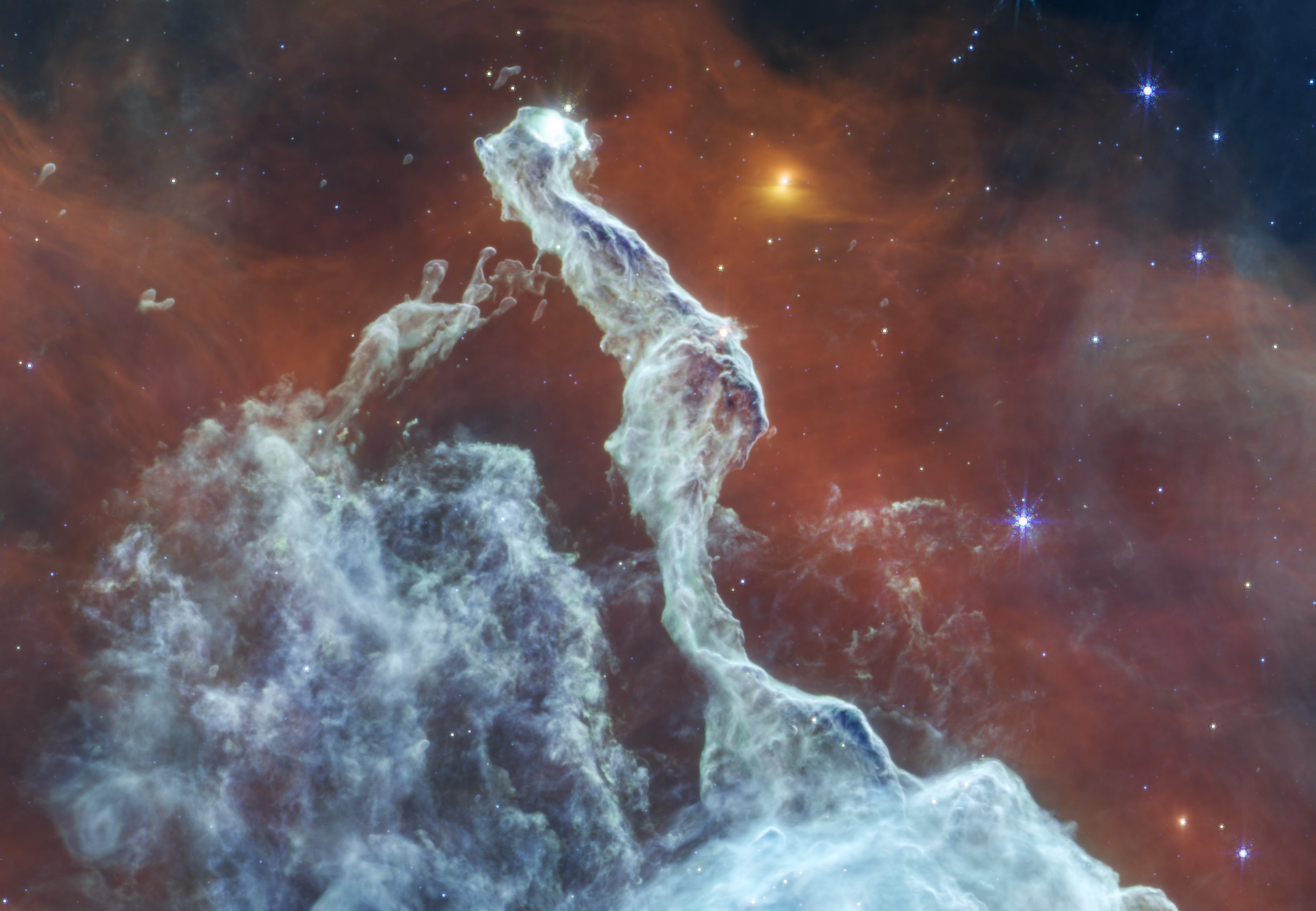
In NASA's James Webb Space Telescope's mid-infrared image, emission from warm dust and carbon-based molecules excited by starlight outlines intricate structures within the Cat's Head Nebula. Changes in local conditions and compositions cause variations in color and brightness. Fine strands and globules are especially apparent to the left of the main pillar. To the right of the pillar, a bright yellow light source is seen against reddish mid-infrared emission, probably an infant star embedded in dust. Intense ultraviolet radiation and winds from massive stars in the Carina Nebula likely sculpted the pillar's distinctive shape, while the denser material in the pillar resists that erosion, at least for now. This is Webb's mid-infrared (MIRI) view of the same object Hubble photographed in visible light — a different view, not the same image.
Source: NASA, "NASA's James Webb Space Telescope captures eerie Cat's Head," October 29, 2026.
Image credit: Image: NASA, ESA, CSA, STScI; Image Processing: Joseph DePasquale (STScI).
As an Amazon Associate I earn from qualifying purchases. If you buy through an active affiliate link, StarPixels may earn a commission at no additional cost to you.