
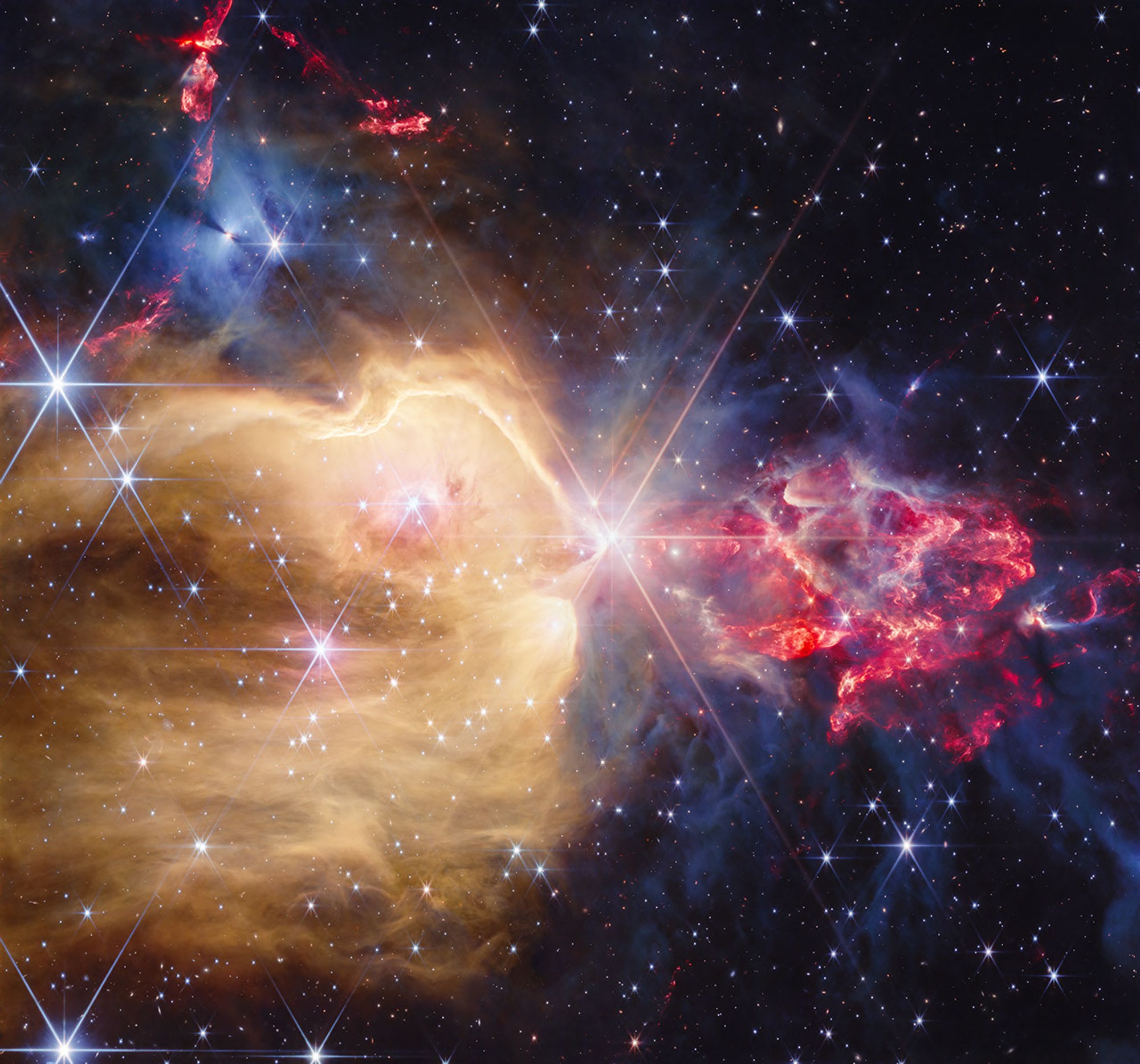
NASA's Astronomy Picture of the Day for November 16, 2026 features a James Webb Space Telescope view of NGC 7129, a stellar nursery about 3,300 light-years from Earth in the constellation Cepheus. The image was released by NASA, ESA and the Canadian Space Agency on October 6, 2026, and it shows stars at different stages of formation side by side: mature stars carving a golden cavity on one side, and protostars blasting red outflows on the other. The picture was taken with Webb's Near-Infrared Camera, NIRCam, which sees through the dust that hides young stars from visible-light telescopes.
The brightest object in the frame is the central star, LkHα 234, pronounced Lick-H-alpha, a pre-main-sequence star weighing around 5 to 8 times the mass of the Sun. Pre-main-sequence stars have mostly finished gathering mass and are contracting under gravity, causing their temperatures to rise. In time, LkHα 234 will fuse its own hydrogen like the Sun. It is the most massive and the most mature star in the region, and it wears the image's most prominent diffraction pattern, the eight-pronged spikes Webb's optics put around bright stars. The cavity to its left, glowing gold and spanning about 3.5 light-years, is the largest demonstration of the star's impact. Outflows from an earlier stage of the star's life carved into the dense molecular cloud of hydrogen, and both the outflows and the star's light energise the gas, causing it to glow. Much of the hydrogen is blown away, but a large amount is compressed, creating the conditions for even more stars to form.
A few of those stars are visible inside the cavity. Several are also pre-main-sequence and emit stellar winds, and the bow shocks near them, curved walls of compressed gas, are created as those winds push into the energetic gas and carve smaller cavities of their own. Together, the central and embedded stars create the sharp ridge seen at the top of the golden cavity. Their light generates a hot environment that pushes against the colder and denser molecular gas outside the cavity, creating a boundary known as a photodissociation region, where the molecules of hydrogen break down into atoms. By influencing the temperature and chemistry of the region, this collection of stars shows how molecular clouds gradually erode over millions of years.
The region to the right of the central star tells a different, equally chaotic story. The clumpy matter shown in red hides much younger objects than those on the left: protostars. The protostar stage is earlier than the pre-main-sequence stage and occurs after molecular clouds of gas and dust compress and fragment. As the protostars accumulate matter and increase their mass, they eject outflows of superheated material. These outflows interact with the dense, grey matter the protostars are wrapped within, creating shocks that cause a textured appearance, and the red glow is the result of that interaction. Multiple outflows from multiple stars overlap from our point of view, which gives the scene its chaotic look. More protostellar outflows can be seen at the upper left of the image, near a blue-colored nebula. The centre of that blue region hosts a protostar surrounded by a donut-shaped disk of material, and the disk casts a shadow against the surrounding nebula, similar to the Bat Shadow structure Hubble observed.
The colours in the image are a code for the gas itself. The golden region on the left is hot, atomic hydrogen, while the red region on the right is cooler, molecular hydrogen, shocked and heated where protostar outflows slam into it. The coldest, densest gas, where protostars have yet to form, is shown in gray.
Reading the frame is a tour of the cluster's ages. The yellow region covers about two-thirds of the image, stretching from the central star to the left border and along the bottom, with several blue stars of different sizes embedded in it. The top third, outside the yellow region, holds a few bright protostars in dense gray gas, and those stars light the gas so it appears blue. A few red outflows from other protostars sit above that grayish-blue region. To the right of the central star, the clumpy, flame-like plume of red dust and gas is about one third the size of the yellow region, and the protostars inside it emit a soft white light.
The image combines six NIRCam filters, F115W, F187N, F200W, F335M, F444W and F470N, with colours assigned to each: blue is F115W and F187N, cyan is F200W, yellow is F335M, and red is F444W and F470N. Webb's infrared light pierces the dense matter that scatters or absorbs other types of light, which is why so many stars that dust once hid are now visible. The frame is about 6 arcminutes across, or 5.7 light-years at the cloud's distance, and it sits at right ascension 21 hours 43 minutes 5.02 seconds and declination plus 66 degrees 6 minutes 45.83 seconds. The data were taken on December 17, 2025, under proposal 12491, led by M. Garcia Marin, and the image was processed by Alyssa Pagan of the Space Telescope Science Institute. Background galaxies are strewn throughout the frame. NASA's retired Spitzer Space Telescope observed the same gas and dust before, at lower resolution; Webb's view shows more detailed filaments and many more background galaxies.
The value of the picture is that it holds stars at different stages of development in a single frame. The more massive stars form and evolve the fastest, so one image captures a spread of ages, from protostars still wrapped in their cocoons to a central star nearly ready to burn hydrogen. Studying stars at different stages shows which physical processes matter most and when, and astronomers will keep using this Webb data to study how the stars and protostars in the region influence the surrounding gas and dust.
Image credit: NASA, ESA, CSA, STScI; Image Processing: Alyssa Pagan (STScI)
Source: ESA/Webb photo release weic2620, "Webb captures commotion from nebula's stellar jets," October 6, 2026; NASA Astronomy Picture of the Day, November 16, 2026; NASA Webb asset page for NGC 7129 (NIRCam image).
As an Amazon Associate I earn from qualifying purchases. If you buy through an active affiliate link, StarPixels may earn a commission at no additional cost to you.