
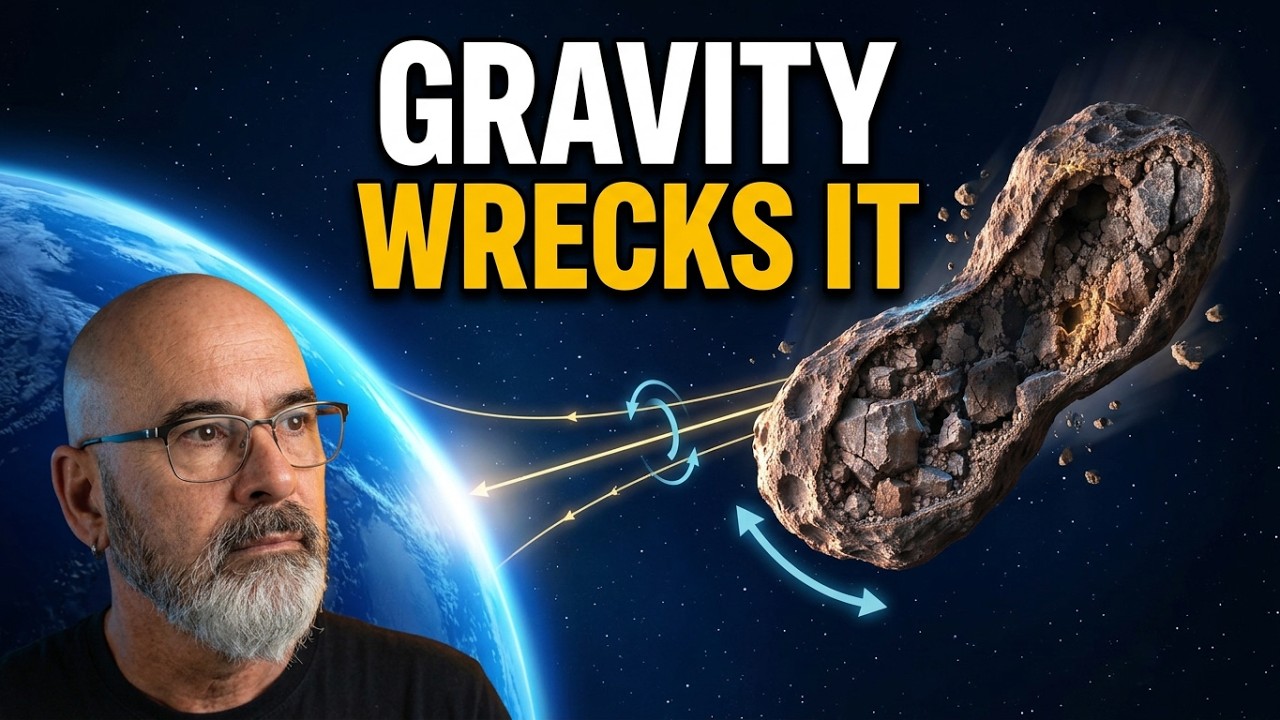
On Friday, April 13, 2029, the asteroid Apophis will pass about 20,000 miles above Earth's surface, closer than our own weather satellites. It will miss. That much is settled. The real story is the other direction: what Earth will do to Apophis through gravity, in a single close pass, to a rock about 1,200 feet long.
THE SAFE FLYBY
Apophis will miss Earth in 2029. Say that first, because the clickbait says otherwise. At 20,000 miles up, it comes closer than geostationary satellites, which sit about 22,000 miles above the equator, matching Earth's rotation so they appear to hang in one place overhead. Apophis comes closer than those satellites, and closer than the ring of space junk that shares their orbit.
It does not fly through them. Apophis arrives on a tilted path that never crosses the equatorial ring, so the satellites and the debris stay out of its way. The pass is close, and it is clean.
THE SCALE
Apophis is about 1,200 feet long, roughly four football fields laid end to end, and about the same size as the Empire State Building is tall. Set against Earth's size, that sounds small. Set against anything humans have ever touched in space, it is enormous, and it is coming within 20,000 miles of us.
WHAT GRAVITY DOES
Earth's gravity will pull on every part of Apophis, but it will pull harder on the closer end than on the farther end. That uneven pull is torque, the same twist you get pushing on one end of a bar. Apophis sweeps past at about four and a half miles a second, and how much of a twist it gets depends on how it happens to be oriented at closest approach.
The twist matters because Apophis already tumbles. Radar shows it rotating with a wobble, roughly once every 30 hours, without a single fixed axis. The flyby's torque will change that spin. How much depends on the asteroid's exact orientation and on what it is made of inside, and both are open questions.
The inside is the bigger unknown. Apophis may be a loose pile of rubble barely held together by its own faint gravity, rather than a single solid rock. That is what the spacecraft we have sent to other asteroids found. When NASA's OSIRIS-REx touched down on Bennu in 2020, the surface gave way like a pit of plastic balls. Japan's Hayabusa2 found the same loose structure at Ryugu. Every asteroid we have touched or landed on so far has turned out to be a rubble pile. That does not prove Apophis is one, but scientists think it is close.
If it is, Earth's gravity could rearrange it. The torque could shift loose rocks and surface debris, trigger quakes and landslides on the asteroid, and change the forces holding the surface material in place. Computer models are exploring how the rocks might move, but nobody knows exactly how much of the surface will shift.
The flyby will also change Apophis's path around the Sun. Earth's gravity redirects its orbit, even changing the class of asteroid it is, from Aten to Apollo. Most models show its year shifting from about 323 days to about 425 days.
HOW WE KNOW IT WILL MISS
In March 2021, Apophis passed almost 11 million miles from Earth, and astronomers bounced radar signals off it from the Goldstone dish in California and the Green Bank Telescope in West Virginia, then listened to the echoes. The radar images were grainy, but they pinned the orbit down closely enough for NASA and the European Space Agency to remove Apophis from the impact risk list for at least the next 100 years.
The radar also gave a clue to its shape: two lobes, like a crooked peanut, tumbling as it turns. That shape is inferred, not photographed. Nobody has seen or photographed Apophis at high resolution.
THE MISSING BEFORE PICTURE
Knowing what changed requires knowing what it looked like before. To measure an asteroid quake, you need instruments at the fault, and to tell which rocks moved, you need a picture sharp enough to pick them out. Right now, nobody has one.
NASA is sending a spacecraft: OSIRIS-APEX, the same spacecraft that visited Bennu, renamed for its new job. The problem is orbital mechanics. It arrives after the close flyby, catching up to Apophis in June 2029. When it gets there, a bright patch of fresh rock or a shifted boulder will not tell scientists whether Earth's gravity caused it, because there is no before picture to compare against.
OSIRIS-APEX will still do real work. Since it left its sample-collection arm behind in the Utah desert with the Bennu sample, it will hover just above the surface and use its thrusters to blow back dust and loose rocks, exposing what lies underneath. It will spend the next year and a half at Apophis collecting data, and its gravitational measurements will help interpret what Ramses sees.
RAMSES IS RACING TO GET THERE FIRST
The European Space Agency, with the Japanese Space Agency, built Ramses to study Apophis before and during the close approach. A deep-space planetary mission can take eight to ten years to develop. Ramses is racing toward a planned April 2028 launch window, and that window is the deadline. Miss it, and Ramses misses its chance to get there before the flyby.
Ramses can move fast because it reuses the chassis and instruments from ESA's Hera asteroid mission, and Japan is providing the rocket. With an on-time launch, it reaches Apophis in February 2029, two months before the encounter. Those two months are critical: Ramses establishes the baseline, the high-definition before picture, then stays with Apophis and photographs and measures the surface repeatedly as it passes Earth.
Ramses carries two CubeSats. Farinella carries a dust analyzer and a low-frequency radar that sends radio waves through Apophis to scan how its internal blocks are stacked. Don Quijote is built to land on the asteroid and continuously monitor the surface for asteroid quakes.
WHAT WE WILL SEE FROM EARTH
Apophis will be visible without a telescope in parts of Europe, Africa, and Asia on April 13, 2029. It should reach about magnitude 3, moving fast across the sky at effectively the width of a full Moon every minute. It will be televised. Even if nothing else happens, Earth's gravity will redirect it and alter its rotation, and there is no collision and no impact.
Whether it changes visibly, and by how much, is an open question the spacecraft will help answer. If everything goes to plan, the cameras will be watching and recording the biggest natural experiment conducted with Earth in our lifetime.
Watch the episode: Earth will Wreck Apophis — https://www.youtube.com/watch? v=D6ycWaGTz5g
Source: NASA; ESA.
Image credit: Video thumbnail: StarPixels Astro.
As an Amazon Associate I earn from qualifying purchases. If you buy through an active affiliate link, StarPixels may earn a commission at no additional cost to you.