
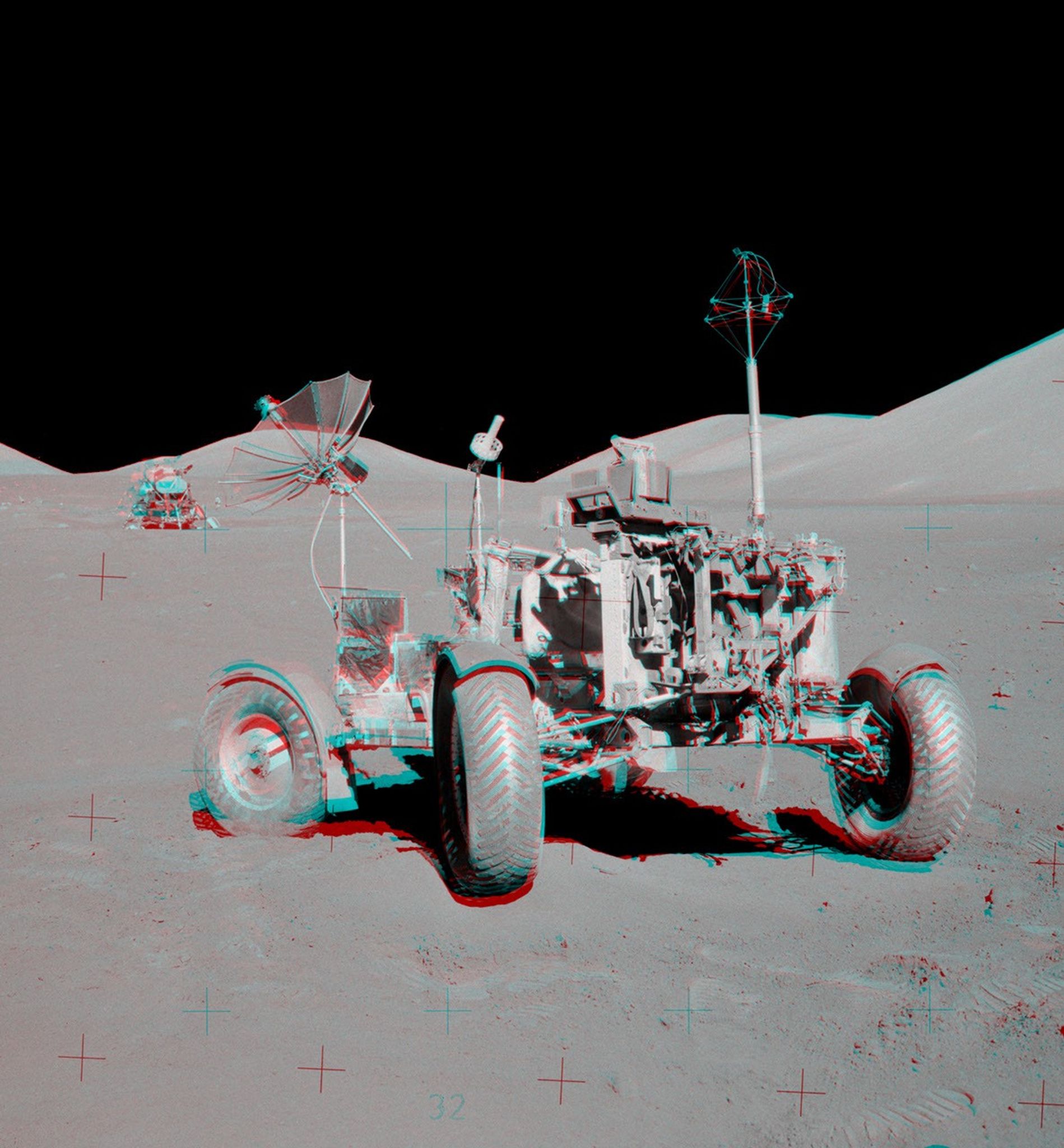
NASA's Astronomy Picture of the Day for November 28, 2026, is a stereo view of the Moon that needs red and blue glasses. The anaglyph shows Apollo 17's lunar rover in the foreground of the Taurus-Littrow valley, with the Lunar Module and distant hills behind it. The photographs are from December 1972. The 3D view is new: Erik van Meijgaarden built it from two of the photographs Gene Cernan took on the surface, 54 years after the pictures were taken.
The rover is parked at a spot the crew called the VIP Site. Cernan and Harrison Schmitt left it there so its television camera could watch the Lunar Module's ascent stage lift off, beaming the departure back to Earth. Apollo 17 was the last crewed landing on the Moon. Cernan and Schmitt spent about 75 hours on the surface in December 1972 while Ronald Evans stayed in orbit overhead. They brought back 110 kilograms of rock and soil, more than any other lunar landing. No one has walked on the Moon since.
Apollo 17 landed in Taurus-Littrow on December 11, 1972, and the Lunar Module Challenger lifted off on December 14, 1972, ending the last crewed landing of the Apollo program. The television camera on the rover was a small RCA colour camera, light enough to ride on the rover and be steered from Earth through the rover's high-gain antenna.
The VIP Site earned its name the hard way. The camera had to be driven by a person who could not see what it was filming. Ed Fendell, operating from Houston, worked from a script of timed commands, sending the first tilt three seconds before liftoff to allow for the radio delay across 240,000 miles. He never watched the picture as it happened; he watched a clock. Apollo 15's camera tilt failed and the spacecraft slipped out of frame. On Apollo 16 the rover was parked too close and the timing broke. Apollo 17 was the third attempt, and the one that worked: Cernan parked the rover about 145 metres east of the Lunar Module, the commands landed on time, and the ascent stage climbed out of frame. The footage is still the only film of humans leaving another world.
The anaglyph is a reminder of how much of Apollo still sits in archives waiting for a second look. The two frames Cernan shot were ordinary Hasselblad photographs, filed away for half a century. Reprocessing them in stereo turns a flat record into a place you can stand in: the rover's wire-mesh wheels, the high-gain antenna, the hills of Taurus-Littrow rising behind the Lunar Module. Cernan and Schmitt remain the last people to drive on the Moon, and the rover they left behind is still parked at the VIP Site, where it has stood ever since.
Source: NASA, Astronomy Picture of the Day, "Apollo 17 VIP Site Anaglyph," November 28, 2026. Also: Smithsonian National Air and Space Museum, "Leaving the Moon, Watching at Home."
As an Amazon Associate I earn from qualifying purchases. If you buy through an active affiliate link, StarPixels may earn a commission at no additional cost to you.