
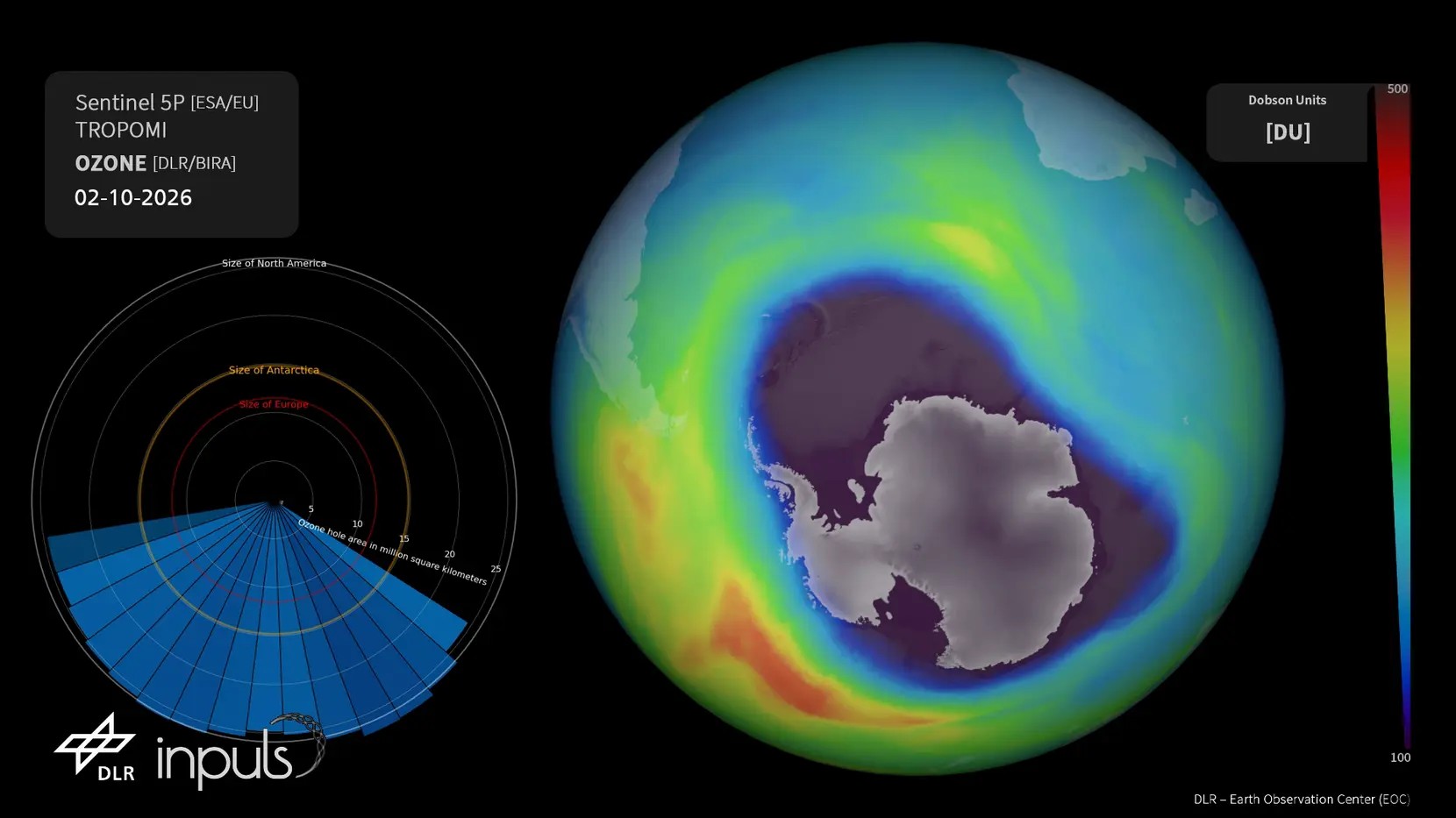
On November 26, 2026, the European Space Agency reported that the Antarctic ozone hole of 2026 ranks as one of the largest in 48 years of records. By September 20, 2026, it had spread across 27.3 million square kilometres, far larger than Antarctica itself and about 6.5 million square kilometres, or 31 percent, above the average of the last 20 years for that time of year. The contrast with 2025 could hardly be sharper: that year's hole was the fifth smallest since 1992.
The driver was weather, not chemistry. An unusually strong and persistent polar vortex kept temperatures in the Antarctic stratosphere cold enough for ozone destruction to run longer than usual. The hole typically starts forming in August, grows through September and reaches its largest size between mid-September and mid-October. As the southern hemisphere spring warms the stratosphere, the vortex weakens and breaks apart, and by the end of December the hole has usually closed.
The numbers come from the Copernicus Sentinel-5P satellite, launched in October 2017 as the first Copernicus satellite built to watch the atmosphere. Its Tropomi spectrometer reads the spectral fingerprints of gases in different parts of the electromagnetic spectrum, mapping stratospheric ozone at higher resolution than earlier instruments. A second, independent assessment from NASA and NOAA, published on November 4, 2026, tells the same story with slightly different numbers: the hole ranked seventh largest by seasonal average area, covering about 25 million square kilometres on average between September 7 and October 13, 2026, and reaching its greatest single-day extent of 27.1 million square kilometres on September 18. That assessment drew on NASA's Aura satellite, NOAA-20 and NOAA-21, the Suomi National Polar-orbiting Partnership satellite, and balloon instruments flown from the South Pole Baseline Atmospheric Observatory.
The two agencies disagree by 200,000 square kilometres on the peak, and that disagreement is the point. ESA measured on September 20, NASA and NOAA on September 18, with different instruments, so the headline number depends on which day and which satellite you ask. More important is a second number the headlines skip: depth. Sentinel-5P data show the 2026 hole was wide but shallow, its depth close to average. Balloon soundings over the South Pole found ozone overhead bottoming out at 105 Dobson units on October 17, 2026. The record low was 92 Dobson units in October 2006. A hole can be record-wide and still mild in the measure that decides how much ultraviolet light gets through.
The large hole is also, paradoxically, evidence that the fix is working. Paul Newman, who leads NASA's ozone research at the Goddard Space Flight Center, put it as a counterfactual: the 2026 hole could have been 1 to 2 million square miles larger if ozone-depleting substances were as common in the air as they were at their peak in 2000. Chlorine from those substances in the Antarctic stratosphere has fallen by about a third from 1980s levels, and the hole has been forming later in the season in recent years, which Newman reads as a sign the layer is healing. The controls set by the Montreal Protocol in 1987 are the reason a hole this big is a weather story rather than a chemistry story. Scientists estimate the ozone hole will recover by the 2070s.
The 2026 hole should close by the end of December, as it usually does. The longer watch is on the instruments that follow Sentinel-5P: the Copernicus Sentinel-5 instrument aboard the MetOp Second Generation A-type satellites, and the Altius mission, which will measure vertical profiles of ozone and other gases. Together they will keep the record going, year by year, until the recovery the Montreal Protocol promised is complete. The Copernicus Atmosphere Monitoring Service graph of ozone loss from 1979 to 2026 shows the 2026 hole in red against the small 2025 hole in dark blue and the near-average 2024 hole in light blue: three years, three very different holes, one slow trend underneath.
Source: ESA, "Ozone hole one of the largest in decades," November 26, 2026. Also: NASA/NOAA, "NASA, NOAA Track 2026 Antarctic Ozone Hole," November 4, 2026.
As an Amazon Associate I earn from qualifying purchases. If you buy through an active affiliate link, StarPixels may earn a commission at no additional cost to you.