
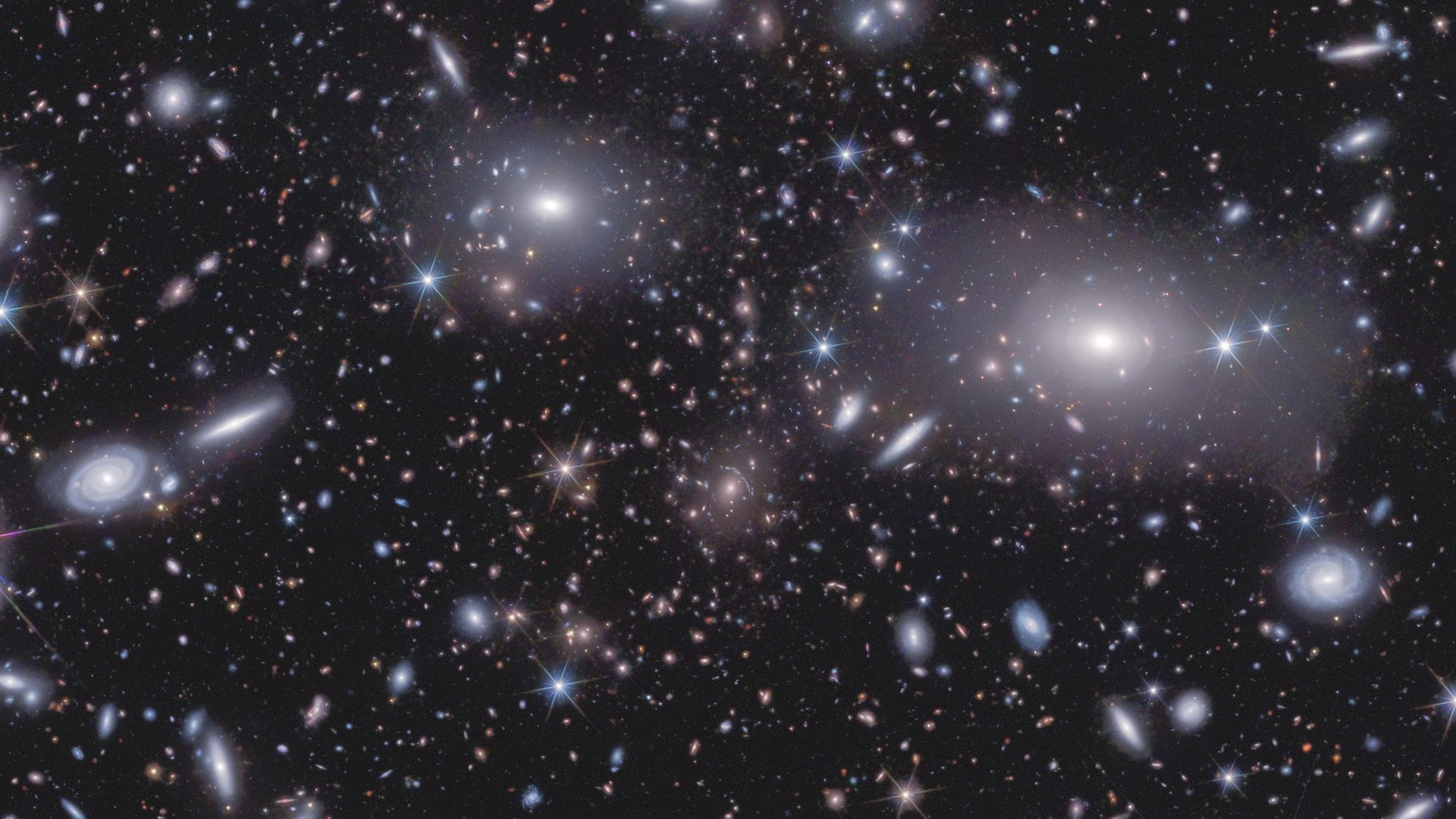
On November 12, 2026, the European Space Agency released the first major batch of data from its Euclid space telescope, a haul that captures the light of more than a billion objects and covers a patch of sky as big as 9,500 full Moons. The release, called DR1-Foundation, holds about 13 months of observations gathered between spring 2024 and spring 2025. It is the first substantial release of mission data since Euclid launched in mid-2023, and it lays the groundwork for the largest three-dimensional map of the cosmos ever built.
The scale is the story. The release catalogues more than 900 million galaxies, around 15,000 strong gravitational lensing candidates, and over 60 million quasar candidates, plus the spectra of more than 160 million sources. The Euclid Wide Survey results cover 1,900 square degrees of sky and total 1.7 million gigabytes of data. That is a sharp change from Euclid's earlier releases, which covered a few days of observations over about 60 square degrees. "We're now releasing more than a year of data covering a significantly larger area," said Valeria Pettorino, ESA's Euclid project scientist. "This unlocks ground-breaking science."
Euclid's job is to map the dark universe: dark matter and dark energy, and the last 10 billion years of cosmic history. The telescope does that by measuring where galaxies sit and how their light has been bent on its way to Earth. With distances for millions of galaxies, scientists can place each one into the three-dimensional structure of the universe and trace the cosmic web, the vast mesh of filaments that holds galaxies together. Most of that web is invisible, made mostly of dark matter, so mapping it takes a telescope that can cover huge areas of sky in sharp detail. Euclid works above the blurring atmosphere, in visible and near-infrared light.
The sharpest payoff in this release is the strong lens catalogue. A strong gravitational lens forms when a massive foreground galaxy bends the light of a more distant galaxy, stretching it into arcs and rings. Lenses let astronomers weigh individual galaxies, including their invisible dark matter, and study how the universe is expanding. They are rare: only one galaxy in several thousand acts as a lens. This release holds the largest strong lens catalogue ever assembled, bigger than all previous catalogues combined. It also holds rarer configurations that used to be one-off finds, such as compound lenses, where several background galaxies at different distances are lensed by the same foreground galaxy, and lenses formed by spiral galaxies and lensed quasars. The lenses were found with a mix of machine learning and thousands of citizen scientists who searched Euclid images through the Space Warps project on Zooniverse. That matters because every lens in the catalogue was found by the same telescope in the same way, so scientists can study them as a population of thousands rather than a set of rare individuals, nearly 50 years after the first strong lens was discovered. "Over 10 years ago, we forecast that Euclid would revolutionise the field of strong lens discovery," said Natalie Lines of the University of Portsmouth. "That day is finally here."
The release also comes with images that show what the data look like at full sharpness. Euclid's view of Abell 3128, a cluster of hundreds of galaxies about 800 million light-years away, took about 70 minutes to acquire and covers 0.12 square degrees of sky, just over half the size of the full Moon. At the centre of the frame sits a strong gravitational lens, the light of a more distant galaxy warped into blue arcs. The same frame catches a second cluster, ACT-CL J0330-5227, which in reality sits about 5 billion light-years behind Abell 3128 but overlaps it in our line of sight. Other images in the release cover the Horologium supercluster, a grouping of more than 30 smaller clusters, and members of the Messier 81 galaxy group, including Messier 81 itself, NGC 3077, NGC 1291 and Holmberg IX. One northern-sky mosaic in the release spans 500 gigapixels.
Distances come from spectroscopy. Euclid splits the light of each galaxy into a spectrum, like light through a prism, and reads the markers left by gases inside the galaxy. Those markers reveal what the galaxy is made of and how far away it is. The release holds spectra for 160 million sources, and Euclid scientists will hunt for the light of hydrogen gas in distant star-forming clouds to measure distances and map the cosmic web. The data are open: catalogues, images and spectra can be explored through the Euclid Data Space platform.
The release is a foundation, not the finished map. It covers about 14 percent of the sky Euclid will eventually survey. The full Data Release 1, due in mid-2027, will add weak lensing measurements and calculations of how galaxies and clusters fit into the cosmic web. Euclid launched in July 2023 and began routine science observations on February 14, 2024, after early image releases in November 2023 and May 2024, a first piece of its map in October 2024, and preliminary data in March 2025 and June 2026. The mission is a European one, built and operated by ESA with contributions from NASA, which provided the detectors for the Near-Infrared Spectrometer and Photometer. More than 2,000 scientists from 300 institutes in 15 European countries, the USA, Canada and Japan form the Euclid Consortium behind the instruments and the data analysis. ESA Director of Science Carole Mundell called the release the largest space-based survey of its kind and a scientific milestone in the study of the cosmos.
Source: ESA, "Euclid lays the foundation for its best-ever 3D map of the Universe," November 12, 2026.
Image credit: ESA/Euclid/Euclid Consortium/NASA, image processing by J.-C. Cuillandre and E. Bertin
As an Amazon Associate I earn from qualifying purchases. If you buy through an active affiliate link, StarPixels may earn a commission at no additional cost to you.