
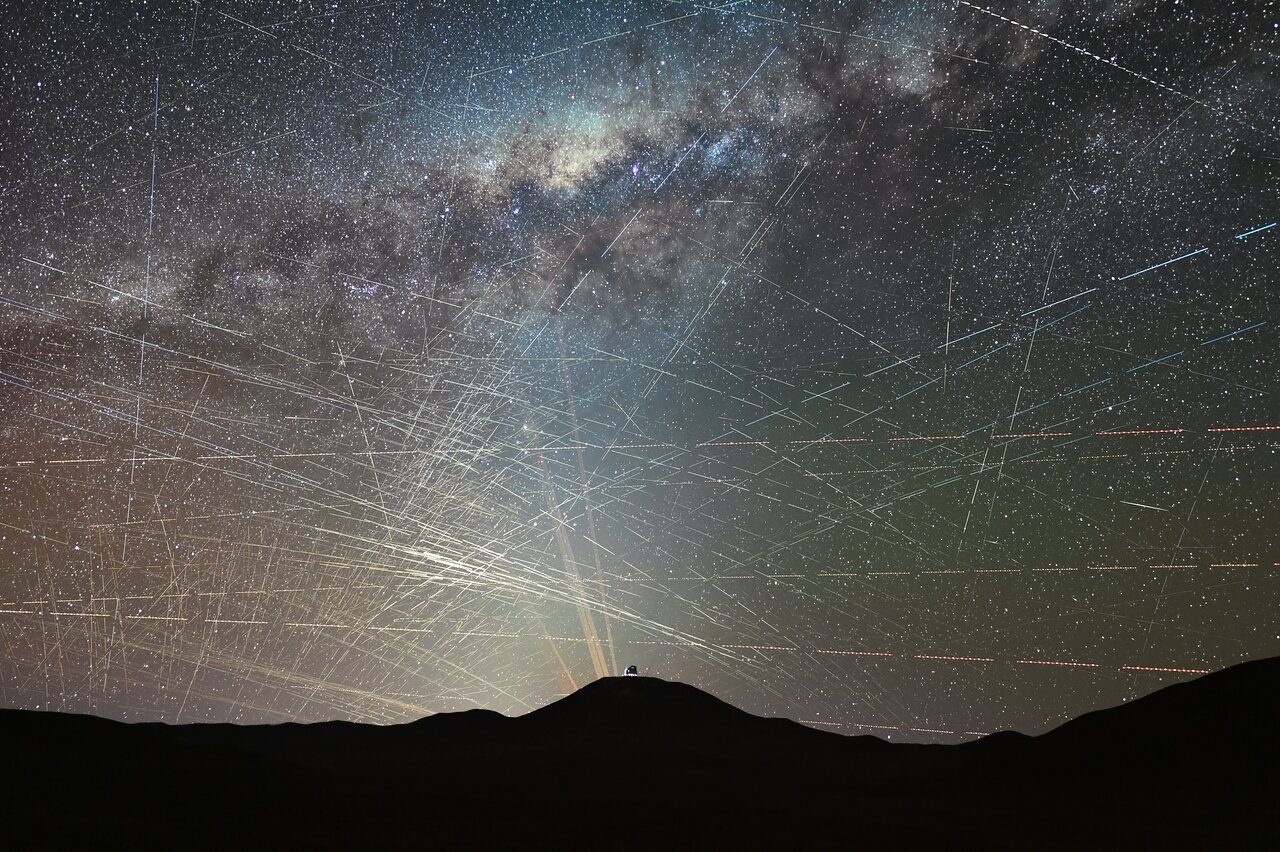
On November 25, 2026, the Federal Communications Commission's Space Bureau authorised SpaceX to deploy up to one million satellites to run data centers in orbit for artificial intelligence computing. The Starmind constellation, as SpaceX calls it, would be more than thirty times the number of satellites and debris objects in orbit around Earth now. The first satellite is due in orbit by November 25, 2033, and the full constellation by November 25, 2040.
The grant covers a fleet of one million non-geostationary satellites in orbital shells 50 kilometres deep, at altitudes from 500 to 1,002 kilometres, in 30-degree inclinations and sun-synchronous inclinations. SpaceX filed the application on January 30, 2026, under file number SAT-LOA-20260108-00016, with the call sign S00798. The license runs for 15 years, starting when SpaceX certifies that the first Starmind satellite is in orbit and operating. The radio authority in the grant is narrow: backup and emergency telemetry, tracking, and command only, in the Ka-band at 18.8 to 19.3 gigahertz and 28.6 to 29.1 gigahertz, on an unprotected, non-interference basis. The satellites will talk to each other mainly by optical links, connecting with SpaceX's Starlink constellations.
The order is a grant-in-part, not a blank cheque, and the conditions carry the story. Petitions to deny were filed on March 6, 2026, by Amazon's Kuiper Systems, Viasat, and the American Astronomical Society, and the FCC received nearly 1,500 comments on the SpaceX application. The Bureau found the grant serves the public interest by advancing American leadership in space and artificial intelligence, and it set hard deployment milestones: one satellite by November 25, 2033, 10 percent of the constellation, or 100,000 satellites, by November 25, 2035, half by November 25, 2038, and the full million by November 25, 2040. SpaceX has 30 days from the release of the order to decline the grant as conditioned.
The catch is in what the FCC did not grant. SpaceX asked for a waiver of the rule that satellites ending their missions below 2,000 kilometres must be disposed of by burning up in the atmosphere, so that Starmind satellites could instead be parked in graveyard orbits. The Bureau deferred that request, finding SpaceX had not provided enough information to show its alternative disposal methods comply with the rules. Before deploying any Starmind satellite that will not burn up on re-entry, SpaceX must file for a modification and justify the waiver. A million satellites with no settled end-of-life plan is a debris question the order leaves open.
The numbers behind the decision are where the astronomy case bites. On July 1, 2026, the European Southern Observatory published a peer-reviewed study by astronomer Olivier Hainaut, accepted for publication in Astronomy and Astrophysics, that calculated what the proposed fleets would do to the night sky. The study found that current proposals to launch over 1.7 million satellites would have devastating consequences for astronomy, and that no more than 100,000 faint satellites, dimmer than visual magnitude 7, should orbit Earth. Starmind alone is ten times that ceiling. By the FCC's own milestone schedule, the constellation reaches 100,000 satellites by November 25, 2035, the astronomers' limit, and keeps going for five more years. When the study was published, just over 14,000 active satellites were in orbit, most of them Starlink. One million is roughly seventy times that number.
The study also worked out what the sky would look like. For a large fraction of each night, hundreds of Starmind satellites would be visible to the naked eye, and at certain times up to several thousand, similar to the number of stars seen under good conditions. On ESO's Very Large Telescope in Chile, dozens of satellite trails would appear in each image taken two hours into the night, a loss of up to 28 percent of the field of view. A camera like the one on the Vera C. Rubin Observatory could have most of its images rendered unusable for several hours each night. The study was the first to count the diffuse glow as well as the trails: satellites too faint to see still scatter light across the whole sky, and the proposed mirror constellation from the startup Reflect Orbital, 50,000 satellites by 2035, would make the night sky three to four times brighter overall, with each mirror satellite as bright as the planet Venus even when its beam points nowhere near an observer.
The astronomy objections were never weighed on their merits. The order states plainly that the Commission has no authority over the potential impacts of the constellation on optical astronomy, and it dismisses those concerns alongside the environmental ones. Under the FCC's October 2026 order modernising its environmental rules, space-based operations do not count as a major federal action, so no further environmental review under the National Environmental Policy Act is required. ESO, the Royal Astronomical Society, and the International Astronomical Union had submitted a joint response to the FCC filings, and the FCC received over 1,800 comments on the Reflect Orbital proposal. Reflect Orbital's own demonstration satellite was authorised by the FCC on July 9, 2026.
Nothing in the sky changes tomorrow. The first Starmind satellite is not due until November 2033, and the constellation is a plan with a licence, not hardware in orbit. What changed on November 25, 2026, is the precedent: the largest satellite constellation ever authorised, ten times the number astronomers say the sky can absorb, approved by a regulator that ruled the astronomy question outside its remit. The test now is the 2033 milestone, and whether the satellites SpaceX eventually flies are kept fainter than magnitude 7, the line Hainaut drew between a sky astronomers can still work with and one they cannot.
Source: Federal Communications, Memorandum Opinion and Order and Authorization DA 26-1273, SpaceX Orbital Data Center System (Starmind), November 25, 2026. Also: ESO, 'Beyond the limit': one million satellites and mirrors in space pose grave threat to the night sky," July 1, 2026; Hainaut, O., Astronomy and Astrophysics (arXiv:2604.09427).
As an Amazon Associate I earn from qualifying purchases. If you buy through an active affiliate link, StarPixels may earn a commission at no additional cost to you.