
The most distant Little Red Dot ever found is also the youngest. Astronomers using the James Webb Space Telescope have confirmed a faint, compact supermassive black hole, CW-LRD-z10, at a redshift of 10.36, placing it just 400 to 500 million years after the Big Bang, when the universe was about 3 percent of its current age. No Little Red Dot had ever been spectroscopically confirmed beyond redshift 10 before. The result was published on November 24, 2026, in The Astrophysical Journal Letters.
Little Red Dots are a population Webb only started finding in 2022: small, red, extremely distant objects that look like galaxies but carry the spectral fingerprints of actively feeding black holes. They matter because they may be the missing link between the first black hole seeds and the giant black holes that sit at the centers of galaxies today. Supermassive black holes have already been detected when the universe was only 700 to 800 million years old, and how they grew that massive that fast remains one of the open problems in astronomy. Little Red Dots, if they are young black holes caught early, could be the answer.
CW-LRD-z10 was found by a team led by Takumi Tanaka, a graduate student at the University of Tokyo's Kavli Institute for the Physics and Mathematics of the Universe, working with professor John Silverman and an international group. They were working with Webb's COSMOS-Web survey, a large program mapping the early universe. The object first appeared as a photometric candidate in a paper published on December 2, 2025, in The Astrophysical Journal. The new paper confirms it with spectroscopy: Webb's NIRSpec instrument, through the EMBER program, measured the redshift at 10.361, with an uncertainty of just a few thousandths.
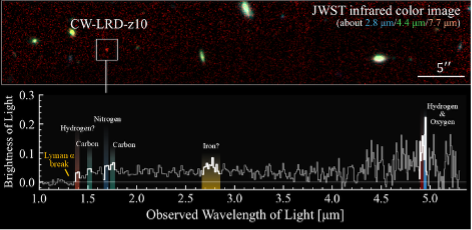
The spectrum is what settles it. It shows a sharp Lyman-alpha break, the cliff where neutral hydrogen in the early universe absorbs the light, plus emission lines from carbon, nitrogen, oxygen, and iron. The carbon and oxygen lines are faint, detected at roughly four times the noise level, but they land exactly where the redshift predicts. The spectrum matches the pattern of Little Red Dots found at lower redshifts, which is what confirms this is the same kind of object, only far earlier. The previous record holder, CAPERS-LRD-z9, sat at redshift 9.288.
The record was not broken by a bigger telescope. It was broken by a new way of using the one already in space. Webb's near-infrared camera, NIRCam, can only study light between 0.6 and 5 microns. For an object at redshift 10 and beyond, the light astronomers need to see has been stretched past that range. The team built a new selection method that combines NIRCam with MIRI, Webb's mid-infrared instrument, to catch the steep red slope that marks a Little Red Dot and separate it from ordinary galaxies. Without MIRI's longer wavelengths, CW-LRD-z10 would have stayed hidden in the COSMOS-Web images, indistinguishable from the crowd.
That matters beyond this one object, because the method is reusable. The same NIRCam-plus-MIRI selection can now be run across other deep Webb fields, and every field it is run on has a chance of turning up more Little Red Dots from the same era. The first find proves the technique works where NIRCam alone could not reach.
The object also lands exactly where theory said the seeds should be. Models of black hole formation have suggested that the precursors to supermassive black holes formed around 500 million years after the Big Bang. Until now, every Little Red Dot found dated to 600 million years after the Big Bang or later, leaving the predicted seed window empty. CW-LRD-z10, at 400 to 500 million years, sits inside that window. And the team's measurement of how common such objects are at that epoch lines up with what earlier models predicted for the rise of the population. The seed picture has passed its first test in the era it was meant to describe, rather than breaking on contact with the data.
There are limits to what one object can say. CW-LRD-z10 is a candidate, not a proven black hole: its spectrum is consistent with a Little Red Dot, and the team is careful to call it a leading candidate. The lines that would prove black hole activity directly, the hydrogen emission lines, are the next target. The team plans to study those lines, along with the object's light distribution, and to search for more Little Red Dots from the same period. If more turn up at similar redshifts with similar densities, the seed era stops being a theory with one data point and becomes a population astronomers can study.
The figure that carries the discovery is worth a look on its own. The top panel is a false-color Webb image built from filters centered near 2.7, 4.4, and 7.7 microns, with CW-LRD-z10 marked as the small red dot at the center. The bottom panel is its spectrum, with the Lyman break and the labeled emission lines. The whole case for the distance rests on that break: it is the point where the universe's neutral hydrogen swallows the light, and its position in wavelength is a direct measure of how far away the object sits.
Source: Kavli IPMU, "Researchers uncover the furthest Little Red Dot in our universe," November 25, 2026; Tanaka et al., "EMBER: A Little Red Dot Candidate at z_spec = 10.36 in the Seed Black Hole Era," The Astrophysical Journal Letters, DOI 10.3847/2041-8213/aebc8d (published November 24, 2026).
Image credit: COSMOS-Web / Tanaka
As an Amazon Associate I earn from qualifying purchases. If you buy through an active affiliate link, StarPixels may earn a commission at no additional cost to you.