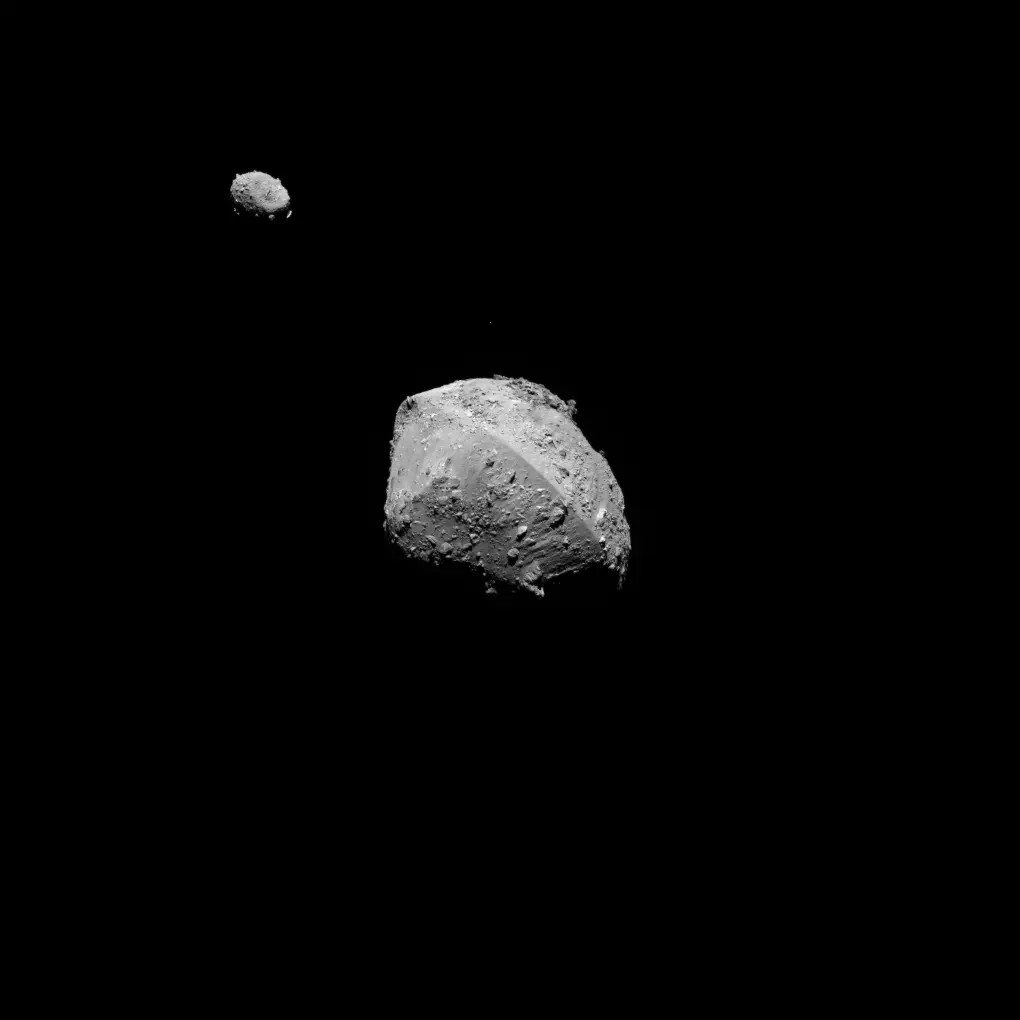
On November 25, 2026, the European Space Agency released the first close-up images of Dimorphos from its Hera spacecraft, and the little asteroid is not what anyone expected. One whole face of the 151-metre moonlet has been flattened by a crater the size of a sports stadium, a crater that runs across the asteroid's entire width. The moonlet is tumbling chaotically in its orbit around its parent asteroid Didymos. And hundreds of boulders no one knew about are circling the pair.
The images answer a question that has stood since September 26, 2022, when NASA's DART spacecraft slammed into Dimorphos at about 22,500 kilometres per hour. The impact shortened Dimorphos's orbit around Didymos by 33 minutes, the first time humans deliberately changed the motion of a celestial body. Telescopes on Earth measured the orbit change easily enough. But no one could see what the impact had done to the rock itself. Was there a crater? Had the asteroid changed shape, or stayed the same? Hera was sent to find out, and it arrived at the pair three weeks before these images were released.
The answer, in the words of Hera principal investigator Patrick Michel, is all three at once. "Scientists debated whether Dimorphos had sustained an impact crater, changed its shape or stayed the same," Michel said. "Much to our surprise the answer turns out to be all three at once! The face struck by DART has been flattened into an impact crater the size of a sports stadium, which extends across the asteroid's entire width." Everywhere else, Dimorphos looks untouched: the boulder fields on its other faces look just like they did in DART's 2022 pictures. Hera took the images from 25 to 30 kilometres away, flying slow rectangular paths around the pair at about 12 centimetres per second, using its Asteroid Framing Camera, the multi-colour Hyperscout H instrument, and the Japanese-built thermal camera TIRI.
The 33-minute orbit change was far more than the models had predicted, and Hera's pictures help explain why the push was so strong. A study published in Nature in 2023 measured the momentum DART actually delivered and found the debris thrown off the asteroid carried more of it than the spacecraft itself. The momentum enhancement factor, beta, came out at 3.61, meaning the impact delivered more than three times the momentum DART brought with it. The spacecraft was the trigger. The asteroid's own material did most of the pushing. That is the catch for anyone planning the next deflection: the size of the shove depends on the target, not just the spacecraft. A solid rock and a loose pile of rubble hit by the same impactor would move by different amounts, so a deflection cannot be aimed with confidence until the target's mass, shape, and interior are known. Measuring exactly that is Hera's job.
The boulders are the second surprise, and they come with their own history. In December 2022, three months after the impact, the Hubble Space Telescope photographed 37 boulders drifting away from Dimorphos, between one and seven metres across, moving at about 0.8 kilometres per hour, roughly the walking speed of a giant tortoise. Hera now shows hundreds of them still circling the binary pair, more than 100 between the size of a football and a washing machine. Four years after the impact, the debris never left. A deflection does not just move the rock. It litters the rock's neighbourhood, and the litter stays. That is a live problem for Hera itself: the spacecraft is due to fly closer in December, to about 13 kilometres, and in January 2027 it will release two shoebox-sized CubeSats into even closer orbits. The team has to thread its spacecraft through the shrapnel of its own experiment.
The third surprise is what the crater says about what Dimorphos is made of. A solid rock struck that hard would be expected to crack or break apart. Dimorphos instead absorbed the blow and rearranged itself, which fits a rubble pile held together by gravity, the same kind of body as the asteroids Bennu and Ryugu. And the impact left the moonlet tumbling wildly, so it never presents the same face twice. That matters for any second attempt: a follow-up push would meet a target whose orientation cannot be predicted in advance, and the orbit itself is harder to measure precisely while the body tumbles. Hera will measure the orbit now and compare it with the orbit DART left behind. A nudge that fades is not a deflection, and that comparison is the number that decides whether a kinetic impactor can be aimed with confidence the next time an asteroid is actually coming at us.
Hera's mission manager Ian Carnelli showed the first images in the dinosaur hall of the Museum für Naturkunde Berlin, a deliberate choice. Sixty-six million years ago an asteroid impact changed the course of life on Earth. "NASA's DART mission demonstrated that we can change an asteroid's orbit," Carnelli said. "Hera is now revealing what happened to the asteroid itself." The two CubeSats coming in January 2027 will go further: Juventas carries the smallest radar instrument ever flown in space and will probe Dimorphos's interior, eventually attempting a landing, while Milani prospects the surface materials and dust. Together the three spacecraft will form the first three-spacecraft system around two asteroids.
Hera is ESA's first planetary defence mission, and it is only the start. ESA is already developing Ramses, a mission with Japan's JAXA to watch the asteroid Apophis during its exceptionally close flyby of Earth on April 13, 2029, when it will pass about 32,000 kilometres above the surface. The crater on Dimorphos is the first direct look at what a kinetic impactor does to its target. The experiment worked. Now comes the science of why it worked as well as it did, and whether it would work the same way twice.
Source: ESA, "Hera reveals stadium-sized asteroid crater from spacecraft impact," November 25, 2026. Also: Cheng et al., Nature (2023); Jewitt et al., Astrophysical Journal Letters (2023).
As an Amazon Associate I earn from qualifying purchases. If you buy through an active affiliate link, StarPixels may earn a commission at no additional cost to you.