
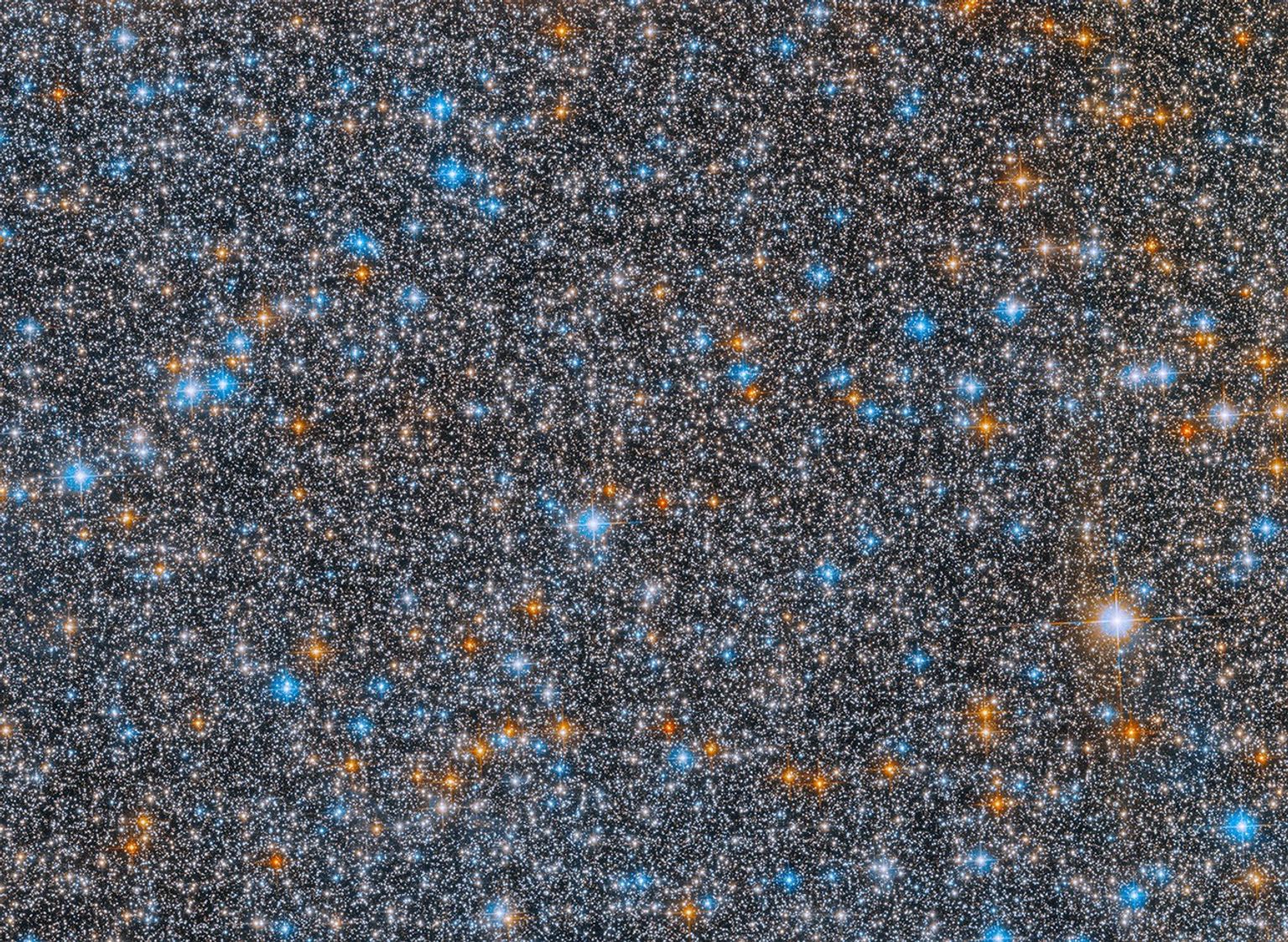
On November 25, 2026, NASA released new Hubble Space Telescope images of the Milky Way's galactic bulge, the densely packed, spherical region of stars that surrounds the center of our galaxy's disk. Hubble's sharp vision picks out individual stars in a field so crowded that ground-based telescopes see only a glow. The pictures are part of a survey built to give the Nancy Grace Roman Space Telescope a map to work from when it starts hunting for planets in the same region.
The bulge is worth the attention because it holds nearly a quarter of the Milky Way's stellar mass, and because it is close enough for astronomers to study its stars one by one. In other galaxies, bulges are too far away and too jam-packed to resolve into individual stars. In ours, Hubble can measure each star's brightness, age, composition, and motion over time. That catalogue is the raw material for finding planets, locating black holes, and tracing dark matter.
Roman's planet hunt relies on microlensing, a trick of gravity in which a foreground star briefly magnifies the light of a more distant star as it passes in front of it. A planet orbiting the foreground star leaves its own fingerprint in the brightening. Hubble's new observations characterize the bulge stars before any lensing happens, so that months or years later, when Roman catches an event, researchers can match the flare against Hubble's record and read off what kind of star and planet produced it.
The timing is tight. Roman launched on August 30, 2026, aboard a Falcon Heavy rocket from Kennedy Space Center in Florida, and its first images are expected around the end of 2026 or the opening months of 2027. NASA expects the mission to find more than 1,000 planets by microlensing alone, and around 100,000 exoplanets in total across all its methods, against roughly 6,200 worlds known as of now. Roman watches hundreds of millions of stars at once, with a field of view at least 100 times larger than Hubble's. Hubble's bulge survey is the reference catalogue that turns that flood of detections into named stars with known properties, instead of anonymous blips.
Microlensing has a built-in flaw that makes the advance work essential. Each event happens once: the alignment of lens star, background star, and Earth never repeats, and the flare is brief, and once it fades the alignment is gone. A detection with no pre-existing record of the host star leaves the planet effectively homeless. Astronomers would know a world exists but could not say which star it orbits or how far away it sits. Hubble's resolution is the fix. In the bulge, stars sit so close together on the sky that only a space telescope can separate them, and Roman's wide field trades that sharpness for coverage. The two telescopes are complementary by design: Hubble maps the crowd, Roman watches it all at once.
Hubble has mapped the bulge before. The WFC3 Galactic Bulge Treasury Program used the Wide Field Camera 3 to track the brightness, positions, and motions of bulge stars, and the SWEEPS survey used the Advanced Camera for Surveys to watch 180,000 stars in the region. The new observations come from program 17776, led by S. Terry of the University of Maryland, and were taken in the red end of the visible spectrum and near-infrared light, the wavelengths where Hubble's sensitivity overlaps Roman's, so the two telescopes look at the same stars in the same colours.
Roman will work from the second Sun-Earth Lagrange point, about 1 million miles from Earth, the same neighbourhood where the Webb telescope operates. Its bulge survey will run across multiple seasons, staring at the same crowded fields again and again. Every flare it records will be checked against the Hubble catalogue, star by star, to pin down the lens and its planet. The catalogue Hubble is building now is what makes Roman's planet census a census of real worlds around real stars, rather than a count of unexplained flashes.
Source: NASA, "NASA's Hubble Views Ocean of Stars in Groundwork for Roman," November 25, 2026. Also: NASA Nancy Grace Roman Space Telescope Press Kit (August 2026); The Planetary Society, Roman launch coverage, August 30, 2026.
As an Amazon Associate I earn from qualifying purchases. If you buy through an active affiliate link, StarPixels may earn a commission at no additional cost to you.