
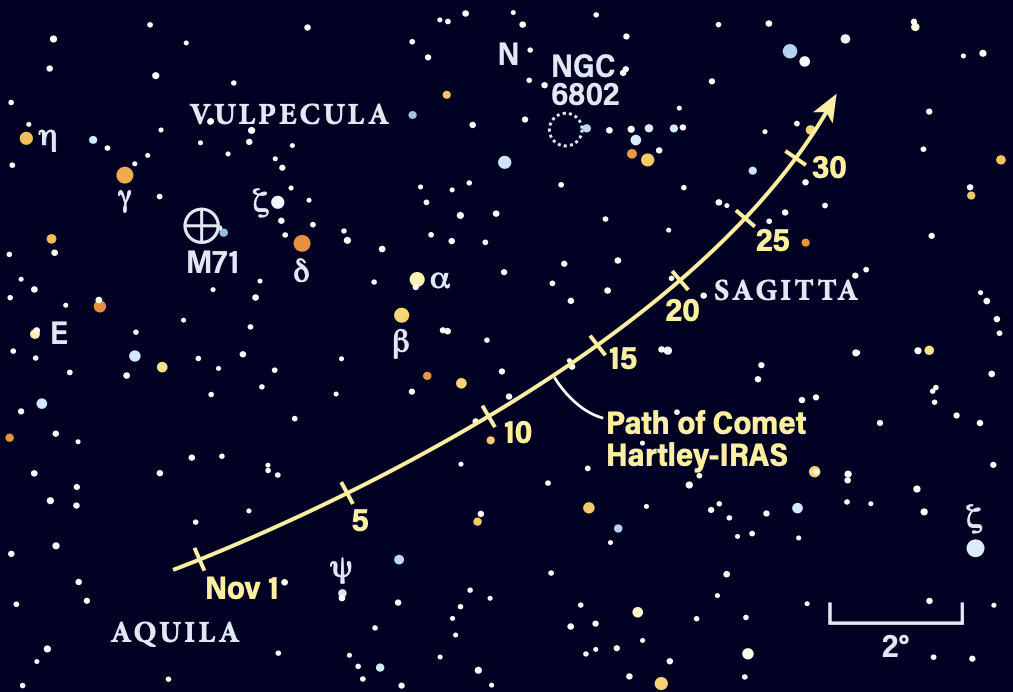
Comet 161P/Hartley-IRAS crosses the rich Milky Way north of Altair with a circular green coma, at 10th magnitude. The Moon-free window closes after November 14 and reopens November 27, the day it reaches perihelion.
The green is the comet's signature. A comet's coma — the glowing atmosphere around its icy nucleus — shines green when sunlight makes diatomic carbon in the gas fluoresce. It is the classic comet color, and on Hartley-IRAS the coma holds a circular shape, a round green glow against the star field. Tenth magnitude puts it firmly in telescope territory: invisible to the naked eye, reachable with a modest scope under dark skies, and worth the effort because this apparition is the last good one for decades. The next favorable viewing geometry does not come until 2069.
The crossing makes it harder and better at once. The comet is moving through the rich Milky Way north of Altair, the bright star in Aquila, which means the background is crowded with stars. A faint comet in a dense star field is easy to lose — the trick is the coma's green tint and the comet's own motion against the fixed stars. Watch the same field on two nights and the thing that moved is the comet. Altair is the anchor: find the bright star, work north into the Milky Way, and look for the round green glow that does not belong to any star chart.
The Moon sets the schedule. The Moon-free window closes after November 14, as the brightening Moon washes out faint targets. It reopens November 27 — the day Hartley-IRAS reaches perihelion, its closest approach to the Sun and typically its brightest. Two windows, then: the dark skies before November 14, and the perihelion window from November 27. The second is the better bet, brightness and darkness together. After that, the wait is measured in decades.
Source: Astronomy
Image credit: Astronomy
As an Amazon Associate I earn from qualifying purchases. If you buy through an active affiliate link, StarPixels may earn a commission at no additional cost to you.