
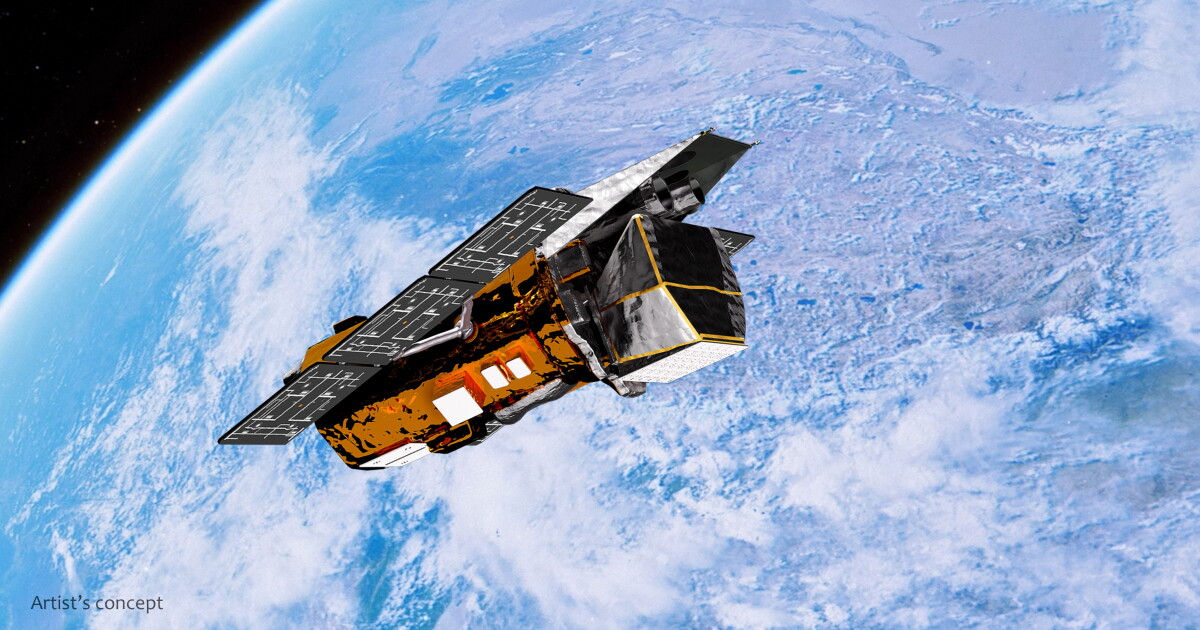
The U.S. Space Force predicts the Swift Observatory will come crashing down on or around Friday after 22 years in orbit. Most of the 1½-ton telescope is expected to burn up, though dense tungsten and mirror parts could survive reentry.
Swift — the Neil Gehrels Swift Observatory, named for its principal investigator — was built to chase the fastest explosions in the universe. A gamma-ray burst flares and fades in minutes, and Swift's trick was speed: its wide-field detector catches the burst, the spacecraft slews itself onto the target in about a minute, and its X-ray and ultraviolet telescopes record the afterglow while it is still bright. That rapid-response loop turned gamma-ray bursts from rumors into astronomy. Over 22 years Swift catalogued more than 2,000 bursts and some 1,400 exploding stars and other transients, and its alerts sent larger telescopes chasing within minutes, night after night, for two decades.
Twenty-two years is far past design life, and low Earth orbit does not forgive neglect. Drag from the thin upper atmosphere has been lowering Swift's orbit the whole time, and with no propulsion left to boost it, the fall was always a matter of when. Uncontrolled reentry means no steering: the spacecraft comes down where physics takes it, and most of a 1½-ton telescope burns up on the way down. Dense parts — tungsten components and mirror pieces — could survive to the ground, which is why the tracking matters. The Space Force prediction, on or around Friday, is a forecast, not a schedule; the exact time and place will firm up only in the final orbits.
The era it closes is the rapid-response era Swift invented. Before Swift, gamma-ray bursts were detected and then argued about for months. After Swift, they were caught, located, and followed up while still glowing. That model — detect fast, slew fast, tell everyone fast — is now standard across time-domain astronomy, carried forward by newer missions. Swift falls. The way of working it built stays in orbit.
Source: U.S. Space Force tracking prediction, as reported
Image credit: NASA (Swift Observatory)
As an Amazon Associate I earn from qualifying purchases. If you buy through an active affiliate link, StarPixels may earn a commission at no additional cost to you.