
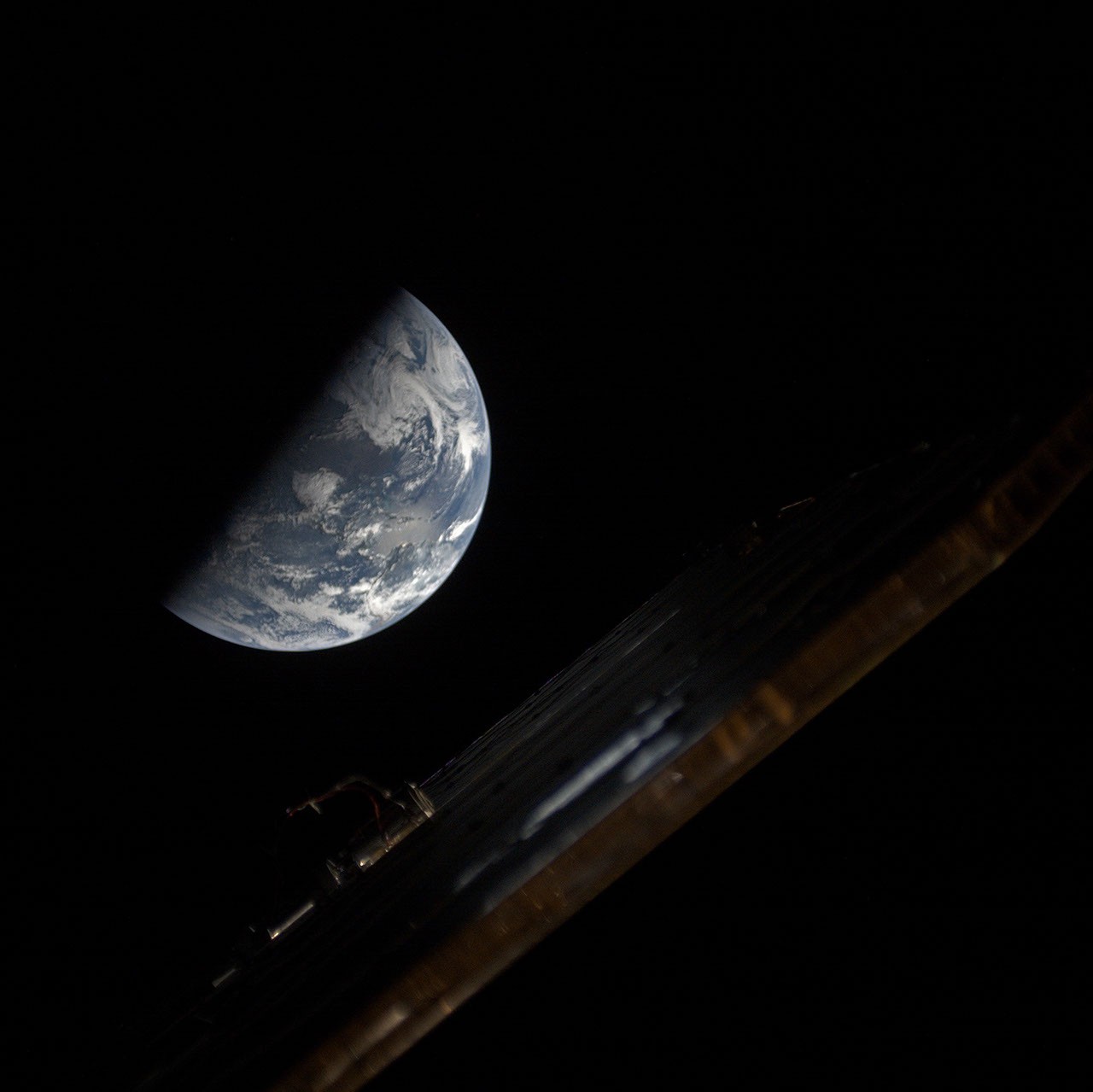
One of NASA's twin ESCAPADE spacecraft looked back at Earth on its way out and took a farewell photograph. The image was taken around 9 a.m. EST on November 9, about three hours after the spacecraft's closest approach to Earth, from roughly 38,500 miles away. The Western Hemisphere fills the frame, a crescent Earth floating in the dark with one of the spacecraft's solar panels in the foreground.
ESCAPADE stands for Escape and Plasma Acceleration and Dynamics Explorers: two small spacecraft flying to Mars together. The farewell pictures came from the Visible and Infrared Observation System camera, provided by Northern Arizona University, which sees Earth in visible light and in infrared. The visible shot is the one that stops you. The infrared view reads the planet by heat instead, with a temperature scale running from about 180 to 340 kelvin.
The flyby that set up the shot was the point of the visit. Each spacecraft combined an engine burn with Earth's gravity, a powered flyby, to bend its path onto a 10-month cruise to Mars. This was the second of the pair to make the swing past Earth this month. A spacecraft sweeping past a planet borrows a slice of that planet's speed around the Sun without spending fuel, and burning at closest approach is where a push counts most. Earth moves around the Sun at about 67,000 miles per hour, and ESCAPADE took a little of that motion with it.
The pair is going to Mars to answer a question about the planet's missing air. Once in orbit, the mission will study how the solar wind, a million-mile-per-hour stream of particles from the Sun, interacts with the Martian environment and strips atmosphere away from the planet. Mars once had thicker air and liquid water on its surface. Most of it is gone, and the solar wind is the prime suspect.
Two spacecraft matter here in a way one cannot match. A single orbiter watching the solar wind cannot tell whether a change it sees is something that happened everywhere at once or something it flew through. Two spacecraft measuring at the same time can separate the two, which turns a weather report into a measurement. Mars lost most of its atmosphere over billions of years, and ESCAPADE will watch the loss happening in real time, with the pair checking each other's readings as they go.
The mission is funded by NASA's Heliophysics Division and is part of the Small Innovative Missions for Planetary Exploration program. The University of California, Berkeley's Space Sciences Laboratory leads it, with Rocket Lab, NASA's Goddard Space Flight Center, Embry-Riddle Aeronautical University, Advanced Space, and Blue Origin as partners.
The farewell had witnesses. As the two spacecraft made their close approaches, a commercial satellite photographed the pair from roughly 3,000 miles away, and a member of the mission team photographed them passing overhead from his home near Los Angeles. Both spacecraft are now on their way, due at Mars in about ten months. The first thing to watch is whether the twin measurements show the solar wind stripping Martian air in gusts or in a steady leak.
Source: NASA, "NASA's ESCAPADE Captures Parting Images of Earth on Its Way to Mars," November 23, 2026, by Vanessa Thomas.
Image credit: NASA
As an Amazon Associate I earn from qualifying purchases. If you buy through an active affiliate link, StarPixels may earn a commission at no additional cost to you.