
The most distant quasar ever seen is now on the books. Euclid, the European Space Agency's dark-universe telescope, has found a quasar called J1504+6252, nicknamed Dún Aonghasa, shining just 630 million years after the Big Bang. It is the first quasar ever identified beyond a redshift of 8, at 8.13, which means its light has travelled for roughly 13.1 billion years to reach us, from a time when the universe was about 5 percent of its current age. The black hole powering it already weighs about 360 million times as much as the Sun.
A quasar is the bright core of a young galaxy, lit by gas falling into a supermassive black hole. The infalling gas heats up and glows so fiercely that the nucleus can outshine the rest of its galaxy. Quasars are a brief phase in a galaxy's life, but they are the brightest beacons in the early universe, which is why astronomers chase them to the greatest distances.
This one breaks Euclid's own record, set only a few months ago, by peering back an additional 40 million years. Euclid picked it out of about 18 months of survey data, among millions of objects, and a follow-up campaign confirmed it: the W.M. Keck Observatory, the Large Binocular Telescope Observatory, the Hubble Space Telescope, and finally the James Webb Space Telescope, which weighed the black hole. The discovery is published on November 24, 2026, in Astronomy and Astrophysics by J. Wolf and colleagues.
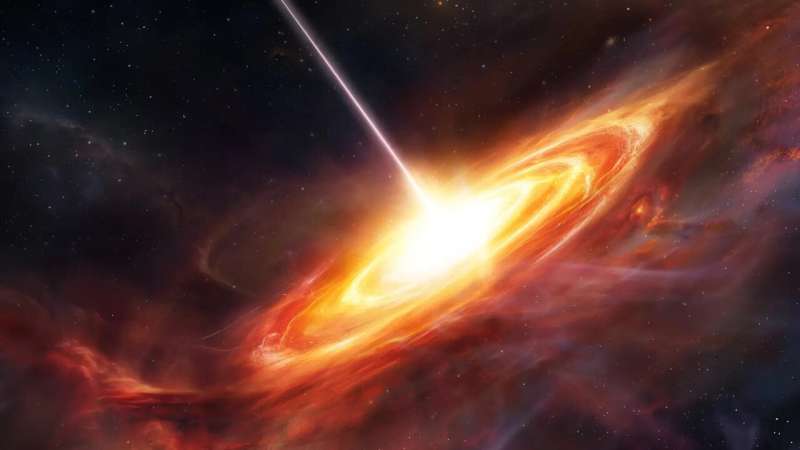
The nickname comes from Dún Aonghasa, a prehistoric cliff-top fort on Inis Mór, off the west coast of Ireland, where the land gives way to the Atlantic. Euclid's own image shows the quasar as a small red dot among faint galaxies. The artist's impression that leads this story shows what Euclid cannot photograph directly: the glowing disk of gas spiralling into the black hole and the jet it throws out.
The find is a problem for the standard story of how black holes grow, and the problem is a matter of plain arithmetic. A black hole can only eat so fast. Once it feeds hard enough, its own light pushes the incoming gas away, which caps the growth rate. Starting from a single collapsed star, a black hole would need roughly twenty doublings to reach 360 million suns, and each doubling takes tens of millions of years at the fastest steady pace. That adds up to more time than the 630 million years the universe had available. So the seed must have been born big, a gas cloud collapsing straight into a black hole and skipping the star stage entirely, or the black hole must have eaten in bursts faster than the steady limit allows. Dún Aonghasa makes the puzzle sharper because it is feeding relatively slowly right now, unlike other distant quasars. Whatever sprint built its mass happened very early and has already ended, which means the fast growth was a brief episode in the first few hundred million years, not a habit it kept.
The record also shows how fast the frontier itself is moving. Euclid has found 12 new quasars beyond redshift 7, more than doubling what was known at that distance, and 31 ancient quasars in its first year and a half. Reaching the redshift 7 threshold took previous surveys 15 years. Euclid cleared it in 18 months. But the new record is not the start of a flood. At redshift 8, quasars are so rare that at most a few tens are expected in Euclid's entire survey, so each one is a large share of the whole sample. This record may stand for years, and the next one will be harder to find than this one was.
That is the value of a telescope built for something else. Euclid launched in 2023 to map the dark universe, the invisible matter and energy that shape the cosmos. Its wide, sensitive infrared view turns out to be exactly what a quasar hunt needs: rare, distant objects stand out against the dark. A mission designed to weigh the universe is now also dating its brightest early lights.
The paper is out on November 24, 2026, and more Euclid data is coming. The question now is whether the early universe made its black holes big at birth or fed them in bursts. Every new distant quasar narrows the answer, and the next one will have to be found in a sky where only a few dozen such objects exist at all.
Source: ESA, "Euclid breaks own quasar record by 40 million years," November 24, 2026.
Image credit: ESA/Euclid/Euclid Consortium/NASA
As an Amazon Associate I earn from qualifying purchases. If you buy through an active affiliate link, StarPixels may earn a commission at no additional cost to you.