
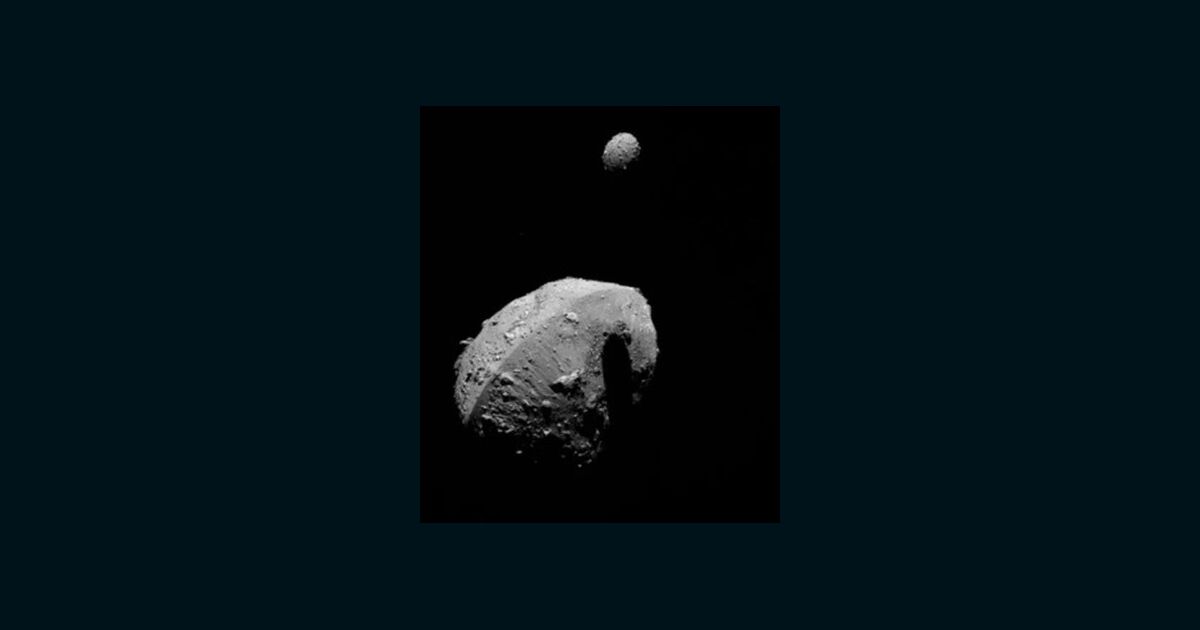
An eclipse happened on an asteroid, and a spacecraft was there to photograph it. Hera, the European Space Agency's planetary-defence mission, caught the smaller asteroid Dimorphos casting its shadow across its parent body Didymos, blanking out the Sun over part of the larger rock. The image is an early view from Hera's arrival at the pair, and it shows the same celestial mechanics as an eclipse on Earth, played out on a scale a person could walk across.
The two bodies are small. Dimorphos is 151 metres across, about the size of the Great Pyramid of Giza. Didymos is 730 metres across, a little smaller than the Burj Khalifa is tall. Dimorphos orbits about a kilometre from Didymos, and the gravity there is feeble: Didymos pulls about 40,000 times weaker than Earth, Dimorphos about 200,000 times weaker. The shadow Dimorphos throws is large on Didymos only because the moonlet is so close to it.
The picture came from Hera's monochrome Asteroid Framing Camera, which the spacecraft uses for navigation and for science imaging. "Eclipses just like last summer's total solar eclipse occur on asteroids as well, when they have a small moon like this one," said Patrick Michel, Hera's principal investigator and director of research at CNRS and the Observatoire de la Côte d'Azur. "Didymos and Dimorphos are subject to the same celestial mechanics as Earth and the Moon, but at a much smaller scale and lower gravity environment. So in principle someone could be sitting on Didymos and have the same kind of eclipse experience, although in practice sitting there would be very difficult because its gravity is so low and it is spinning very fast."
Hera launched in October 2024 and spent two years reaching the pair. It is there because of what happened in 2022, when NASA's DART spacecraft slammed into Dimorphos to shift its orbit around Didymos. DART shortened the orbit by 33 minutes, the first time humans deliberately changed the motion of a celestial body. Hera is the follow-up, a close-up crash-scene investigation to measure the crater, the orbit change, and the debris, and to gather the data that turns a grand experiment into a technique that could be repeated.
The eclipse picture is a measurement as well as a photograph. The shadow's place on Didymos pins down the two bodies' relative positions at Hera's arrival, the same geometry DART changed four years ago. The real test ahead is whether the change held. A nudge that fades is not a deflection. Hera will measure the orbit now and compare it with the orbit DART left behind, and that number is what decides whether a kinetic impactor can be aimed with confidence the next time an asteroid is actually coming at us.
The first close-up images arrive on Wednesday, November 25. The Hera team will share them that evening, with a livestream starting at 19:45 CET on ESA WebTV and the ESA YouTube channel.
Source: ESA, "Hera's Didymos asteroid in eclipse," November 23, 2026.
Image credit: ESA
As an Amazon Associate I earn from qualifying purchases. If you buy through an active affiliate link, StarPixels may earn a commission at no additional cost to you.