
The answer first
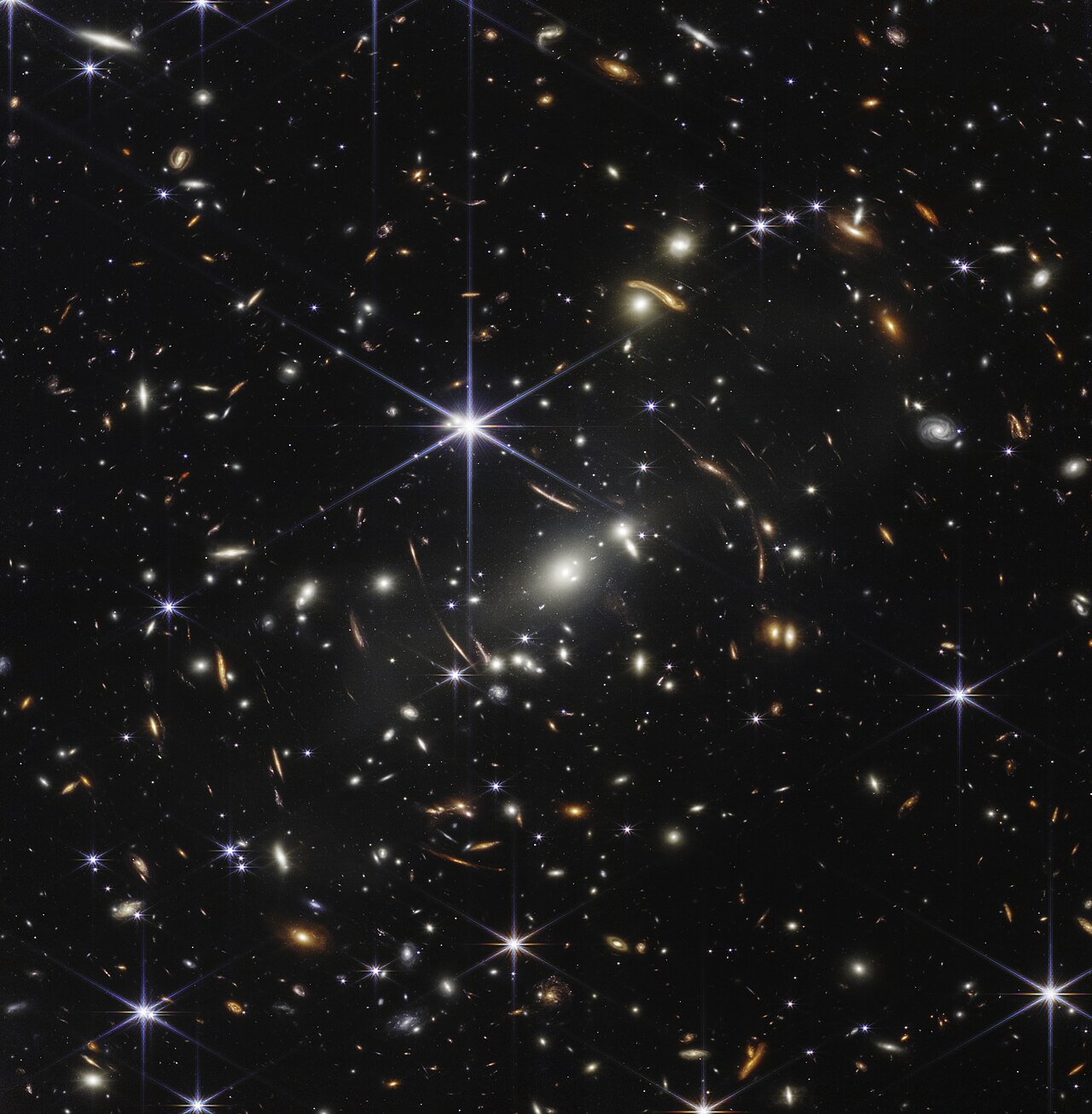
JWST observations expanded the census of bright galaxies in the universe's first few hundred million years. Some candidates initially looked too massive or too mature for standard formation timelines.
Spectroscopy, improved stellar-population models, dust assumptions, and active black-hole light can change inferred masses. The tension is real science in motion, not a settled overthrow of cosmology.
The idea that changes the view
The surprise is not that early galaxies exist; it is how quickly some appear to have assembled.
What most explanations leave out
A bright galaxy is not automatically a massive galaxy, and a photometric redshift is not the same as a spectroscopic confirmation.
Evidence and named signals
- Spectroscopic redshifts identify reliable early objects.
Selection effects favor the brightest systems.
Familiar view — Webb early galaxy problem.
Hidden mechanism — The surprise is not that early galaxies exist; it is how quickly some appear to have assembled.
What remains uncertain
Researchers are still testing whether models need new physics, faster early star formation, or better treatment of observations.
Why it matters—or what you can observe
Webb is turning a vague 'cosmic dawn' into a measured population with dates, spectra, and testable formation histories.
The burst explanation
The newest piece of the puzzle came from simulations, not from a new telescope image. Researchers at Northwestern University and the Flatiron Institute modeled how galaxies formed at cosmic dawn — roughly 100 million to one billion years after the Big Bang — and found that small galaxies can shine far brighter than their mass suggests. The trick is bursts: star formation that switches on in intense flashes rather than burning steadily. A galaxy caught mid-burst looks brilliant; the same galaxy between bursts looks faint. Brightness, in other words, is a snapshot, not a measurement of mass.
The bursts arise naturally in the simulations. A burst of stars forms, and a few million years later the most massive of those stars explode as supernovae. The explosions push gas around and shut star formation down for a while — until gas falls back in and the next burst fires. That flicker is especially common in low-mass galaxies, which is exactly the population Webb keeps finding bright and early. The study's authors report that the burst picture brings the models and the observations into agreement on brightness, within the standard cosmological model, without needing new physics.
It does not settle everything. Bursts explain brightness; they do not by themselves explain every massive early galaxy, and the mass estimates still depend on the same assumptions about dust, star-formation history, and black-hole light that this article already flags. The ALMA view adds a second thread: some early galaxies are furious star factories — one galaxy seen 600 million years after the Big Bang forms stars about 180 times faster than the Milky Way does — with warm dust that makes a modest dust supply look luminous. Fast, hot, and bursty is becoming the default picture of the early universe, not the exception.
What to watch: the test is the quiet galaxies. If bursts are the answer, the early universe should also hold plenty of faint galaxies between bursts — systems Webb sees only in deep, long exposures or through gravitational lensing. Surveys built to find the faint population, not just the bright one, will say whether the "too many too early" problem was a selection effect all along.
Further reading and primary sources
ESA Webb first deep field
- NASA Webb science
As an Amazon Associate I earn from qualifying purchases. If you buy through an active affiliate link, StarPixels may earn a commission at no additional cost to you.