
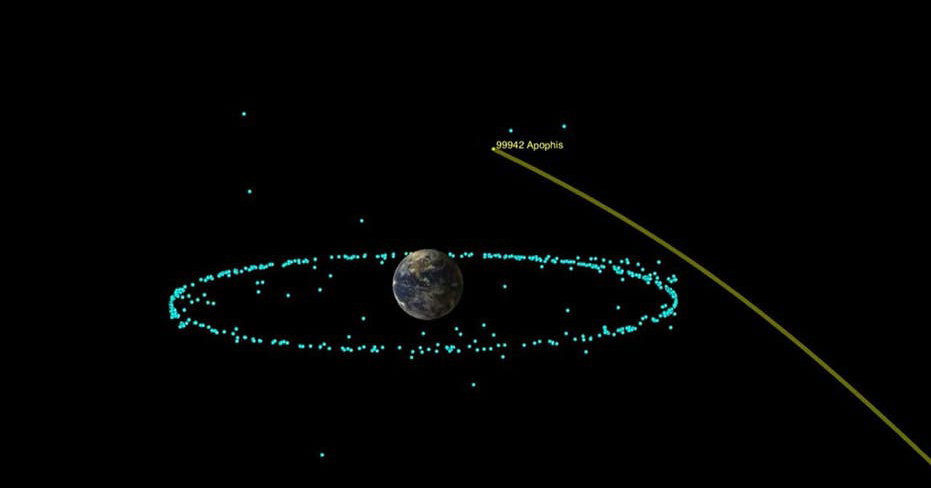
On April 13, 2029, an asteroid about 1,100 feet across will pass Earth closer than many of the satellites that ring our planet — and it will miss us completely. The asteroid is 99942 Apophis, and NASA's best measurements put its closest approach at about 20,000 miles above Earth's surface. The satellites in geosynchronous orbit sit about 22,236 miles up. Apophis will pass inside their altitude, on a path that never crosses their ring, and NASA is confident there is no risk of an impact for at least 100 years.
The reason the pass is safe is geometry. Apophis does not orbit in the same flat plane as the satellites. Its trajectory is tilted about 40 degrees to Earth's equator, so when it crosses the equatorial plane — where the geostationary ring sits — it is well outside the belt. At its closest, it is above the plane, separated from the satellite ring by the tilt of its path alone. The paths simply do not intersect. NASA has said plainly that the flyby presents no danger to people, to astronauts, or to satellites.
Apophis was discovered on June 19, 2004, by astronomers Roy Tucker, David Tholen, and Fabrizio Bernardi at Kitt Peak National Observatory in Arizona. Early tracking put it briefly at the top of the impact-risk lists, and at one point it reached level 4 on the Torino scale — the highest rating any asteroid has ever received. Years of further observation, capped by a radar campaign at NASA's Goldstone complex in 2021, steadily narrowed the uncertainty until the risk was ruled out entirely. Apophis was removed from NASA's Sentry impact-risk table in 2021, and the 2029 encounter is now a flyby to watch, not a threat to fear.
What makes it worth watching is that it is the closest approach by an asteroid of this size that scientists have known about in advance. Apophis is a stony, or S-type, asteroid, made of silicate rock mixed with nickel and iron, about 1,100 feet (340 metres) across and stretched into an elongated shape. On the night of the pass, it will be visible to the unaided eye from the Eastern Hemisphere — a point of light drifting across the sky, close enough to see and far enough to be harmless.
The pass is also a science opportunity that comes once in a generation. Earth's gravity will pull on Apophis as it goes by, tugging unevenly on its near and far sides. That tidal force will twist and stretch the asteroid, and may set off landslides on its surface and change how it spins. Its orbit will come out slightly larger than it went in. Two spacecraft are being sent to watch it happen: the European Space Agency's Ramses mission, which is planned to rendezvous with Apophis before the flyby and ride along through it, and NASA's OSIRIS-APEX — the former OSIRIS-REx, renamed after it delivered its sample from the asteroid Bennu — which will arrive shortly after the close approach and study the asteroid for a year and a half. For the first time, we will have a front-row seat to what a close planetary encounter does to a small world.
Source: NASA, Apophis Facts — https://science.nasa.gov/solar-system/asteroids/apophis-facts/
Image credit: tourismcanberra.com (credit unverified — diagram source not confirmed as NASA)
As an Amazon Associate I earn from qualifying purchases. If you buy through an active affiliate link, StarPixels may earn a commission at no additional cost to you.