
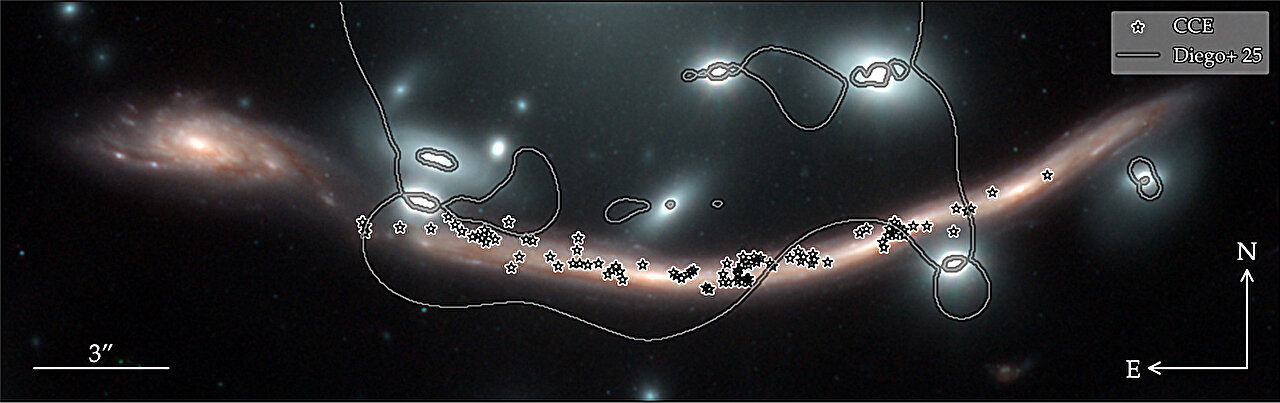
The James Webb Space Telescope has counted more than 100 individual stars flickering in a single distant galaxy. The count is 104 magnified stellar events in the Dragon, a galaxy about 6.5 billion light-years away, stretched into a long arc by the gravity of the massive cluster Abell 370. That more than doubles the previous record of 44 events in the same galaxy, and it turns a curiosity into a sample: enough events to start asking statistical questions about the stars themselves, and about the dark matter doing the magnifying.
The Dragon is not an ordinary galaxy. It sits behind Abell 370, a cluster of galaxies whose gravity bends and stretches the light from anything behind it, the way a lens bends light. The Dragon's light is pulled into a long, thin arc, and along that arc the magnification is extreme. Individual stars inside the Dragon can cross lines of very high magnification called caustics. When a star crosses one, it flares briefly, sometimes hundreds or thousands of times brighter than it would otherwise appear. Webb caught these events by comparing images taken between 2022 and 2024, across three observing cycles and four infrared filters, and looking for points of light that had changed brightness from one visit to the next. Most of the events are supergiant stars, the most luminous stars a galaxy can hold. The flickers typically last days to weeks, though the largest stars can stay visible for months.
The previous record stood at 44 events, reported in 2025 from two epochs of data. The new study, led by José María Palencia of the Institute of Physics of Cantabria, added a third cycle of observations and found 104 distinct events, about two and a half times as many. The Dragon is a good place to look because it is relatively nearby for a lensed galaxy, at a redshift of 0.725, and bright. It was also the first giant arc ever identified, back in 1987, and it has been watched ever since. Each event in the new catalogue is a single star seen across more than half the observable universe, magnified by a cluster that happens to sit in front of it.
The dark matter angle is what makes the sample interesting beyond the record. The events cluster near the critical curve, the line in the sky where the magnification is highest. The team counted how many events appear on each side of that curve. Far from the curve, both sides look the same. Close to it, the count drops on one side but stays the same on the other. That asymmetry is a proposed signature of fuzzy dark matter, a form of dark matter made of extremely light particles that behave like waves rather than like tiny billiard balls. Waves like that would ripple the mass inside the cluster on small scales, and that would change where the lines of high magnification form.
It is a hint, not a detection. The paper says so plainly: the same pattern could come from the critical curve being drawn in slightly the wrong place in the lens model. If the model is off, the asymmetry is an artifact, not physics. That is the honest state of the finding, and it is also why the sample matters. With 44 events, an asymmetry is a curiosity. With 104, it is a pattern worth testing, and the events themselves give astronomers another way to map the critical curves, by tracing where the highest magnification actually happens.
The study was published in Astronomy and Astrophysics on September 30, 2026. As Webb keeps watching Abell 370, the sample will grow, and the test will sharpen. Either the fuzzy dark matter reading holds up, or the lens model gets better. Both outcomes teach us something, and both start from the same thing: counting stars flicker, one by one, in a galaxy 6.5 billion light-years away.
Source: Palencia et al., Astronomy & Astrophysics (2026), DOI 10.1051/0004-6361/202660640; phys.org, Nov 8, 2026 — https://phys.org/news/2026-11-jwst-tracks-magnified-stellar-events.html
Image credit: José María Palencia et al., Astronomy & Astrophysics (2026)
As an Amazon Associate I earn from qualifying purchases. If you buy through an active affiliate link, StarPixels may earn a commission at no additional cost to you.