
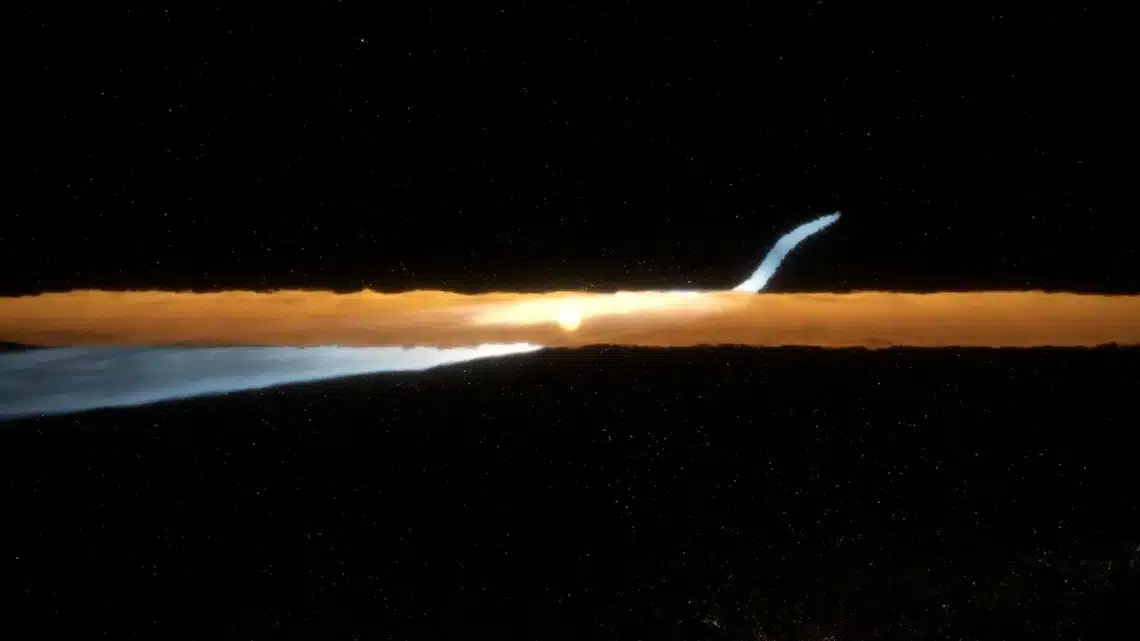
In 2024, the James Webb Space Telescope spotted something odd beside the young star Beta Pictoris: a long, curving plume of dust arcing away from the star's debris disk, nicknamed the Cat's Tail. Hubble had stared at the same star for decades and never seen it. Now it has. A team at the University of Arizona combined six rounds of Hubble observations taken between 2012 and 2025 and found the tail glowing faintly in visible light, the first visible-light detection of the structure. The work was published in The Astrophysical Journal Letters in October 2026, and it is a follow-up, not a repeat: Webb found the tail in heat, and Hubble has now confirmed it in reflected sunlight, and that second view is what lets astronomers say what it is made of.
The answer is why it hid for so long. The dust is almost entirely organic refractory material, heavily carbon-based and tar-like. Long chains of carbon atoms absorb visible light, so the grains are nearly black. Webb's infrared camera sees the heat the dust gives off, and in that light the tail is bright. Hubble sees starlight bouncing off the dust, and the tail reflects almost none of it. In Hubble's images the tail is roughly 200 to 1,000 times fainter than it looks to Webb, with a signal-to-noise ratio of only about 5 to 10. Pulling it out took 14 years of stacked observations and a coronagraph, a small mask that blocks the star's glare so the faint dust around it can show up at all.
The leading explanation, from the 2024 Webb work, is a smash between two large icy bodies, and the new study puts numbers on it. The tail holds roughly 20 quintillion kilograms of dark organic dust. To make that much, each of the two colliding bodies must have weighed at least 1 to 3 times 10 to the 21st power kilograms, in the same league as Pluto's moon Charon or the dwarf planet Makemake, and about one to three times the mass of Ceres, the largest object in our asteroid belt. The crash happened roughly 100 to 200 years ago, a blink of an eye by cosmic standards. The impact may have been violent enough to vaporize carbon, which then cooled and recondensed into the porous, fluffy grains Hubble and Webb now see. The grains are only about a micron across, yet their internal structure is hard to explain with ordinary collision models, and that puzzle is part of why the team keeps studying the feature.
The new observations also changed the picture of the tail's shape. It stretches up to 1,000 astronomical units, about 93 billion miles, more than 25 times the orbit of Pluto. Earlier readings had it trailing far behind the star. By combining Hubble's visible light with Webb's infrared images and computer modeling, the team now thinks it may run mostly sideways across our view, in the same plane of the sky as the star, possibly extending a little bit behind it. Hubble also traced the outer disk out to around 500 astronomical units from the star, the farthest this instrument has ever followed it, and found a gentle warp in the dust halo. That distortion may come from the gravity of Beta Pictoris b, a gas giant about 10 times the mass of Jupiter and one of three known planets in the system.
Beta Pictoris itself is only about 20 million years old, a young star about 63 light-years away in the constellation Pictor, and it is a laboratory for how planets form. Its system shows what our own Kuiper Belt may have looked like at the same age, when hundreds of Pluto-sized bodies crowded a much denser region and the giant planets scattered them. The Cat's Tail is a fresh collision caught in the act, still spreading. Two telescopes were needed to read it: Webb's heat showed where the dust is, and Hubble's reflected light showed what it is. Together they say the wreckage of two dwarf-planet-sized worlds is still drifting through a young planetary system, nearly black, and only just visible.
Source: Avsar et al., The Astrophysical Journal Letters, Oct 7, 2026, DOI 10.3847/2041-8213/aeac4a; Webb discovery: Rebollido et al., 2024
Image credit: NASA, ESA, CSA, STScI, Ralf Crawford (STScI)
As an Amazon Associate I earn from qualifying purchases. If you buy through an active affiliate link, StarPixels may earn a commission at no additional cost to you.