
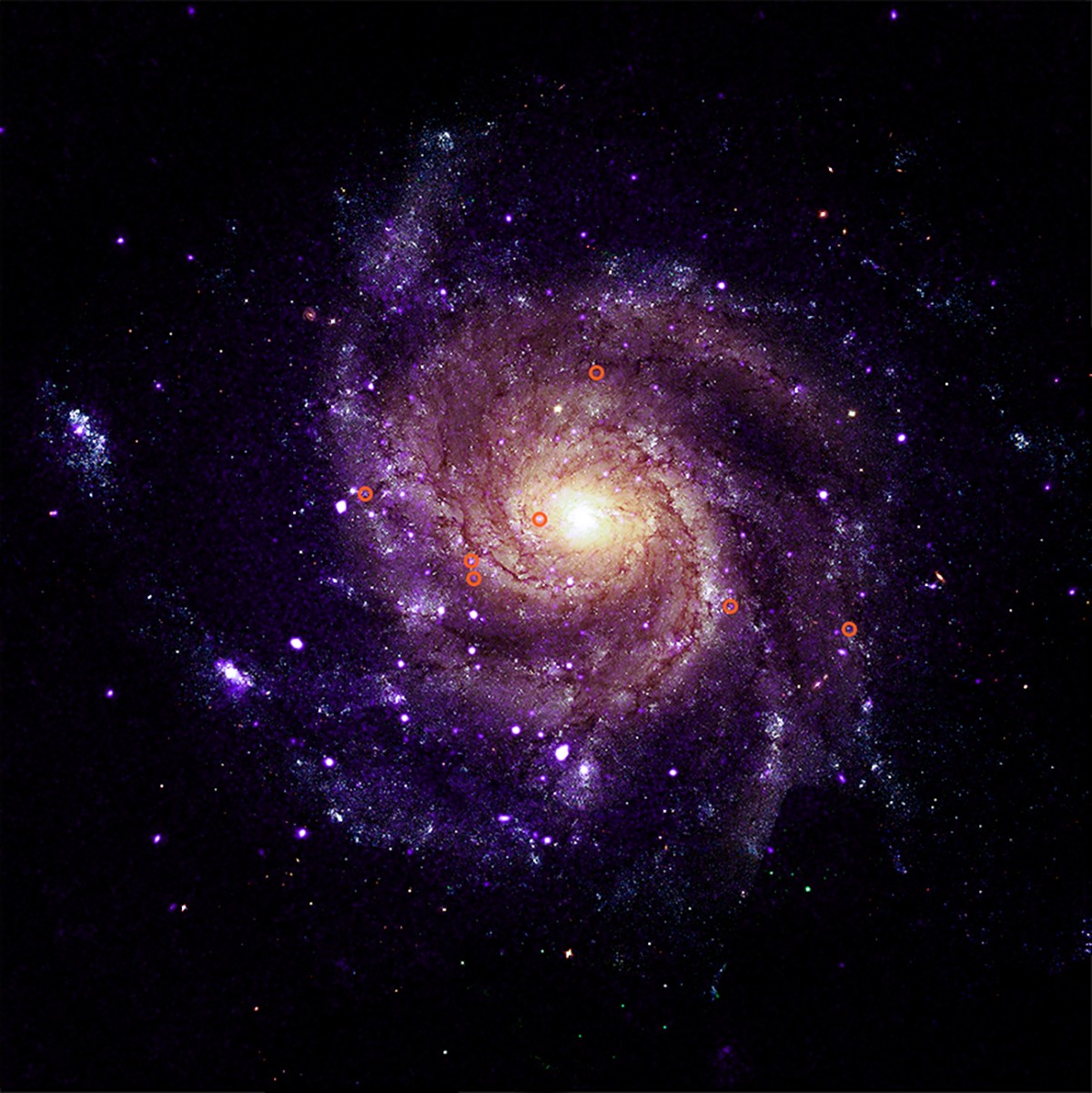
Astronomers digging through the public archive of NASA's Chandra X-ray Observatory have found something no one had noticed before: 84 sources that show up only in the softest X-rays and vanish at higher energies. They call them hypersoft X-ray sources, and they appear in six nearby galaxies, including Andromeda and the Pinwheel. The discovery, published in Nature Astronomy, may help with two long-standing puzzles at once: what stars become Type Ia supernovae, and what ionizes the gas between stars.
The team found them by comparing images taken at different X-ray energies, using Chandra observations collected between 1999 and 2017. The sources appear between 0.15 and 0.3 kiloelectronvolts and are effectively absent above 0.3, with more than eight times as much signal in the low band as in the 0.3 to 1.0 band. That is why they stayed hidden. Most X-ray searches look for harder emission, and these objects barely register there. The six galaxies searched were Andromeda, the Pinwheel, and four ellipticals: NGC 3115, NGC 3379, NGC 4697, and NGC 4472. The count ran from 7 to 21 per galaxy, with 21 in Andromeda and 7 in the Pinwheel. The sources sit away from the galactic nuclei, in regions of both active star formation and older stellar populations.
Nobody knows yet what these objects are. The leading idea is a compact object, a white dwarf, a neutron star, or a black hole, pulling gas from a companion star. The infalling gas heats up and glows in X-rays before it lands on the white dwarf or neutron star, or falls into the black hole. Because their X-rays are so soft, the team argues that most of their energy probably comes out as extreme ultraviolet light, which interstellar hydrogen and helium absorb before it can reach instruments near Earth. So the ultraviolet is inferred from the low-energy X-ray tail and thermal models, not directly measured. That matters because that hidden ultraviolet could be what is stripping electrons from the diffuse gas in and around galaxies, a process that shapes how fast galaxies form stars.
The supernova connection is the reason astronomers care most. Type Ia supernovae are the standard candles that revealed the expansion of the universe is accelerating, but no one has ever caught one of their parent stars before it explodes. The leading suspect is a white dwarf stealing matter from a companion until it detonates. Known supersoft X-ray sources are too scarce to account for the observed Type Ia rate, so a population pouring most of its energy into an absorbed ultraviolet band could hide the missing accretion. Some hypersoft sources may be white dwarfs with expanded photospheres, or post-nova stages, that ordinary X-ray selections overlook. That is a candidate, not a confirmation. The sample spans different host environments and a wide luminosity range, black holes may occupy the bright end, and optical counterparts, orbital information, and long-term monitoring are needed before any single object can be placed on a path to explosion.
The result comes from reprocessing old data, not a new observing campaign, and that is part of the point. The Chandra archive still holds more, and the same kind of search can be run on other galaxies. If even some of these 84 turn out to be Type Ia progenitors, astronomers would finally have a way to spot these explosions before they go off, instead of only catching them after. The lead researcher is Mustafa Muhibullah of the University of Alabama. The paper appeared in Nature Astronomy in September 2026, and the objects it describes are, for now, a new class with a name and a census, waiting for someone to work out what they are.
Source: Muhibullah et al., Nature Astronomy (2026), DOI 10.1038/s41550-026-02959-7; phys.org, Sept 9, 2026 — https://phys.org/news/2026-09-chandra-uncovers-hypersoft-ray-sources.html
Image credit: HST ACS/WFC3 mosaic of M101, via Nature Astronomy (2026)
As an Amazon Associate I earn from qualifying purchases. If you buy through an active affiliate link, StarPixels may earn a commission at no additional cost to you.