
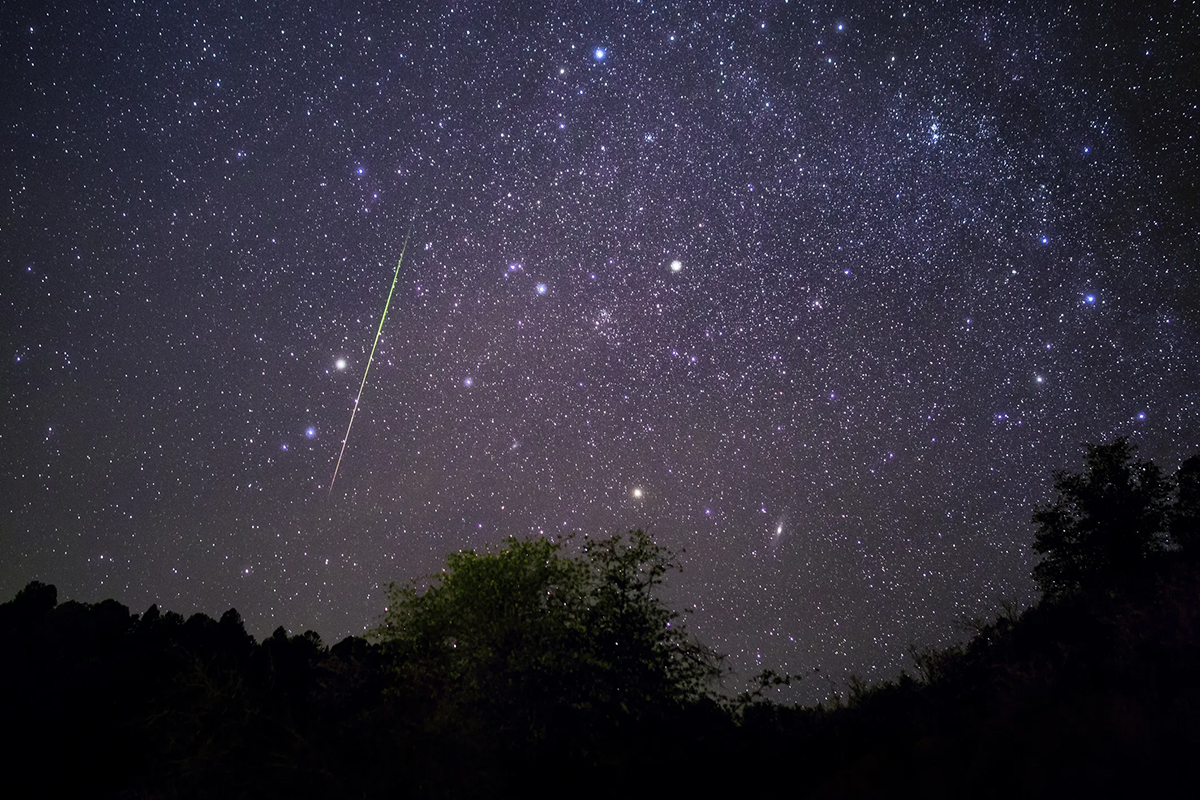
The Leonid meteor shower returns this month, and this year the Moon is getting out of the way. The shower peaks on the night of November 17 into the early hours of November 18, 2026, with the peak expected to centre on about 01:00 UT on the morning of the 18th. Under a dark sky, observers can expect around 15 meteors an hour at the peak — a modest rate, but the Leonids make up for it in speed and brightness, and this year the prime viewing hours will be properly dark.
The Moon is the reason. On the peak night, the Moon is a little over half lit, a waxing crescent of about 54 percent, and it sets before midnight — at 23:35 UT, according to the chart for the shower. That means the hours after midnight, when the Leonid radiant is highest, will be moonless. Moonlight is the single biggest thing that spoils a meteor shower, washing out the fainter meteors, so a peak with the Moon down is worth more than a peak with a higher rate and a bright Moon in the way.
The Leonids come from Comet 55P/Tempel-Tuttle, which circles the Sun about once every 33 years and leaves a trail of dust and debris behind it. Every November, Earth passes through that trail, and the dust grains — most of them no bigger than a grain of sand — hit the upper atmosphere at about 71 kilometres a second, among the fastest of any meteor shower. The air in front of each grain heats and glows, and the grain burns up in a streak of light. The meteors all seem to come from a single point in the sky, the radiant, which sits in the head of the constellation Leo the Lion, marked by the Sickle asterism. The radiant rises at about 22:20 UT and climbs to nearly 60 degrees above the horizon by about 05:40 UT, so the best viewing runs from after midnight through the pre-dawn hours.
The Leonids are famous for what they sometimes do. Every 33 years or so, when Earth passes through a particularly dense part of the comet's trail, the shower can turn into a storm. In 1833, observers counted thousands of meteors a minute — one widely cited estimate puts it at up to 2,500 a minute, or about 150,000 an hour — and people woke thinking the sky was falling. The great storm of 1966 was the same kind of event. There is no storm forecast for 2026, and no surge in activity is expected; this is an ordinary Leonid year, with a steady 10 to 15 meteors an hour under dark skies. Forecasters are already looking ahead to a possible major outburst in 2033, when the rate could reach 300 to 400 an hour.
For this year, the advice is simple. Find the darkest sky you can, give your eyes twenty minutes to adapt, lie back, and look up — not straight at the radiant, but across the sky, where the meteors will be longer and easier to see. No telescope is needed, and no telescope helps; a meteor shower is a wide-sky event, and the best instrument is a pair of dark-adapted eyes and a clear night. The shower is active from November 6 to November 30, so if the peak night is cloudy, the nights around it are still worth a look.
Source: BBC Sky at Night, Nov 4, 2026 — https://www.skyatnightmagazine.com/advice/skills/leonid-meteor-shower-when-how-see
Image credit: BBC Sky at Night
As an Amazon Associate I earn from qualifying purchases. If you buy through an active affiliate link, StarPixels may earn a commission at no additional cost to you.