
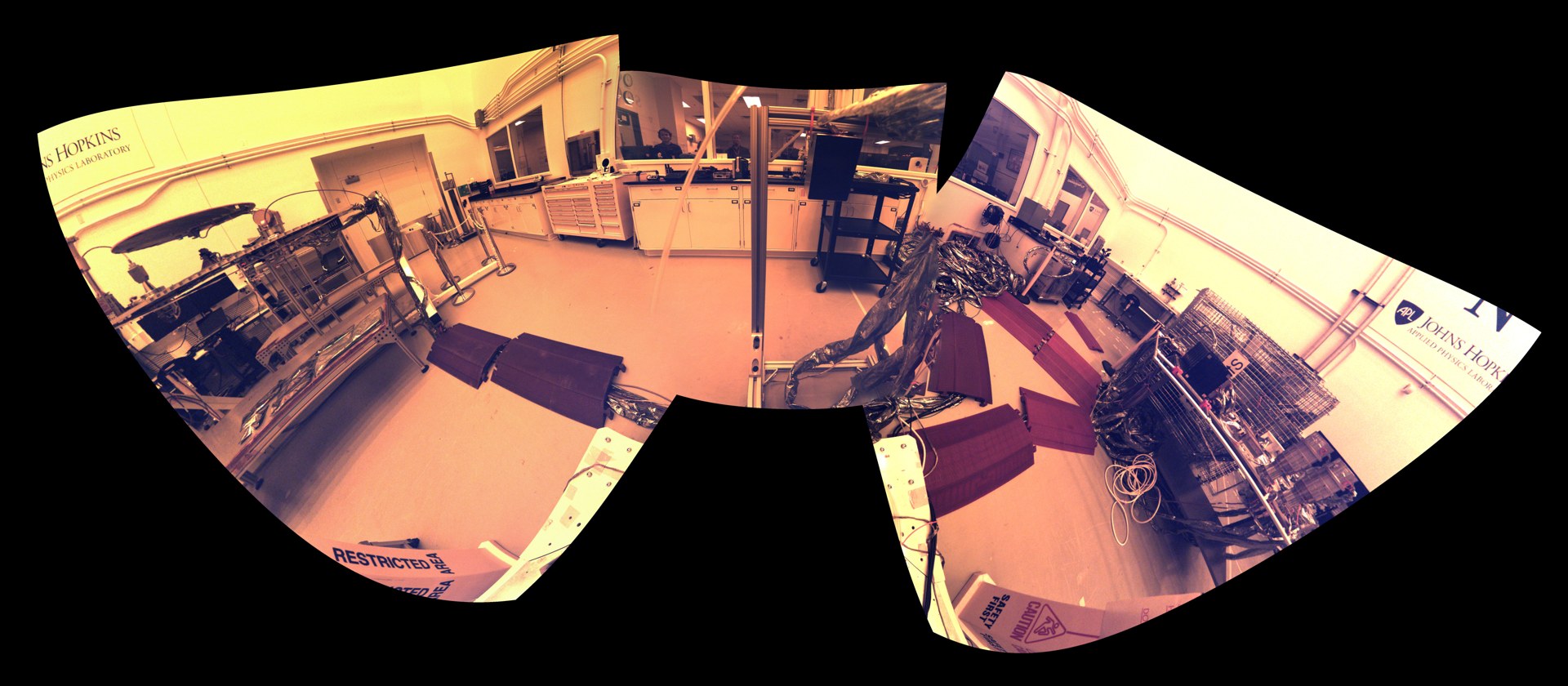
NASA's Dragonfly rotorcraft can now see. The seven cameras of DragonCam, the science imaging suite for the car-sized rotorcraft bound for Saturn's moon Titan, have been installed at the Johns Hopkins Applied Physics Laboratory in Laurel, Maryland, where the spacecraft is coming together for a launch in July 2028 and an arrival at Titan in late 2034. DragonCam is the first science instrument package to reach the spacecraft, and its cameras have already taken their first pictures: a panoramic view of the cleanroom at APL, shot on November 9, 2026, shortly after the suite was installed on the rotorcraft.
The cameras were built by Malin Space Science Systems, and all seven had been installed in their insulated housings, tested, and integrated into the rotorcraft by mid-November 2026. Two forward-mounted cameras, a wide-angle camera with a 90-degree field of view and a medium-angle camera that overlaps part of that view at higher resolution, will give Dragonfly stereoscopic sight of the terrain ahead. Two more wide-angle cameras on the sides complete the panoramic view. Two downward-facing wide-angle cameras look at the ground beneath the rotorcraft to judge whether a landing spot is safe. A high-resolution microscopic imager, installed on November 6, 2026, by technicians Chad Cook and Seth Harvey, will aim at the drill site of Dragonfly's sampling tool to pick out details in millimeter-sized sand grains. Two navigation cameras, also built by Malin, were installed during the summer of 2026.
Seeing Titan is a harder job than it sounds. The moon's air is minus 290 degrees Fahrenheit, so the cameras sit inside a foam enclosure and look out through windows that insulate them from the cold. Titan's long night lasts nearly eight Earth days, and a configurable LED array built at APL, spanning the light spectrum from infrared to ultraviolet, will light the sampling site so DragonCam can read the color of surface materials and infer what they are made of. Under ultraviolet light during that long night, the LEDs may also make organic molecules fluoresce, glowing in a way that gives them away. The same illumination lets the cameras show Titan the way human eyes would see it.
The pictures are not decoration. Dragonfly is a relocatable lander: it will touch down, drill and sample the surface, then lift off and fly to a new site, over and over. Each sample needs its landscape. "DragonCam will give us critical context for the samples collected by DrACO," said Carolyn Ernst, the DragonCam instrument scientist at APL, referring to the Drill for Acquisition of Complex Organics. The images will relate each sample to Titan's broader landscape and piece together the story of its geology. Without the cameras, the chemistry would have no address: a scoop of organics means one thing in a dune field and another in a crater floor.
That matters because of where Dragonfly is going. Titan is the only moon in the solar system with a thick atmosphere, about four times denser than Earth's air, and the only world besides Earth with rain, rivers, lakes, and seas on its surface, except that Titan's are liquid methane and ethane, not water. Titan's air is about 95 percent nitrogen, close in makeup to Earth's 78 percent, which is part of why the moon feels so familiar despite the cold. Its equatorial dunes are made of dark organic grains, not sand. Dragonfly will land in the Shangri-La dune field and work its way toward Selk crater, a 50-mile-wide impact site where the impact may have melted the icy bedrock into a pool of liquid water that stayed liquid for tens of thousands of years under an insulating ice layer. That pool is the closest thing to a prebiotic chemistry experiment in the outer solar system, and Dragonfly's cameras are the scouting tool that will pick the sampling spots.
Flight is the reason the mission works at all. Titan's thick air and low gravity, about one-seventh of Earth's, make a rotorcraft practical in a way it could never be on Mars: Dragonfly is expected to fly more than 100 miles over a nearly three-year mission, almost double the distance traveled by all the Mars rovers combined. The same dense air that makes flying easy is what makes landing blind impossible, which is why the downward cameras check each new site before the drill goes in.
The rest of Dragonfly's instruments are still to come. Components of DraGNS, the gamma-ray and neutron spectrometer, DraGMet, the geophysics and meteorology package, DraMS, the mass spectrometer, and DrACO are set for delivery, integration, and testing over the next several months. "With the capability to take images when Dragonfly is on the surface as well as while flying, DragonCam will give us both detailed views and sweeping panoramas of Titan's landscape," said Elizabeth Turtle, the Dragonfly principal investigator at APL. "Seeing these cameras become part of the Dragonfly lander is an exciting milestone that brings us another step closer to this unprecedented exploration."
The cleanroom panorama the cameras took on November 9, 2026, is the first image DragonCam has ever produced, and it already shows the suite working as designed: three wide-angle views stitched into one sweep of the room, the rotorcraft's top deck and its circular high-gain antenna at the left, the integration team visible through the control room windows. The yellow tint is a tell: DragonCam captures light differently than the human eye sees it, and the color will be corrected in software. The next pictures it takes will be of a world no camera has ever flown over.
Source: NASA, "NASA's Titan-Bound Dragonfly Rotorcraft Gets Its Eyes," November 24, 2026; NASA, "NASA's Dragonfly Mission Sets Sights on Titan's Mysteries"; NASA, "Why Is NASA Sending Dragonfly to Titan? Here Are Five Reasons."
Image credit: NASA/Johns Hopkins APL/MSSS
As an Amazon Associate I earn from qualifying purchases. If you buy through an active affiliate link, StarPixels may earn a commission at no additional cost to you.